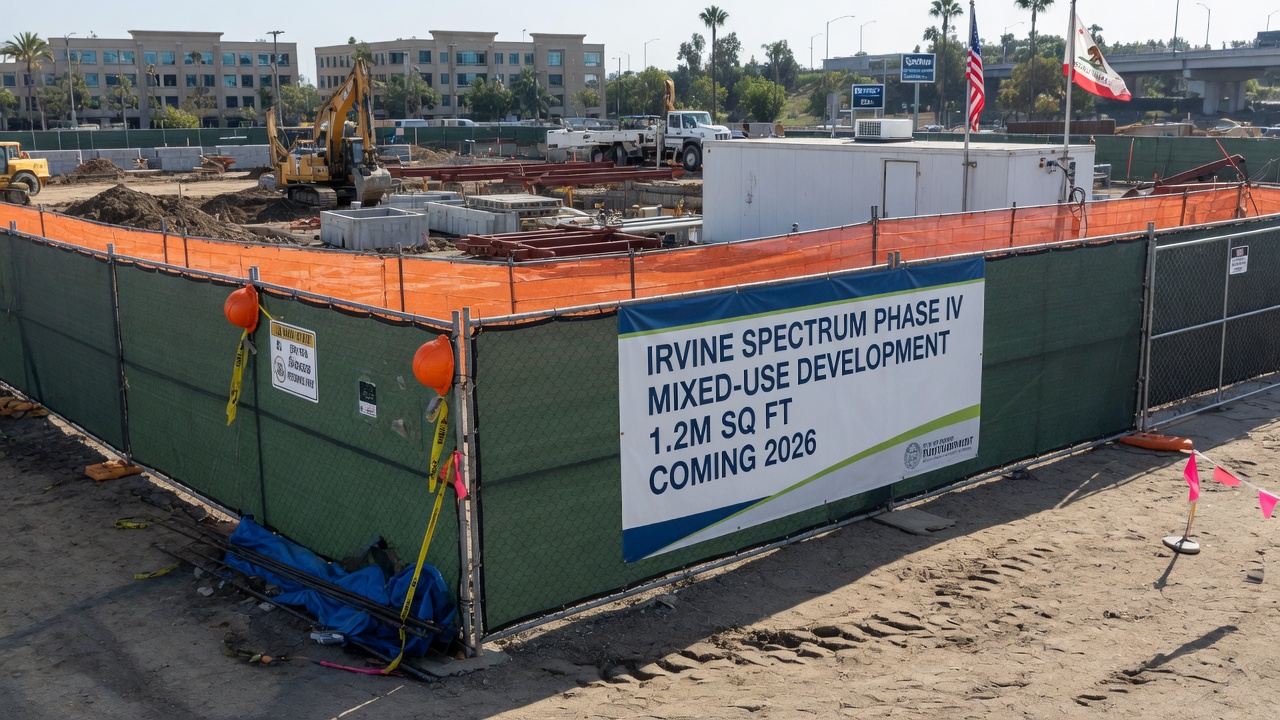
Construction site banners in Irvine are printed vinyl or mesh hung on fence, scaffold, or a project ID frame so the public can name the GC, trucks can find the gate, and a posting board can be read. Spec the hang first — fence, scaffold, or trailer — then mesh, grommets, and whether City or Cal/OSHA will look at it.
The catalog shot is always a clean chain-link run with a perfectly tensioned 4-by-20 and a skyline. Your site is more likely a 6-foot rented panel fence on an Irvine infill lot, a scaffold elevation over a sidewalk on Jamboree, a trailer whose posters bleached into pink, and a superintendent who needs the GC name readable from the street before the inspector parks. That is why we quote construction banners as a hang: where it ties, what the wind will do, who has to read it, and whether anyone in a city or safety hat will treat it as a sign. Avanti Printing at 15321 Barranca Pkwy, Irvine, CA 92618 prints the vinyl and the mesh. Call (949) 387-0787 if you already measured the fence panels and only need us to match last month’s spec.
This is the estimator version of that conversation. It is written for Irvine and Orange County jobsites that will still be dusty on Friday. It covers fence banners, scaffold banners, project identification, and posting boards as print jobs. It is not a legal opinion on OSHA, Cal/OSHA, CSLB, or the City of Irvine Sign Ordinance. Confirm those rules with your safety person, your permit runner, and the agency that wrote them. It is not a mesh-versus-solid catalog, not an outdoor-lifespan essay, and not a tour of indoor pull-up stands. Quotes still confirm size, material, quantity, finish, and date.
Who hangs construction site banners in Irvine and Orange County
If you are building, wrapping, or leasing anything from the Irvine Business Complex to Great Park to a Tustin Legacy block, the fence is already a billboard. Neighbors, city staff, truck drivers, and the owner’s lender all read it whether you designed it or not. Construction fence and scaffold banner printing is how you control that read: company ID, project name, a safety reminder, a leasing teaser, or a printed screen so the public is not staring into a hole.
Typical buyers from Irvine, Tustin, Santa Ana, Costa Mesa, Newport Beach, Lake Forest, Laguna Hills, Anaheim, and Huntington Beach are not shopping a retail sale banner. They are shopping a hang that has to survive Orange County sun, a Santa Ana, a rented fence that will be moved twice, and a permit conversation they hoped to skip. General contractors want the company name and license on the street face. Developers want a coming-soon panel that does not accidentally become a prohibited advertisement. Scaffold contractors want mesh that the PE will not throw off the elevation. Safety managers want posting boards that still exist after the first rain. Leasing teams want a fence run that looks like architecture, not a swap-meet sail. Superintendents want a gate banner the concrete truck can actually see at 6 a.m.
This is for you if the graphic will live on a temporary perimeter, a scaffold, a k-rail, or a jobsite trailer, and you can send a vector logo instead of a screenshot from the website header. It is also for you if last quarter’s vinyl is a shredded flag on the 405-facing run. It is the wrong spec if you need an indoor retractable, a vehicle wrap, or a permanent monument. We print those too under large format printing in Irvine, but the vinyl, the finishing, and the failure modes are different jobs.
California buyers outside Orange County use the same mesh and the same outdoor scrim. The local twist is the climate and the paperwork: west-facing UV, dry canyon winds, Irvine Company and village HOA opinions about what a construction fence may look like, City of Irvine sign programs for decorative construction fences, UCI-adjacent vendor rules, and infill lots where the only street frontage is also a sight triangle. Those conditions change material, size, copy, and whether you should be on vinyl at all. They do not change the fact that a construction banner is a flexible printed panel you hang, not a painted wall and not a legal posting just because you put the word SAFETY on it.
- GCs and construction managers on Irvine and Tustin infill, podium apartments, and office TIs who need readable company ID on a rented fence.
- Scaffold companies wrapping elevations over sidewalks on Jamboree, Barranca, and Spectrum-area retail.
- Developers and owners who want a project ID that planning will not treat as a rogue billboard.
- Safety leads who need Cal/OSHA-style posting boards in the trailer and at the gate, printed so they survive handling.
- Leasing and marketing teams covering a long fence during a multi-year build without turning every panel into a sail.
- Trade partners — fence, demo, grading — who get told Friday that the street face has to look like a company on Monday.
Pick the banner from the hang, not from a rendering
Coverage is the decision. Mesh, grommets, copy, and price all follow it. “We need construction banners” is not a hang map. Neither is a marketing elevation that ignores the 6-foot rented panels, the rolling gate, the hydrant, and the sight triangle at the corner. Start with what has to be read, from where, for how long, and on what structure. Then stop. Extra vinyl across a driveway opening is not branding. It is a kite you will reprint after the first blow.
Use the table as a shop filter, not a menu you must climb. Typical industry practice on Orange County jobsites is fence-first for company ID, mesh on long or high hangs, rigid or laminated boards for postings that an inspector will actually look for, and a separate conversation for anything the City will treat as a sign. Your ticket will lock size, material, quantity, finish, and date — and it should also lock the hang.
| Hang | Typical print | Typical size conversation | Wind | Who actually reads it | Where it fails |
|---|---|---|---|---|---|
| Chain-link or panel fence | Mesh; 13 oz vinyl only on short, low panels | Height about 2–4 in short of the rails; length in fence-panel modules | Mesh is the default on long OC runs | Neighbors, city staff, lenders, passing traffic | Solid vinyl on a 405-facing run; four corner ties |
| Scaffold elevation | Mesh, often with pole pockets on tubes | Bay width by lift height; seamed panels | Scaffold engineer owns the load; mesh reduces sail, does not erase it | Street, brand, dust and view screen | Solid vinyl as a building wrap; hanging on incomplete scaffold |
| Project ID / coming soon | 13 oz or 18 oz vinyl, or a rigid board | Often 4×8, 4×6, or a size the city already described | Smaller sail if it is a board; still a sail if it is a long vinyl | Planning, owner, CSLB, the public | Copy the ordinance forbids; vinyl where the city wants wood or metal |
| Cal/OSHA and safety posting | Laminated print on rigid board, not a flogging banner | Poster sizes, 18×24, 24×36, trailer-door kits | Keep it off the windward fence if you want it to exist next month | Crew, inspector | A brand banner labeled SAFETY; paper in a poly sleeve that cooks |
| Gate and wayfinding | 13 oz vinyl or coroplast | 2×4 to 4×8, high contrast | Short hang, still use every grommet | Trucks, inspectors, new subs | Script logos; phone numbers in the hem |
| Decorative construction fence | Printed mesh or vinyl to a sign program | Elevation-driven; panelized to the fence | Program plus wind, not instead of wind | Planning, neighbors, the owner’s brand team | Printing the rendering before the program exists |
Fence banners are the workhorse. Most Orange County perimeters we print for are 6-foot chain-link or 6-foot panelized temp fence in 10-foot or 12-foot modules. A graphic that ignores those modules will fight the posts, bunch at the gates, and leave a bald stretch where the rolling gate lives. Design in panels. Leave the gate a gate. Leave the hydrant a hydrant.
Scaffold banners are a different structure and a different liability. The printed mesh is a wind area on someone else’s engineered elevation. We will finish pole pockets and grommets to the tube and the tie pattern you give us. We will not certify the scaffold. If the scaffold contractor or the PE says the elevation cannot take a printed face, that is the end of the banner conversation, not the start of a thicker vinyl.
Project ID is the board at the street that names the job. It is also the panel that most often collides with a city sign type. In Irvine that collision is real: a “future facility” sign in the zoning text is not automatically a grommeted vinyl, and a decorative construction fence can require a sign program. Read that section later. Do not order a 4-by-16 “NOW LEASING” because a rendering looked busy.
Posting boards are not decoration. If the job is to put the Cal/OSHA poster, the Code of Safe Practices, and the emergency numbers where employees can actually read them, you want a rigid, laminated face in the trailer or under a shelter — not a 13-ounce flag on the windward fence. We will print both. We will still tell you which one will be there in March.
A construction banner is a hang on a temporary structure. Name the structure. Name who has to read it. Then pick mesh, vinyl, or a board. Do not pick a rendering and ask the fence to behave like a billboard.
Wind is the first spec on an Orange County jobsite
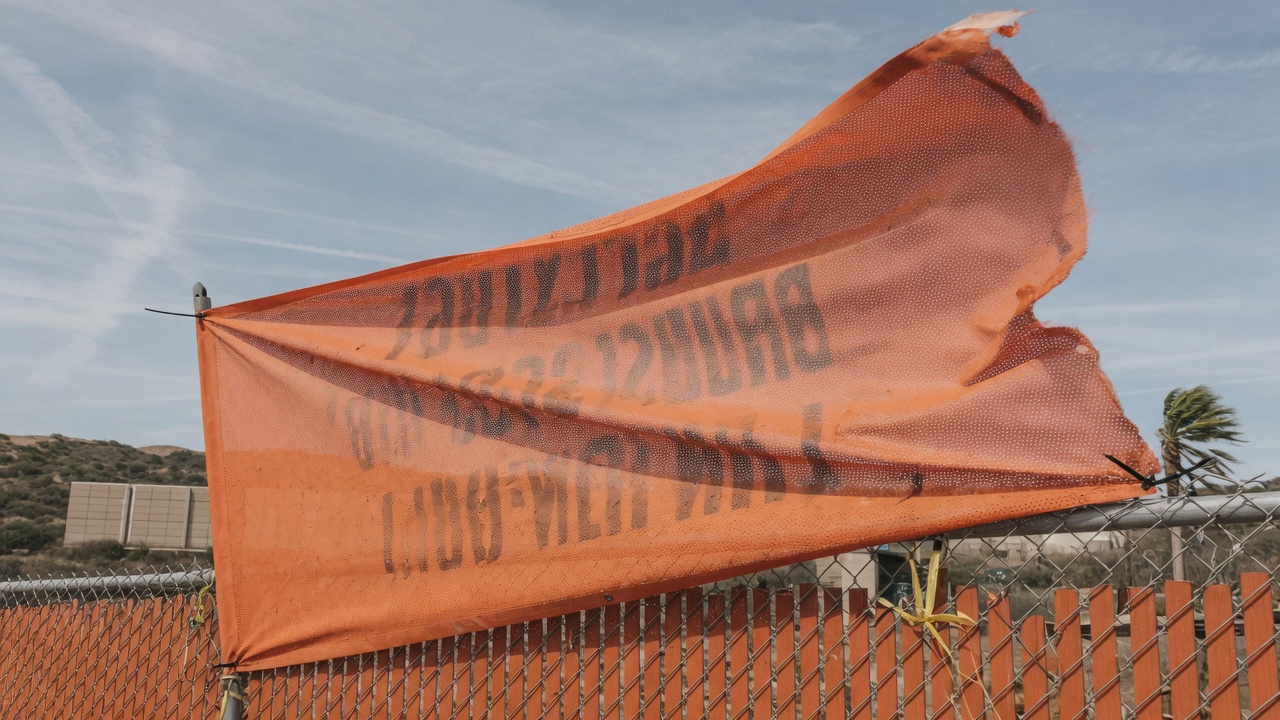
A solid vinyl banner is a sail. A long mesh banner is a smaller sail. A scaffold face with printed mesh is still an added wind area on a temporary structure. Orange County does not need a hurricane for that to matter. It needs a Santa Ana, a west-facing lot, and a fence that was tied at the corners because Friday was payday.
Santa Ana winds are dry downslope events, most common in the cooler months, and they get squeezed in canyons and passes. Fremont Canyon, the Santa Ana River corridor, and open pads with nothing upwind are where we see fence banners unzip. You do not need the peak gust on your particular panel. You need enough cyclic loading to egg out a grommet, then a zipper down the hem. Inland Irvine, Tustin, and Anaheim Hills often see the harder inland version. Coastal Newport and Costa Mesa add a daily onshore slap that is lower drama and still enough to scuff a slack panel every afternoon.
Geometry beats ounce-weight. An 18-ounce banner with four corner zip ties will still start a tear at a corner. A mesh panel on bungees at every grommet, close to the fence so air cannot balloon behind it, will often ride out a blow that destroys the “heavier” job. Put the panel on the fence, not in front of a hole in the fence, when you can. If you must span a gate opening or a scaffold access, say so on the quote. We may talk about a heavier spec, more attachment points, a removable panel, or not hanging there. We will not pretend 13-ounce on four zip ties is an engineered wind design.
Scaffold is the grown-up version of the same sentence. Printed mesh reduces pressure compared with a solid PVC face of the same size. It does not make the load zero, and it does not make us the scaffold engineer. Debris netting, printed mesh, and solid sheeting are different wind stories. If your PE already designed the elevation for a particular netting, do not surprise them with a printed banner of a different open area. Send the finish and the size to the person who owns the scaffold. If they say no, we print a fence run instead.
Wind slits cut into solid vinyl are a religious argument in this trade. Holes you add after printing are also the start of a tear, and they punch the graphic. We do not treat slits as a default on construction vinyl in Orange County. If the site is that windy, the grown-up options are mesh, more attachment points, a closer mount, a pipe in a pole pocket, or a smaller panel. Do not DIY a row of holes with a hole saw on a finished print and then call us when it unzips from the first hole.
After a named wind event, walk the install before you schedule a reprint. Look at corners, elongated grommet holes, hem lift, and whether the panel now has a memory wave. A slightly stretched fence banner can still name the GC. A corner that has started to unzip will not make it through the next event. Repair is rarely honest on outdoor vinyl once a tear leaves the hem. Budget a reprint, and this time use every grommet.
West and south faces still add the slow clock. This article is not a lifespan catalog, but you should not ignore facing. A west fence along Barranca or Jamboree takes afternoon sun on already-warm PVC. Magenta and yellow tire first. A navy field chalks. High-contrast type still reads when a photograph has gone dusty. If the job is a two-year fence wrap, say the duration so we spec mesh, ink, and hardware for a long hang, not for a grand-opening weekend.
Mesh on the fence and scaffold — without turning this into a catalog
Mesh exists on construction sites because air has to go somewhere. Typical industry fence and scaffold meshes are in the neighborhood of 7 to 9 ounces per square yard, PVC-coated polyester with an open weave, printed so the graphic still reads at street distance. Those weights are typical ranges, not a micrometer reading of the roll on our printer this morning. The open area is why a 4-by-50-foot fence run is a construction product instead of a kite. The holes are also why small type and hairline logos look dotted at arm’s length.
Use mesh when the hang is long, high, or on a structure that already has a wind conversation: full fence fronts on Irvine infill, scaffold elevations, anything facing an open lot or a canyon, anything that will stay up through Santa Ana season. Use solid 13-ounce or 18-ounce vinyl when the panel is small, close-read, short-term, or a project ID that has to look like a sign at ten feet — and when the hang is not a sail. A 2-by-4 gate sign can be solid vinyl. A 4-by-20 street face on rented panels should not be, unless you have a frame, a lot of ties, and a reason.
This is not the mesh-versus-solid essay. That is a different page and a different argument. On a jobsite the decision is usually boring: mesh on the perimeter and the scaffold, solid vinyl or a rigid board on the ID and the posting. Mixing them on purpose is professional. Mixing them because leftover 13-ounce was in the truck is how you get two failure modes on one street.
Viewing distance is the other mesh rule. From the second lane on Jamboree, a well-printed mesh logo is a logo. From the sidewalk, you see the weave. Do not put a 2-inch license number, a QR code, or a script wordmark on mesh and expect it to survive at six feet. Put the legal line large, high-contrast, and in a mass that a hole pattern cannot eat. If the mark is legally small, put it on a solid panel or a rigid board, not on the fence weave.
Black backing versus white mesh, blockout, and “window mesh” are different constructions. Construction fence mesh is usually a single-face outdoor print. You will see some light through it. That is not a defect. If you need the reverse to be a clean color because the crew is staring at the back of the fence all day, say so. A second face is a second print or a different build, not a checkbox.
Flame certificates show up when a site, a city inspector, or a campus asks for a mill sheet. Many banner vinyls and some meshes are tested to NFPA 701. If someone will ask, tell us before we print so we pull a mill sheet that matches the roll. Do not hang leftover promotional vinyl on a public-assembly interior and hope. Construction exteriors are a different conversation from ballrooms, and the certificate still belongs on the quote if it was requested.
Project ID boards: GC, license, and what actually belongs on the panel
Project identification is the panel that names the job to the street. Typical copy — not a legal form, a print list — is the project name, the general contractor, a phone number that rings a human, the city or building permit number if you want it there, and, if you are a licensed California contractor advertising on the sign, the license number. Architects, owners, and lenders sometimes want a line. Safety headlines (“HARD HAT REQUIRED,” “ALL VISITORS CHECK IN”) earn their keep at the gate. Dates (“COMING 2027”) earn a reprint when 2027 arrives and the panel is still up.
The California Contractors State License Board treats signs that identify you as a contractor as advertising. Licensed contractors are expected to include the license number on advertising, including signs. That is a board rule, not a printer rule. We are not your lawyer and this paragraph is not a compliance opinion. Send the business name exactly as it is licensed and the license number in the first file. We will print it at a size you can read from the street. Confirm current CSLB advertising rules yourself before you approve a beautiful fence with no number. A reprint to add “Lic. #” as a patch looks like a patch.
Letter height is a viewing-distance problem. A typical industry rule of thumb — not a building code — is about one inch of letter height per ten feet of viewing distance for a high-contrast block letter. A driver on an Irvine arterial is not reading 2-inch type. A pedestrian at the fence is. Put the company name and the license in a mass that works from the lane you care about. Fine serifs, hairline scripts, and knockout type on a photograph of a sunset all die at 35 miles an hour. High contrast on a simple field beats a perfect brand-gray on dusty mesh.
What does not belong on the ID panel: a paragraph of marketing, a QR code the driver cannot scan, a photo of a happy family that will look like a billboard to planning, and copy the city already told you not to use. “Now leasing,” “now available,” registered-brand flourishes, and off-site advertising are the lines that turn a project sign into a different sign type in some ordinances. If your civil set or your planning notes already restrict copy, send those notes. We will set type to the notes. We will not invent a loophole.
Rigid versus vinyl for ID is a site decision. A 4-by-8 aluminum composite or painted wood panel in a frame is a sign. It sits still, it takes smaller type, and some city sign types describe wood or metal on purpose. A grommeted vinyl in the same size is cheaper, faster, and a sail. On a short, framed post it can be the right product. On a long fence it is a fence banner pretending to be a monument. If the city or the owner wants a board, we should be in rigid large-format boards, not in a 13-ounce hem.
Multiple languages are a print versioning problem, not a translation service. If the gate has to work for a Spanish-speaking crew, say so and send the approved copy. Do not ask us to run a website through a browser translator and call it a safety sign. English/Spanish pairs are two layouts or one bilingual layout with a hierarchy. Put them on the quote as versions.
Change-order copy is how ID boards die of embarrassment. The GC changes. The phone number is a cell that got recycled. The “opening fall” became spring. Tape-over letters on outdoor vinyl look like tape-over letters. Print a new panel. We can turn a replacement quickly when the template and the vector already exist. We cannot make a rolling error look intentional.
OSHA and Cal/OSHA posting as a print job, not as legal advice
Safety posting is a compliance job that happens to need a printer. We will make the board. We will not tell you that a board is sufficient, current, or in the right place. California is a state-plan state. Construction employers here live under Cal/OSHA, not a federal-poster-only world. Your safety person, your insurance advisor, and the Division of Occupational Safety and Health own the list. This section is practical print advice so the posting you already decided to display can still be read.
The Department of Industrial Relations publishes a construction-oriented list of documents and postings that commonly belong on a jobsite. The Cal/OSHA Pocket Guide for the Construction Industry is a starting point you can hand to a superintendent; it is not a substitute for Title 8 or for counsel. In that guide’s administrative chapter you will see, among other items, the Cal/OSHA poster “Safety and Health Protection on the Job,” a Code of Safe Practices, emergency phone numbers, employee access to medical and exposure records, citations if you have them, and hazard warnings that depend on the work (asbestos, lead, confined space, controlled access zones, and so on). DIR also maintains a broader workplace-postings page. Download current official posters from the agency. We can print, enlarge, laminate, and mount. We cannot certify that last year’s PDF is still the official poster.
Emergency numbers are a print layout with a legal parent. Title 8, section 1512, tells construction employers to post telephone numbers for a physician (and an alternate if available), hospitals, ambulance services, and fire-protection services near the job telephone or otherwise make them available where no jobsite phone exists. That is the agency’s rule, not ours. Practical print version: a high-contrast 11-by-17 or 18-by-24 laminated sheet inside the trailer, and a second copy at the gate if the trailer is not where people actually stand. Put the site address on it. A crew that cannot tell 911 which pad they are on has a posting problem that is also an emergency problem. We will typeset the list you send. We will not invent the hospital.
Where the posting lives matters more than the laminate. A paper poster in a poly sleeve on the windward fence is a poster that will cook, fog, and fly. A laminated print on 3/16-inch foam board, PVC, or aluminum composite, mounted in the trailer or under the lunch fly, is a posting that can still be read in August. Outdoor-rated is not the same as “nail it to chain-link and forget it.” If you need a weather-facing safety banner (“HARD HAT AREA,” “AUTHORIZED PERSONNEL ONLY”), that can be vinyl or a rigid, and it is still not a substitute for the official Cal/OSHA poster.
Danger, warning, and caution headers are specified by the site’s safety plan and by the standards that plan points at. ANSI Z535-style layouts use specific header colors and words. Send the file or the standard you are matching. Do not ask us to “make it look OSHA” from a brand palette. Safety orange, safety red, and black on yellow exist so a header is recognizable at a glance. If we print a fashion burgundy DANGER, we printed a brand poster. Your safety person will not thank us.
Multi-employer sites are how postings get lost. The GC’s trailer is not automatically every sub’s poster wall. Each employer still has obligations; the details are theirs. Practical print version: if you are the controlling contractor and you want a common posting board, say how many boards, where they hang, and whether subs may add their own. We will kit identical boards. We will not referee who is the controlling employer.
Do not treat a company brand banner as a required posting. A 3-by-8 with your logo and the words “SAFETY FIRST” is advertising with a slogan. It can still be useful at the gate. It does not replace the Cal/OSHA poster, the Code of Safe Practices, or the emergency numbers. Keep the brand on the fence. Keep the official postings on boards that do not flog.
Spanish and other languages: if the crew needs them, the safety person decides. We print the approved translation at the same size as the English. We do not machine-translate a regulation poster and hope. Official bilingual versions, when the agency publishes them, beat a shop translation.
Reprint the posting when the official poster changes, when the hospital routing changes, when the superintendent’s cell on the emergency sheet is no longer the superintendent, or when the board is faded, graffitied, or missing. Inspectors look for presence and readability, not for whether the photo of the trailer was pretty in the kickoff deck.
City of Irvine, other OC cities, and the fence you cannot turn into a billboard
A perfect print can still be the wrong sign. Check planning and the landlord before you hang a street-facing graphic, then us. That order saves reprints that are really removals.
The City of Irvine publishes sign permit and sign-program rules and points at Division 7 of the Zoning Ordinance. Start there. Temporary banner permits in Irvine are their own family — grand openings and similar event banners with size and day-count rules — and they are not automatically the same thing as a construction fence graphic. Decorative construction fences are called out as a sign type that can require a sign program. Temporary “future facility” signs in the zoning exhibits have been written with limits on size, location, copy, illumination, and material (the exhibit language has described wood or metal, not “any vinyl you like”). Those details move. We will not quote the ordinance as if this blog were the municipal code. Have your permit runner read the current text, or email the Planning Counter (the City lists [email protected] and 949-724-6308 on its sign pages) and ask which sign type you are actually in.
Practical print translation, not legal advice:
- If planning says the street ID has to be a framed wood or metal sign of a maximum size, we should print a rigid panel, not a 4-by-20 vinyl.
- If copy such as “for lease” or “now available” is prohibited on that sign type, do not put it in the file and hope the inspector likes the kerning.
- If the fence graphic is a decorative construction fence, budget time for a sign program. Printing first and applying later is how you buy a second print.
- If the property already has a sign program — Spectrum-area retail, IBC office, a village mixed-use, an apartment community — that program can be stricter than the citywide text. Ask for the PDF.
- Do not install in the public right-of-way, in a sight triangle, or over a regulatory sign. A banner that hides a stop sign is not a branding win.
Other Orange County cities are not Irvine with a different logo. Santa Ana, Tustin, Costa Mesa, Newport Beach, Lake Forest, Laguna Hills, Anaheim, and Huntington Beach each have their own temporary-sign and construction-fence habits. Coastal cities can be pickier about banners. Caltrans-adjacent frontage is a different animal again. If the job is outside Irvine, name the city on the quote. We will still print. We will still not pull the permit for you unless that is a separate, written request, and even then the applicant of record is usually you.
Irvine Company, university, and HOA overlays sit on top of the city. University Research Park, IBC, Spectrum, and a lot of village-adjacent infill come with written criteria, vendor insurance, and opinions about how long a printed fence may look like a campaign. UCI-adjacent work can add campus vendor and brand rules if any of the hang is on university property. Village HOAs care about construction screening on streets that still have occupied homes. Send the packet. We can print to a drawing. We cannot argue with a committee.
Temporary chain-link is often allowed around construction even where permanent chain-link is not. That does not mean every printed wrap on that chain-link is allowed. Screening the work is one intent. Turning the screen into a leasing supergraphic is another. If the owner wants the second one, they need the approval path for the second one. We will still tell you the wind story either way.
Illumination is almost never part of a construction banner quote, and several temporary sign types in Irvine are written as unlit. Do not plan to uplight a vinyl fence at night unless someone in planning already said yes. We print the panel. We are not your electrician.
Quote fence, scaffold, and project ID banners
Materials, finishing, and the file that survives a jobsite
Construction banners fail in finishing as often as they fail in wind. The print can be perfect. If the edge cannot take load, you own a poster with holes. If the file is a 400-pixel logo, you own a soft rumor of a GC name. Put material, hem, hardware, and art on the same ticket.
Vinyl, mesh, and rigid cousins
Thirteen-ounce scrim is the default solid outdoor banner in this shop: polyester scrim between PVC faces, flexible enough to roll, finished with a welded hem and grommets. Eighteen-ounce is heavier, stiffer, often with a blockout core, useful on a long hot hang or a double-sided pole sign — still a sail if you hang it as a sail. Mesh is the construction default on long fences and scaffold. Rigid boards (PVC, foam, coroplast, aluminum composite) are the posting and ID default when the panel should not flog. Matte faces read easier in afternoon Irvine glare than gloss, which becomes a mirror at 4 p.m. on a west fence. If brand guidelines demand gloss, we can print it. You will still have a mirror.
We can share the mill sheet for the vinyl or mesh on your job. Those sheets often list tensile and tear using coated-fabric methods such as ASTM D751. We will not pretend a generic number off the internet is your roll. If a PE or a GC wants the sheet, ask. It is a better document than a blog paragraph, and it is still not a scaffold design.
Hems, grommets, pole pockets, webbing
A grommet is a metal ring set through a hem so a tie can load the hem, not a raw hole in the face. Shop practice on construction panels is typically corners plus every 18 to 24 inches along the edges, tighter on tall or windy hangs. That spacing is shop practice, not a building code. The rule you should not break: use all of them. Loading only the two top corners is how a 20-foot fence banner becomes a 20-foot tear.
Ball bungees are the default we recommend for fences because they give. Banner tape (webbing with hooks) distributes load better than a single S-hook at each corner. Zip ties are a trap. They have no give, they cut vinyl when the panel moves, and they become brittle in UV. If you already zip-tied last year’s banner, look at the holes. They are ovals. That is the post-mortem. Rope works if you can keep even tension and you are not sawing the grommet with a thin, sharp line.
Pole pockets earn their keep on scaffold tubes and on framed ID. A pocket is a welded or sewn tunnel, usually 2, 3, or 4 inches depending on the tube. Measure the outside diameter. A 1-inch pocket on a 1.25-inch tube is a wrestling match that peels the weld. Closed ends keep the tube from walking out; open ends are easier to feed; a center gap lets you bolt to a cleat. If you paid for a pocket, put a tube in it. Do not order grommets and then try to slide a scaffold tube through them.
Large mesh runs often want webbing in the hem before the grommets, especially at corners. That is finishing time on the quote, not a free extra. If your last fence banner died at the top corners, say so. We will finish this one like we believe the wind. Bottom hems scrape gravel, get hit by weed trimmers, and collect irrigation grit. Leave a little daylight at the bottom of a fence. A panel that puddles on the sidewalk will look dirty in a month and torn in a season.
Hardware metal is a coastal item even on inland jobs that move to Newport later. Brass or stainless beats bare steel if the hang is long. Rust stains on a white hem look like a print defect until you look closer. They are still a reason to reprint if the ring has crumbled.
Files, type, seams, and color
Logos, license numbers, and headlines belong as vectors: AI, EPS, PDF with outlines, or a packaged file we can actually open. A PNG from the website header will stair-step at fence size. We cannot invent a wordmark from a 600-pixel app icon the night before a groundbreaking.
Photographs on a fence are judged from a parking lane, not from a 300 dpi poster standard. For construction-size print, about 100 to 150 dpi at final size is a typical industry target that holds at street distance. 72 dpi web heroes look like 72 dpi web heroes, even in traffic. A four-foot-high fence panel at 150 dpi is 7,200 pixels in that dimension. Phone shots of a rendering rarely have it. If the photo is the product, supply pixels. If the photo is atmosphere behind a vector headline, the headline is doing the work — put the work in vector.
Build at finished size plus bleed that continues through the hem. Keep live matter inside a safe zone so phone numbers, license numbers, and URLs do not vanish into the fold or sit under a grommet. Outline fonts or package them. CMYK. RGB neon will dull. If a brand red is contractual, send the coated number and approve on the actual material, not only on a laptop in the trailer.
Seams belong on fence posts and scaffold standards when the art allows it. A 10-foot or 12-foot module that matches the rented panels is easier to hang, easier to move, and easier to replace when one bay takes a forklift. A single 80-foot welded sheet looks seamless in a rendering and is a two-crew nightmare on a windy lot. Panelize unless you have a reason not to. Number the panels the way the elevation is numbered. Leave the rolling gate a separate, removable piece.
White in a print file is unprinted white vinyl, not white ink, unless we spec a print-white construction. Do not send a file with a white box behind the logo and assume we will print a white panel on a white mesh. That panel is an extra rectangle you will see.
Safety colors and brand colors are different jobs. If the same fence has a company ID and a DANGER header, do not force both through the brand palette. The safety header should look like a safety header. The company mark can live next to it on its own panel.
How it actually hangs: fence, scaffold, k-rail, and the trailer
Measure the hang, not the wish. Width and height of the opening you can actually cover, in feet and inches, and a photo with a tape. Note posts, gates, hydrants, sight triangles, scaffold bays, k-rail joints, and whether the fence will be relocated in two weeks. A 0.25-foot error on a gasket-tight board is a wrinkle. A 6-inch error on a fence run is a bald strip of chain-link under your phone number.
On 6-foot chain-link or panel fence, a typical industry habit is to print about 2 to 4 inches short of the top and bottom rails so ties can wrap the rail and pull the panel flat. Print it to the full 72 inches and the ties have nothing to grab; the banner sits on the knuckle of the mesh and ripples for the rest of the job. Confirm whether your “6-foot fence” is fabric height, post height, or a 6-foot panel with a kick of gravel at the bottom. We would rather you be a little short of the rail than buried in the dirt.
Mount close to the fence so wind cannot balloon the panel. A six-inch standoff turns a fence banner into a sail. Tie every grommet. Work in panel-length sections, top rail first, then bottom, then verticals, pulling even tension. Slack in the afternoon heat is normal on PVC; drum-tight at 8 a.m. can tear at 3 p.m. when a gust hits. The useful middle is even tension with a little travel.
Scaffold hangs belong to the scaffold contractor’s method statement. Typical print finishes are grommets to lashing, or pole pockets that slide on a tube. Do not lash a banner to a guardrail in a way that defeats fall protection or blocks a required opening. Do not hang on an incomplete elevation. Do not ask a laborer on a stepladder in the street to tension a 20-foot panel in the afternoon wind. Access, closures, and a lift if you need one belong on the quote next to the square footage. Cheap mesh with an unbudgeted lift and a lane closure is not a cheap job.
K-rail and jersey barrier are not a fence. There is no continuous knuckle to tie through. You need a frame, weights, or a grommet pattern that matches the hardware you actually have. A banner draped over k-rail and “secured” with two sandbags is a banner on the 5 by lunch. Say k-rail on the ticket so we do not finish it like chain-link.
Jobsite trailers are mixed media. The posting wall inside wants rigid laminated boards. The exterior wants a small ID that can take a door slam. The windows, if you are covering them for privacy or for a graphic, want film, not a grommeted banner taped to glass. Heat between glass and vinyl, tape residue, and a graphic that will not last like film are why that is a window graphics conversation — perforated, opaque, or interior-applied film made to live on glass. Construction dust on trailer glass is a prep line. Say if we are installing.
Installer access is why two identical 40-foot fence jobs are not the same quote. Empty lot, parking at the curb, weekday morning: that is the easy version. Occupied village street, school pickup, a boom in a fire lane, a property manager who wants Saturday 7 to 9 a.m. and a certificate of insurance naming extra insureds: that is the other version. Irvine wind in the afternoon on an open pad is a real limit on a large panel. We will not start a 4-by-40 in a Santa Ana because the superintendent is watching the clock.
Do not block ADA paths, fire-department connections, hydrants, required egress, or traffic-control devices while we work or after we leave. Door hardware, lock boxes, and call boxes stay clear. If the rendering shows a seamless mural across a pedestrian gate, the rendering is lying about the gate.
Pickup versus install: rolled mesh and vinyl can leave Barranca in a box if your labor has hung a fence banner before. Most first-time crews under-tie, over-tighten, or hang across the rolling gate. Tell us who is on the fence. We would rather send a simple panel map than reprint a wrinkled 4-by-20.
Mistakes that turn into reprints, failed inspections, or both
Most reprints we see on construction banners are not RIP errors. They are wind geometry, leftover copy, city-sign surprises, and posting boards that were treated like sale banners. This is the short list we would rather walk through before we print.
- Solid vinyl on a long, open fence or scaffold. You built a sail. Mesh on the long hang; solid on the small ID if you must.
- Four corner ties on a 20-foot panel. Wind loads the middle. The middle has nothing. Use the spacing we set.
- Zip ties, no give. Oval holes, then tears. Bungees or webbing, and a little travel.
- Hung across a gate, a driveway, or a scaffold access like a billboard. You built a kite, and you blocked the work. Panelize. Leave openings open.
- Printed to the full fence height with no rail to wrap. The banner sits loose and ripples until someone hates it. Short the rails on purpose.
- Web-resolution marks and 2-inch type on mesh. A 600-pixel PNG and a hairline license number are a dotted suggestion of a GC. Vector logos. Type with mass.
- Critical copy in the hem or under a grommet. Phone, license, URL, and “visitors check in” sitting in the last inch vanish. Safe zone.
- Missing CSLB name or number on a contractor ID. Then a patch. Then a fence that looks like a patch. Put the legal line in the first file.
- Copy the city already restricts. “Now leasing” on a sign type that forbids it, vinyl where the exhibit says wood or metal, a decorative fence printed before the program exists. Read planning, then print.
- A brand banner treated as a Cal/OSHA posting. Inspectors look for official posters and specific lists, not for a slogan. Boards in the trailer; brand on the fence.
- Paper posters in sleeves on the windward fence. They cook, fog, and fly. Laminate on rigid, under shelter.
- Old GC, old phone, old date. The vinyl is still physically fine. It is still lying. Reprint.
- One 80-foot sheet on a fence that moves in 10-foot panels. You cannot relocate it without a ceremony. Panelize to the modules.
- Hanging on scaffold without the scaffold contractor. Wind load and fall protection are not print settings. Get the yes first.
- A banner used as window film on the trailer. Tape residue and cooked vinyl. Use window graphics on glass.
- No access plan. The mesh is ready. The street is a school queue until 4 p.m., and the campaign launched at noon. Access is a spec.
Heat-stretching and over-tensioning deserve their own paragraph because they get blamed on “cheap vinyl” when they are often an 8 a.m. drumhead on PVC that went limp at 3 p.m. and then tore at a grommet. Tension even. Recheck after the first hot afternoon. Orange County summer is the exam. A January morning in a shaded lot is not.
Leftover subcontractor names deserve the other paragraph. Fences keep old vinyl because “it is still on there.” The vinyl is still on there and it is still the wrong company. When the GC, the dumpster vendor, or the crane company changes, reprint or take it down. A disconnected number on the street face is worse than chain-link.
What to send so the quote is real
A useful quote for construction site banners names the hang, the size, the material, the quantity, the finish, and the date it must be on the fence. “Need banners for the Irvine job” is a voicemail. Send the following to Avanti Printing and we can price without twenty questions. Walk-ins at 15321 Barranca Pkwy, Irvine, CA 92618 are fine if you bring the dead banner or a photo of the fence with a tape. Phone is (949) 387-0787.
- Address and city: Irvine village / IBC / Spectrum / Tustin / Santa Ana / other. Street-facing or interior lot. Coastal or inland.
- Hang map: fence (chain-link, panel, height, module length), scaffold (bay width, lift height, tube OD), k-rail, trailer, framed ID. Photos of all faces in daylight. Note gates, hydrants, sight triangles, and posts.
- Finished size of each panel, and whether that number is the opening or the vinyl after hems. How many panels, and whether art is identical or versioned (English/Spanish, two gates, two GCs).
- Material: mesh, 13 oz, 18 oz, rigid board, or “recommend from the hang.” Matte or gloss.
- Finish: grommets (spacing), pole pockets (which edges, tube diameter, open or closed), webbing, or a mix. Laminate on posting boards.
- Copy status: vector logo, CSLB name and number, phone, project name, safety headers, or a PNG and a groundbreaking date.
- Permissions: city sign type if known, sign-program PDF, landlord or Irvine Company criteria, scaffold contractor sign-off, COI needs.
- Access: who hangs it, hours we can work, lift or lane closure, whether the fence will move.
- Date: first day it must be on the fence or scaffold, not “ASAP.” Duration you want it to look intentional.
Quotes confirm size, material, quantity, finish, and date. On construction work, size means panels and hangs, material means mesh versus vinyl versus board, quantity means how many faces and versions, finish means grommets, pockets, and laminate, and date means both print-ready and hang-window. If any of those is missing, the number you see is a guess. Rush exists when the material is in house, the vector is clean, and someone can actually hang it. It does not exist when the logo is a screenshot and the scaffold is not up.
If the same site also needs trailer window film, a rigid directory, or a leasing office graphic, put those on the request as separate lines. Different media, different files, different finishing. Mixing them into one “just brand the jobsite” instruction is how outdoor mesh gets specified like a poster, or a trailer window gets a grommeted banner taped to it. Start with banner printing in Irvine for the hanging vinyl and mesh, and keep the other products on their own specs under the same PrintBig Irvine roof.
Pickup versus delivery: a rolled 4-by-40 mesh is a two-person carry and a van, not a back seat. Tell us the site contact and whether a forklift can meet a pallet. Do not ask us to leave a finished print against a fence on an unlocked pad.
Send hang method, size, and files for a quote
Frequently asked questions
Do I need mesh or solid vinyl on an Irvine construction fence?
Mesh on long fence runs, scaffold elevations, and anything that will see Santa Ana wind or an open pad. Solid 13-ounce or 18-ounce vinyl on small gate signs, short close-read panels, and some framed project IDs. Rigid boards for Cal/OSHA-style postings that have to survive handling. That split is typical shop practice, not a wind-tunnel certificate. If you only want one material for a whole street face, pick mesh. Do not pick leftover 13-ounce because it was on the shelf.
What size should a fence or scaffold banner be?
There is no single construction size. Fence banners should follow the modules you actually rented — often 6-foot height minus a couple of inches for the rails, by 10-foot or 12-foot panel lengths — and should stop at gates and posts. Scaffold banners should follow bay width and lift height the scaffold contractor gives you. Project ID often lands on 4-by-8 or 4-by-6 if a city size cap does not say otherwise. Send photos with a tape. Do not send “make it big.”
Can you print Cal/OSHA and emergency-number boards?
Yes. You supply the current official poster files and the phone list; we print, enlarge if you need a trailer-wall size, laminate, and mount on foam, PVC, or aluminum composite. We do not decide which posters you must display, and we do not treat a brand slogan as a substitute. Keep official postings under shelter. Keep weather-facing safety headlines as their own vinyl or rigid if the safety plan calls for them.
Do I need a City of Irvine permit for a jobsite banner?
Sometimes you need a sign permit, sometimes a sign program, sometimes a temporary-banner permit that is a different animal from a construction fence, and sometimes the landlord’s criteria are the real gate. Decorative construction fences and “future facility” ID signs are the usual collision points. Start with the City’s published sign pages and your planning notes. We print to an approved drawing. We do not issue the permit, and this article is not a determination that your fence wrap is exempt. Put the approval status on the quote so the date you want on the fence is a date you can actually hang.
How do I hang a banner so Santa Ana winds do not shred it?
Mesh on the long hang, close to the fence, every grommet, bungees or webbing with a little give, corners reinforced, no span across an opening unless you designed that span on purpose. Walk the fence after a blow. Replace a starting tear. Weight helps less than geometry. Scaffold hangs need the scaffold contractor in the conversation before the first grommet is tied. We will finish the panel for that hang. We will not pretend finishing is engineering.
Should the project ID be vinyl or a rigid board?
If the city or the owner described a framed wood or metal sign, or if the panel has to take smaller type at a sidewalk, use a rigid board. If the ID is a short, well-tied vinyl on a frame and nobody in planning asked for wood or metal, vinyl can be the right product. A long “project ID” that is really a fence wrap should be specced as a fence banner, usually mesh, not as a monument that happens to flop.
Can you match fence banners to trailer window graphics and interior boards?
We can print all three under the same roof. Treat them as three specs: mesh or vinyl for the fence, film for glass, rigid laminated prints for the posting wall. Color will be close, not a spectro match across mesh, film, and board under three different lights. Send sizes separately. Do not crop the fence file onto a window and hope.
What if I need it on the fence this week?
Call (949) 387-0787 with hang method, finished sizes, mesh versus vinyl versus board, a usable vector, and the date. A standard grommeted mesh panel with clean art is a different rush than a scaffold pocket job that still needs a PE to say yes. Quotes still confirm size, material, quantity, finish, and date — including a date that is soon, if we can meet it. We will say no if the honest answer is no.
Hang it like the inspector and the wind are both coming
Construction site banners in Irvine fail when you buy a retail sale-vinyl fantasy for a fence-and-scaffold problem, when you treat a slogan as a Cal/OSHA poster, or when you print a leasing mural before planning has a sign type for it. They work when you map the hang, pick mesh for the sail and a board for the posting, put the license where a driver can read it, and budget the ties as part of the graphic.
Bring us the fence, the scaffold notes, the posting list, and the file. Avanti Printing, 15321 Barranca Pkwy, Irvine, CA 92618, will spec mesh, vinyl, or a rigid board against that site, leave the phone number out of the hem, and tell you when you should have ordered a sign instead of a sail. Call (949) 387-0787 or send the quote form with size, material, quantity, finish, and date. Most of the jobs on this page should still be a banner — just not a four-corner banner on an Irvine wind event.