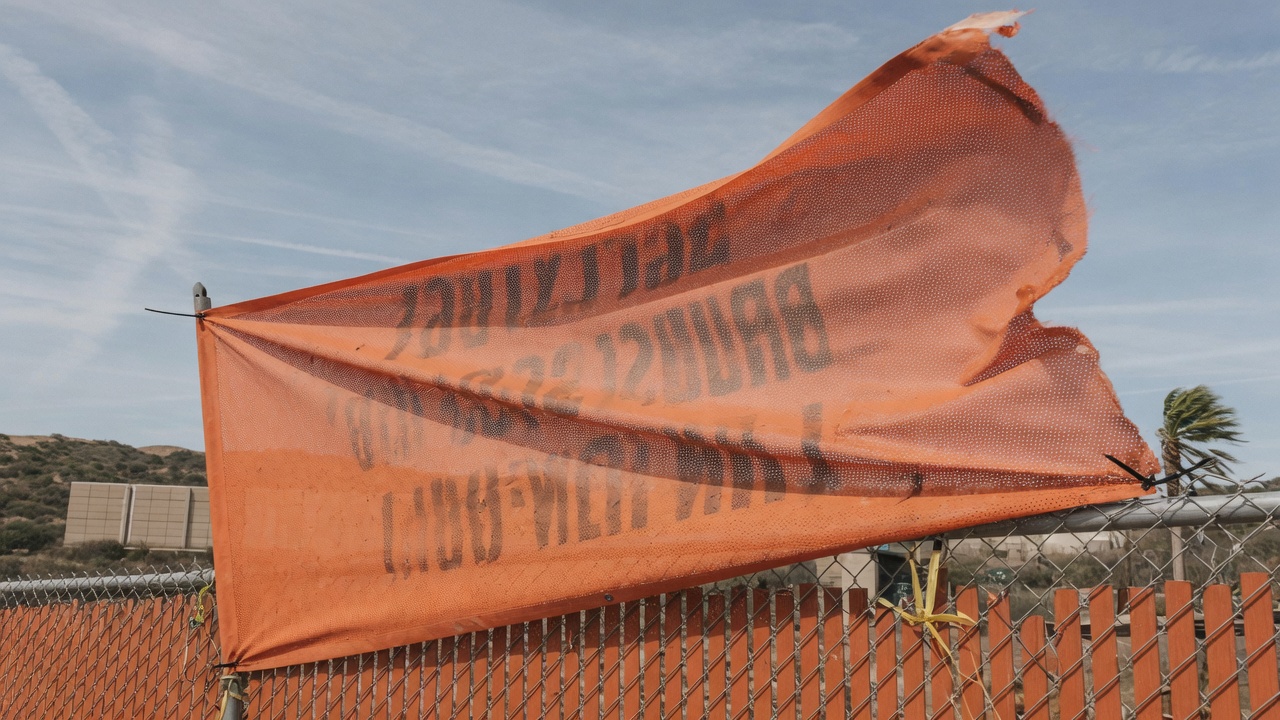
Choose mesh vs vinyl banners by wind load and viewing distance. Mesh — typically about 8-ounce PVC-coated polyester with roughly 20 to 40 percent open area — lets Santa Ana air through a fence or construction run. Solid 13-ounce or 18-ounce scrim vinyl is the opaque, close-up print. Mesh is not fabric.
That last sentence is on purpose. This page is a material choice between two PVC banner constructions: an open weave made to leak wind, and a solid scrim made to hold ink and block the view. It is not a vinyl-versus-fabric essay, not an indoor pull-up catalog, and not a five-year fade warranty. Avanti Printing at 15321 Barranca Pkwy, Irvine, CA 92618 prints both mesh and solid vinyl for Orange County fences, storefronts, and jobsites. Call (949) 387-0787. Quotes confirm size, material, quantity, finish, and date. They should also confirm how the panel hangs, whether the site sees Santa Ana winds, and whether anyone needs to see through the graphic — or not see through it.
If you need a hanging banner for a chain-link line, a construction rail, a parking-lot span, or a header that people will read from ten feet, stay on mesh and vinyl banner printing. If the job is a rigid board, a wall graphic, or a window film, that is a different product under large format printing in Irvine.
Who is choosing mesh vs vinyl in Orange County
If you run a jobsite, a leasing fence, a dealership lot, a school field, or a storefront anywhere from San Clemente to Brea, you already treat banners as temporary architecture. The question is not “do we need a banner.” The question is whether that rectangle should be a sail or a screen. Mesh vs vinyl banners is that decision. Get it wrong and the fence walks, the neighbors see the dumpsters anyway, or the logo looks like it was printed on a tennis net when a customer walks up to the tape.
Typical buyers we talk to from Irvine, Tustin, Santa Ana, Anaheim Hills, Orange, Lake Forest, Costa Mesa, Newport Beach, Huntington Beach, Laguna Hills, and Foothill Ranch are not shopping décor. They are shopping a printed panel that has to live on chain-link through a Santa Ana, or a solid face that has to look like a poster at handshake distance. General contractors want perimeter screening that does not turn a rented fence into a kite. Developers want “now leasing” copy that still reads after a wind event. Retail and restaurant operators want a sale banner on a header or a sidewalk fence. Property teams want a construction wrap that keeps the brand visible without pretending the site is a blackout wall. Schools, churches, and civic groups want event dates on a playground fence and then leave them up because taking them down is nobody’s job.
This is for you if the graphic will live on a fence, a scaffold-adjacent rail, a pair of posts in a parking lot, or a long construction run in Orange County air. It is also for you if last year’s solid vinyl unzipped at a corner in October and you are not eager to repeat the experiment. It is the wrong spec if you need an indoor aisle graphic, a photo wall, or a retractable stand. Indoor shows and booths are a trade show display conversation — mesh holes do not belong in a hotel foyer, and a solid outdoor scrim does not belong in a cassette.
California buyers outside Orange County use the same two constructions. The local twist is the wind stack: named Santa Ana events that squeeze through canyons, open lots with nothing upwind, temporary fence that was never designed as a billboard frame, and west sun that still cooks whatever you hang. Those conditions change material more than they change ink. They do not change the fact that mesh is a perforated PVC weave and solid vinyl is a closed face with a polyester scrim inside it.
- General contractors and developers hanging company ID, safety, and leasing copy on Irvine and Tustin jobsite fencing.
- Retail and restaurant operators along Barranca, Jamboree, PCH, and the Spectrum who need a fence or header banner that will not take the posts with it.
- Auto dealers and open lots in Santa Ana, Tustin, and Huntington where a 4-by-20-foot panel can see wind from the freeway.
- Leasing and property teams who keep a construction graphic up longer than the original permit board implied.
- Schools, parks, and churches tying event vinyl to chain-link, then leaving it through a weekend of canyon wind.
- Coastal sites in Newport, Costa Mesa, and Huntington that get a daily onshore breeze even when the Santa Ana map is quiet.
A working comparison, not a sample-book argument
Ask five printers “mesh or vinyl” and you will hear five confident defaults. The honest answer is a site answer: how much air, how close the reader stands, and whether you need the panel to hide what is behind it. Use the table as a decision frame for Orange County hangs. Your quote still has to lock size, material, quantity, finish, and date — and we will still ask whether the banner sits on a fence, across a gap, or on a wall.
| Factor | Mesh (typically ~8 oz open weave) | 13 oz solid scrim vinyl | 18 oz solid / blockout vinyl |
|---|---|---|---|
| Wind load | Air passes through; the grown-up fence and construction default | Closed face; a sail if it can balloon | Still a sail; heavier, not a mesh substitute |
| Opacity | Never opaque; fence, sky, and lights show through the holes | Mostly opaque single-face; sky can still silhouette it | True blockout available for two readable faces |
| Print at arm’s length | Dotted; fine type and faces suffer | Sharp; the close-up outdoor default | Sharp; same print class as 13 oz, tougher body |
| Best viewing distance | About 15–30+ feet; fence-line and roadway | Handshake to parking-stall | Handshake to parking-stall |
| Typical hang | Chain-link, construction rails, long windy runs | Headers, walls, short events, close read | Long hangs, pole pockets, double-sided poles |
| Weight in the truck | Lighter; easier on a long fence | The familiar roll | Stiffer; two-person on a 4-by-20 |
| Where it fails in OC | Storefront close-ups, night blackout, small legal type | Santa Ana on a gap or a long unbraced fence | Same geometry problem; you paid more for a stronger kite |
Read the table as shop practice, not as a sealed engineering stamp. Mill sheets for mesh often advertise something in the neighborhood of 25 to 40 percent airflow. Ultraflex UltraMesh Premium 100, a typical industry mesh, is a 10-ounce PVC-coated polyester with a published 30 percent air-flow through the basket weave. Other rolls we see are lighter, around 7 to 8 ounces, with a similar open-area idea. Those percentages are manufacturer claims on a free panel, not a promise that your zip-tied fence run will see 30 percent less load after you cover a rented panel with graphics. Open area helps. Geometry, attachment spacing, and whether air can get behind the face still decide whether the posts stay in the dirt.
Solid 13-ounce scrim is still the default outdoor banner in this shop when the hang is not a wind problem: a header on a wall, a weekend sale, a parking-lot A-frame face that is backed by a frame, a close-read “grand opening” that people will photograph. Eighteen-ounce is more vinyl and, usually, a denser scrim. It is tear insurance. It is not a permission slip to span a driveway with four corner grommets in October.
Mesh vs vinyl banners is a wind-and-opacity decision. Mesh leaks air and leaks view. Solid vinyl holds view and holds air. Pick the leak you can live with.
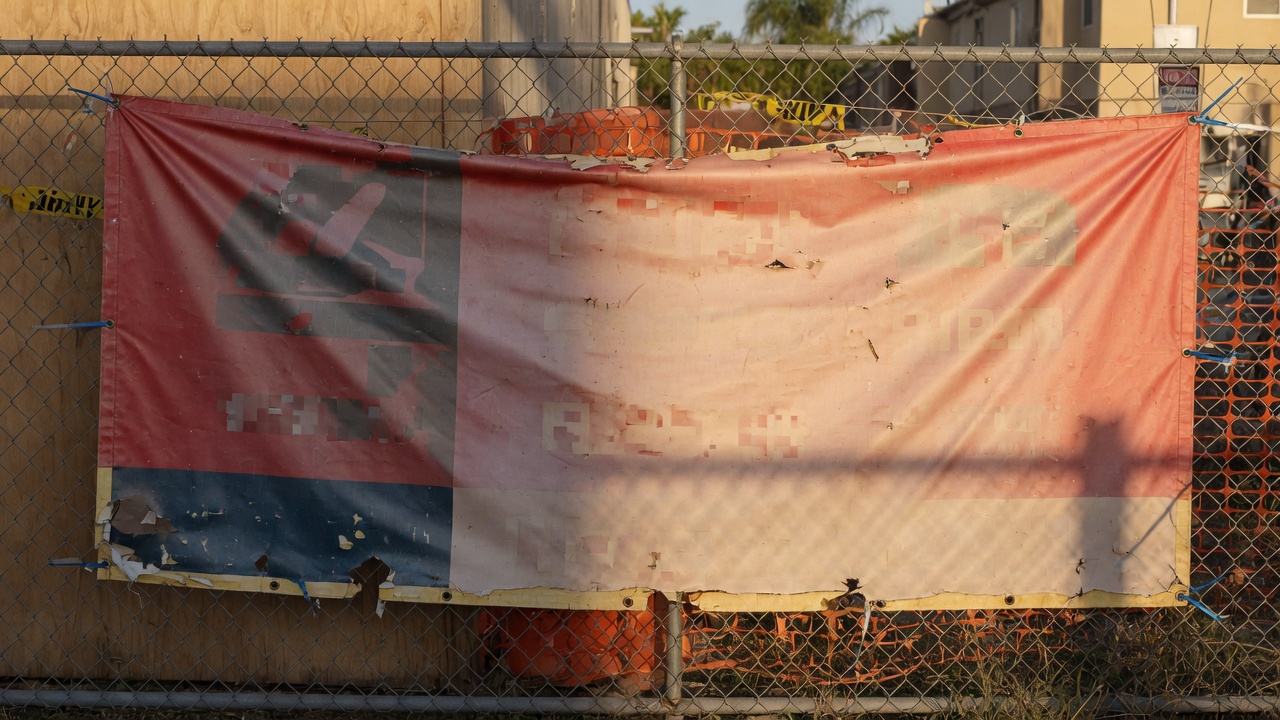
Wind load is speed squared times area
A solid vinyl banner is a rectangle that tries to stop moving air. The bigger the rectangle, the more air it tries to stop. Mesh punches holes in that rectangle on purpose so some of the air does not have to go around. That is the entire product, dressed up as a graphic.
Sign shops and estimators use a simplified velocity-pressure idea that comes out of the same 0.00256 V² neighborhood you will see in ASCE 7 wind discussions: pressure in pounds per square foot scales with the square of wind speed in miles per hour. Multiply by area and you get a force. It is a back-of-the-ticket estimate, not a building calculation. We are not stamping your fence. We are explaining why a 4-by-16-foot closed panel on two posts is a different object from the same copy on mesh against chain-link.
Work a 4-by-8-foot panel, 32 square feet, as a teaching example — typical industry arithmetic, not a lab report from Barranca:
- At 30 mph, 0.00256 × 30² × 32 is on the order of 70 pounds of force on a closed face.
- At 40 mph, the same panel is on the order of 130 pounds.
- At 60 mph, you are in the neighborhood of 300 pounds on that one 4-by-8.
Double the speed and you roughly quadruple the pressure. That is why a “breezy” afternoon and a Santa Ana gust are not cousins. A 4-by-20-foot solid run is 80 square feet. At 50 mph you are looking at hundreds of pounds trying to peel grommets, lean posts, or walk a rented fence panel. Mesh does not make that number zero. If about 30 percent of the face is open, a crude first cut is that you are no longer asking the vinyl to stop 100 percent of the stream. Real life is messier: the fence behind the mesh is a second grid, print coverage clogs some holes, and a taut panel still presents area. The useful sentence is still true. Mesh lowers the sail. Solid vinyl is the sail.
Height and gap make it worse. A banner mounted so air can get behind it balloons. A banner stretched across a driveway, a scaffold opening, or the space between two buildings is a kite. A banner sitting tight to chain-link, tied on a sensible spacing, is a screen on a screen. Put the panel on the fence when you can. If you must span a gap, say so on the quote. We may talk mesh, more attachment points, a pipe in a pocket, or smaller panels. We will not pretend 13-ounce solid on four zip ties is an engineered wind design.
Wind slits on solid vinyl are a religious argument in this trade. Some shops cut crescent holes so air can pass. Those holes are also the start of a tear, and they punch the graphic you paid to print. We do not treat slits as a default on outdoor vinyl in Orange County. If the site is that windy, the grown-up options are mesh, more ties, a closer mount to a fence, a pipe rail, or smaller panels. Do not DIY a row of holes with a hole saw on a finished solid print and then call us when the tear starts at the first crescent.
Hardware still beats ounce-weight if the hang is wrong. An 18-ounce solid with four corner ties will start a tear at a corner. An 8-ounce mesh on bungees at every grommet, close to the fence, will often ride out a blow that destroys the “heavier” job. Weight is tear insurance on a closed face. It is not a substitute for letting the air through.
Santa Ana winds, canyons, and the fence that walked
Orange County does not need a hurricane for a banner to fail. It needs a Santa Ana, a long panel, and a hang that assumed July traffic, not October air.
The National Weather Service describes Santa Ana winds as dry air that flows east to west through Southern California mountain passages, most common in the cooler months from September through May, often feeling warm because the air compresses as it descends. See the NWS note on mountain and valley winds, including Santa Ana winds.
Santa Ana winds occur when air from high pressure over the desert Southwest flows west toward low pressure off the California coast. They are most common from September through May, and they often feel warm because descending air is compressed. These strong winds can cause major property damage.
Local hazard talk in south Orange County has long treated canyon-accelerated Santa Anas as a real windstorm class, not a folk tale. Fremont Canyon near Tustin, the Santa Ana Canyon corridor, Anaheim Hills, and the river basin have reputations because air gets squeezed. You do not need the peak gust on your particular fence for a banner to fail. You need enough cyclic loading to egg out a grommet, walk a temp-fence foot, or turn a slack solid panel into a flag.
Where that hits mesh vs vinyl banners on real OC sites:
- Foothill and canyon-adjacent fences. Anaheim Hills, parts of Tustin, Orange, and the Santa Ana Canyon corridor. Air is not polite. A solid 4-by-50-foot run on rented panels is how you buy a Monday call from the GC.
- Open parking lots and dealerships. Nothing upwind. A solid panel between two posts is a rectangle the wind can see from the 5 or the 55.
- Construction perimeters. Long runs, temporary posts, water-filled bases, and whoever hung it used the corner grommets only. Mesh is the default here for a reason. The fence was rented as a fence, not as a billboard structure.
- Gaps. Hung across a driveway, a scaffold opening, or between two buildings. Worst geometry. You built a kite. If the copy must live there, say so. Mesh plus a pipe plus more ties is still not magic, but it is more honest than solid vinyl with optimism.
- Coastal onshore days. Newport, Costa Mesa, Huntington. Not always a named Santa Ana. Daily breeze plus slack solid vinyl still scuffs a hem. Mesh still leaks that air. Solid still flaps if you hung it like laundry.
After a Santa Ana, walk the install before you schedule a reprint. Look at corners, elongated grommet holes, leaning fence panels, and whether the graphic now has a memory wave. A slightly stretched mesh panel can still sell units from the street. A solid vinyl corner that has started to unzip will not make it through the next event. Repair is rarely honest once a tear leaves the hem. Budget a reprint, and this time pick the material that matches the air.
Temp fence is the quiet failure. The banner did not “rip in the wind.” The wind loaded the banner, the banner loaded the stand, the stand walked, and now your graphic is in the lane. Mesh reduces that chain. It does not cancel a fence that was already hungry for ballast. If the GC is covering a long, tall run in a canyon-adjacent lot, talk about panel size, tie spacing, and whether the fence vendor knows the graphic is going up. A printer cannot ballast a fence we did not sell.
Fence banners: chain-link is a mesh job
Chain-link is mesh’s home turf in Orange County. The fence is already a grid. Wind already moves through it. You are adding a printed grid, not a wall. That is why mesh vs vinyl banners on a fence is usually not a close call if the run is long, the site is open, or the calendar includes fall and spring wind.
Put the mesh on the fence, not in front of a hole in the fence. Ties at every grommet, typically every 18 to 24 inches along the edges — tighter on a tall run or a site we know is a wind corridor. Ball bungees give. Zip ties do not. Zip ties cut vinyl when the panel moves, go brittle in UV, and turn grommet holes into ovals. If last year’s solid banner is still hanging by four corners and a prayer, look at the holes. They are the post-mortem.
Size to the fence you have, not to a billboard you saw on a freeway. A finished 3-by-8 with a 1-inch hem started larger. Measure the opening you will cover, decide whether the number is live image or finished size, and leave a little daylight at the bottom so the hem is not eating asphalt, irrigation crust, and weed-whacker line. A panel that puddles on the sidewalk will look dirty in a month and torn in a season.
Long runs should be panelized. One 4-by-40-foot solid sail is a single point of failure. Four 4-by-10-foot mesh panels on the same fence are four smaller screens, easier to carry, easier to replace if a truck kisses a corner, and less eager to load the whole line at once. Seams will show. On a construction or leasing fence, seams are honest. On a photo-real “hide the site” wrap, seams are a design problem you should solve in the file, not by ordering one impossible ribbon of solid vinyl.
You will see the fence through mesh. That is not a defect. Holes are the product. Dark ink hides the wire better than a white field. A white or pastel field turns the chain-link into a texture inside the logo. If the brand police demand a white flood behind a delicate mark, they are asking for solid vinyl — and then we have to talk about wind. High-contrast, big type, simple fields: that is fence-distance mesh. A thin gold script on cream is a storefront vinyl, not a 200-foot construction run.
Night lighting punches through mesh. Streetlights, jobsite towers, and a full moon behind a pale panel will star the holes. If the graphic has to look like a painted wall after dark, mesh will not do that job. Solid vinyl will look more like a wall and will also catch more air. There is no third banner that is both a blackout and a screen. Rigid screening and windscreen products exist in the construction world; they are not this SKU, and we will say so if that is what you actually need.
Do not hang mesh like a poster in a courtyard where people stand three feet away and take phone photos of the type. Do not hang solid vinyl like a windscreen on a two-story rented fence in Anaheim Hills in October. Those two sentences are most of the reprints we see on this product pair.
Construction perimeters, opacity, and what neighbors actually see
Construction banners in Irvine, Tustin, Costa Mesa, and Santa Ana are where mesh vs vinyl banners stops being theoretical. The GC wants branding. The city or the owner wants the site screened. The neighbors want not to look at a hole in the ground. The wind wants the fence. Those four wants do not all fit on 13-ounce solid vinyl.
Mesh is the usual construction-perimeter print because the fence is temporary, the run is long, and the air is real. It will carry a logo, a rendering, a website, and a “coming soon” at street distance. It will not turn the site into an opaque showroom. Through the holes you will still see equipment, stacked material, porta-potties, and sky. If the owner’s brief was “nobody should see the job,” mesh is the wrong promise. Say that in the first email, not after the rendering is printed on a weave.
Opacity on purpose:
- Need to hide the site. Mesh cannot. Solid vinyl hides more in still air and becomes a sail in a Santa Ana. Full blackout of a construction perimeter is often a different product: tighter windscreen, rigid panels, or an engineered wrap — not a grommeted banner we hang like a grand opening. Tell us the hiding job. We may tell you a banner is the wrong tool.
- Need the brand to read from the street. Mesh at fence distance, high contrast, big type. This is the job mesh was built for.
- Need both. You are stacking two problems. Some sites mix a lower solid kick or a windscreen with an upper mesh brand band. Some accept that the rendering is a picture with holes in it. Some move the hero image to a solid panel on a wall that does not fly. Do not order one 4-by-200-foot solid hoping it will be a privacy fence and a billboard.
Permits and site rules are not print defects. Construction fencing in Orange County sits under whatever the building permit, the GC, the owner, and the city inspector already agreed to. We print to the size you send. We do not issue the fence permit, and we will not tell you a full-coverage solid wrap is “probably fine” on a rented panel line next to a school. If the packet wants screening with a wind rating, bring the packet. If the packet is silent, assume mesh unless the hang is short, low, and backed by a wall.
Safety copy still has to be readable. Fine OSHA-adjacent lines, small bilingual blocks, and QR codes to a safety PDF do not survive mesh holes at ten feet. Put the legal paragraph on a solid sign, a rigid board, or a printed pocket the superintendent actually posts. Put the 4-foot logo on the mesh. Mixing a 12-point paragraph into a 4-by-20-foot mesh panel is how you get a graphic that looks designed in InDesign and illegal on the sidewalk.
Scaffold and building-face mesh is a cousin of fence mesh, not the same ticket. Building wraps at height are wind, access, keder, and sometimes an engineer. A blog paragraph is not that spec. If you are covering a scaffold on an Irvine mid-rise, say height, duration, and how the mesh attaches. We will quote a construction-grade mesh and a finish that matches the hardware — or we will tell you the install is beyond a grommeted banner. Do not assume the same 8-ounce fence roll is a high-rise wrap.
Dust, mud, and overspray are construction facts. Mesh holds grit in the holes. Rinse if you can; do not pressure-wash on turbo. Solid vinyl holds a mud film on the face and looks like fade until you wash it. Neither material is a painted wall. Budget a look that can get dirty, or budget a reprint when the building opens and you want a clean leasing graphic on a calmer hang.
Print quality through holes
Mesh is a picture with holes in it. The holes are not a RIP error. They are how the wind gets out. If you stand three feet from a mesh banner, you will see the weave, the fence, and the dots in a face. If you stand across the street, you will see the brand. Design for the street.
What actually happens to ink on an open weave:
- Type. Hairline scripts, 2-inch phone numbers, and thin strokes lose pieces of themselves to holes. As a shop rule of thumb — not a type code — give letterforms mass. Fence-distance headlines want weight. Body copy that would be fine on a 13-ounce poster will look moth-eaten on mesh. If a line must be small, it should not be on mesh.
- Photos and faces. A hero portrait that will be judged at a storefront is a solid-vinyl job. A skyline rendering viewed from the second lane of Barranca can live on mesh if contrast is high and you are not counting eyelashes. Soft gradients posterize into the weave.
- QR codes and URLs. A QR on mesh is a coin toss at walking distance and a failure at fence distance. Put codes on a solid sticker, a yard sign, or a takeaway. URLs on mesh need to be huge and high-contrast, or they need to live somewhere else.
- Color. You are printing on a fraction of the area. Saturated fields still read. Pastels and cream floods look weaker because the world shows through. Dark fields hide the fence better. White fields advertise the holes.
- Logos with open counters. A, 8, B, 0, and a wordmark with thin internals will flicker as you walk. Enlarge them or put them on a solid panel.
Liner-backed mesh prints cleaner than no-liner mesh because the printer is hitting a temporary face, not spraying through the holes onto the belt. We will spec what the job needs. Do not order no-liner because it sounded cheaper if the art is a photograph you care about. Do not order liner-backed and then expect the panel to be opaque; the liner peels. The holes remain.
Viewing distance is the honest test. Walk the site. If the closest a driver gets is 20 feet, mesh can carry a simple campaign. If a pedestrian will stand at the tape and read hours, a phone number, and a tagline, that strip should be solid vinyl — and that strip should not be the 40-foot windward face of the lot. Mix materials on one site when the jobs are different: mesh on the long fence, solid on the gate where people wait, a rigid board for the permit and the QR. That is how grown-up jobsites look. One material for every problem is how you get a pretty file and an ugly Tuesday.
File setup for mesh is the same CMYK, vector-logo lecture as any large banner, with a stricter safe zone. Build at finished size plus bleed that continues through the hem. Keep live matter out of the last inch and away from grommet points. Do not park a phone number on the bottom hem. Outline fonts or package them. Photographs need actual pixels at size; 150 dpi at final size is a typical industry target for fence viewing, and mesh will not save a 72 dpi web hero. If the only art is a PNG from a website header, say so early. We can tell you whether it holds at roadway distance. We cannot invent a vector wordmark from a 400-pixel logo the night before a fence goes up.
Matte versus gloss matters less on mesh than on solid, because the weave already breaks the face. Gloss on solid vinyl on a west-facing header is a mirror at 4 p.m. Mesh on a fence is rarely a gloss conversation. If brand guidelines demand a shiny solid, we can print it on 13-ounce. You will still have a mirror at sunset, and you will still have a sail if you hang it in a gap.
When solid vinyl is the right banner
Mesh is not a personality upgrade. It is a wind tool. Plenty of Orange County banners should stay solid 13-ounce or 18-ounce scrim. The tell is close viewing, a backing that already stops the air, or a need to hide what is behind the print.
Choose solid vinyl when:
- People will read the panel from a few feet: a storefront header, a grand-opening photo, a menu of services, a phone number you actually want called.
- The hang is on a wall, a fascia, or a frame that already has a back. Wind cannot balloon a panel that is against stucco the way it balloons a panel in a fence gap.
- You need opacity: hiding a window that is not getting window film, covering an ugly rail, a double-sided pole hang that must not ghost. Blockout 18-ounce exists for two readable faces. Mesh “double-sided” is just see-through both ways with a muddy reverse.
- The job is short and still: a weekend sale, a Saturday event on a sheltered courtyard fence, a banner you will take down Monday and roll.
- Indoor-adjacent: a hall, a gym, a booth. Indoor mesh looks like you used outdoor leftovers. Indoor events want indoor media. If it is a show, look at trade show displays instead of punching holes in a foyer graphic.
Choose 13-ounce solid for most seasonal Irvine headers and anything you will roll and reuse. Choose 18-ounce solid when the panel will stay up through a summer and a Santa Ana season on a hang that is not a kite — a west wall, a pole pocket on posts, a long-term “now leasing” that is actually on a building, not across a canyon-adjacent lot. Eighteen-ounce will not forgive four corner grommets in a gap. If the site is a fence in the wind, do not “upgrade” from 13-ounce solid to 18-ounce solid and call it a mesh decision. Upgrade the construction to mesh, or change the hang.
Double-sided work wants a blockout. Two 13-ounce panels taped back to back is a sloppy sandwich that ghosts in the sun and peels at the edge. Mesh will ghost by design; you can read a reverse image through the holes, badly. If both faces must read on a pole, say so and we will spec solid blockout. If both faces “sort of reading” is acceptable on a fence because the other side is the alley, mesh may still be fine. Say which.
A solid banner on a fence is not forbidden. A small, well-tied, short-duration solid panel on a sheltered courtyard fence in Irvine can look better than mesh at handshake distance. A 4-by-24-foot solid on an open Tustin construction line in October is how you meet the fence company again. Tell us the site, not the material you liked in a catalog photo taken in still air.
Materials, hems, grommets, and the file we actually print
Both products are PVC over polyester. Mesh leaves the weave open. Solid scrim buries a mesh between PVC layers so the face is closed. That is why they print differently, hang differently, and fail differently. The quote should name the class, not “banner vinyl.”
Mesh we actually run is typically in the 7- to 10-ounce range, PVC-coated polyester, white face, holes you can see before we print. Some rolls ship with a liner for print; some do not. Flame statements show up when a venue or inspector asks. Many banner materials, mesh included, can be supplied with an NFPA 701 mill sheet if the event or city wants one. If someone will ask, tell us before we print so we pull a roll that matches the certificate. Do not hang leftover fence mesh in a ballroom and hope.
Solid outdoor banners here are typically 13-ounce scrim, with 18-ounce and blockout as the heavier cousins. Outdoor-rated inkjet — latex or UV-curable depending on the job — onto outdoor scrim. We do not, as a default, laminate a grommeted outdoor banner the way we might laminate an indoor panel. A laminate on a flogging solid can edge-lift. Durability comes from ink plus vinyl plus a hang that does not beat the panel to death.
Hems are where banners live or die. On solid 13-ounce, a welded hem is the outdoor default: PVC fused to itself, no stitch line to wick water. On mesh, shops often sew, tape-and-sew, or add webbing because there is less PVC face to weld. Webbing along the edges is the high-wind mesh finish: a belt for the grommets to sit in so the weave does not tear out around the ring. If your last mesh banner died at the corners, say so. We will finish this one like we believe the canyon. Tape-only hems are for indoor short-term and emergencies. They are not a six-month construction-fence plan.
Grommets sit in that hem, typically at corners and then every 18 to 24 inches. On a tall, skinny panel or a known wind site we tighten the spacing. Use all of them. Loading only the two top corners is how a 20-foot banner becomes a 20-foot tear. Size is usually a #2 or #3 grommet. Bigger is not automatically stronger if the hem is still a single fold of tired mesh. Corner patches, webbing, and a doubled hem at the corners are the boring extras that make fence graphics survive October.
Pole pockets still belong on some solid jobs: a pipe in the top so the header stays straight, grommets on the sides. Mesh fence jobs are usually all grommets. Do not order a pocket and then zip-tie the mesh through the tunnel. Do not order grommets and then try to slide a 1.25-inch pole through them. Tell us the hang before we finish.
We can share the mill sheet for the roll on your job. Coated-fabric methods such as ASTM D751 show up on tensile and tear numbers. We will not pretend a generic number off the internet is your roll. If a GC or an engineer wants the sheet, ask. It is a better document than a blog paragraph, and it is still not a wind-design stamp for your particular fence.
Artwork rules that prevent reprints on both materials:
- Build at actual size or a clean even scale. Mark the scale.
- Vectors for logos and type. Outlined fonts or packaged fonts.
- Photographs with pixels at size. About 150 dpi at final size for fence viewing. 72 dpi web heroes look like 72 dpi web heroes at 8 feet, and worse on mesh.
- CMYK. RGB neons will dull. If a brand red is contractual, send the coated number.
- Bleed through the hem. Live matter inside a safe zone. Grommets eat corners.
- On mesh: high contrast, mass in the letterforms, no QR as the hero, no 12-point legal.
- On solid: you can go tighter on type, still not business-card small on a 4-by-8 that is read from a car.
- Finished size versus opening. Answer which number you measured.
Quote mesh or solid vinyl for an Orange County fence
Mistakes that reprint a banner or walk a fence
Most failures we see on mesh vs vinyl banners are not RIP errors. They are material mismatches, four-corner hangs, and files built like a social post. This is the short list we would rather walk through before we print.
- Solid vinyl on a long, open, canyon-adjacent fence. You built a sail. The fence company will notice before the brand does. Use mesh, or shorten the run and change the hang.
- Mesh for a handshake read. Fine type, faces, hours, and QR codes on a weave. Pedestrians see dots. Use solid vinyl where people stand, mesh where they drive.
- Expecting mesh to hide the jobsite. Holes leak view, lights, and sky. If blackout is the brief, a grommeted banner may be the wrong product.
- Four corner grommets on a long panel. Wind loads the middle. The middle has nothing. Use the spacing we set.
- Zip ties, no give, on either material. Oval holes, then tears. Bungees on a fence. A pole in a pocket on a header.
- Hung across a gap like a billboard. Worst geometry for solid vinyl. Still serious for mesh. Say it is a span so we can talk panels, pipes, and whether the idea is wise.
- Upgrading 13-ounce solid to 18-ounce solid to “beat the wind.” You bought a heavier kite. Wind wants open area or a better hang, not more PVC.
- Wind slits cut in the parking lot. You invented a tear pattern and punched the logo. If the site needs air, order mesh.
- Small legal copy and QR codes on mesh. Unreadable, then “the printer made it fuzzy.” The holes made it fuzzy. Move that content.
- White flood on mesh over chain-link. The fence becomes the texture. Darken the field or accept the grid.
- Double-sided hopes on mesh. You will see a muddy reverse, not a second page. Blockout solid for two faces.
- Indoor mesh. Holes under cans look cheap. Indoor jobs want indoor media, not a construction roll.
- Critical copy in the hem. Phone numbers and URLs in the last inch vanish into the fold or the grommet. Keep live matter inside a safe zone on both materials.
- Web-resolution art on a 4-by-16-foot face. Outdoor distance is forgiving. It is not that forgiving, and mesh is less forgiving than solid.
- Wrong size because someone measured the chain-link panel, not the opening, and ignored the hem. We will ask whether your size is live image or finished size. Answer that.
- Ignoring the landlord, HOA, GC, or city. A perfect banner on a fence it was not allowed to occupy is a perfect banner in a dumpster. Irvine office parks, retail centers, and jobsites have rules. Check before we print a 4-by-20 you cannot hang.
- Leaving a dated campaign up because the vinyl is “still fine.” The material survived. The copy is lying. Reprint.
Pressure washing and folding deserve their own scolding. Turbo pressure wash drives grit through mesh holes and scuffs solid ink. Rinse, do not sandblast. Folding either product puts a white crack through a logo. Roll it. PVC remembers. We will reprint that. We will also tell you it was the fold.
Landlord and city rules still end banner life at day zero. Irvine Company retail criteria, City of Irvine sign rules for some temporary signs, Newport and Costa Mesa banners, HOA committees, construction permit boards — none of those grade on color gamut. If you need a permitted wall sign, that may be a rigid panel, not a grommeted banner. Ask them, then ask us.
What to send so the quote is real
A useful quote for mesh vs vinyl banners names size, material, quantity, finish, and the date you need it. “Need a banner for the fence” is a voicemail. Send the following to Avanti Printing and we can price without twenty questions. Walk-ins at 15321 Barranca Pkwy, Irvine, CA 92618 are fine if you bring the dead banner. Phone is (949) 387-0787.
- Finished size, width by height, and whether that number is the opening or the vinyl after hems.
- Where it hangs: city, chain-link, temp fence, wall, poles, storefront header, construction rail. Photo with a tape helps.
- Wind notes: canyon-adjacent, open lot, gap span, Santa Ana history, coastal breeze. “It gets windy” is a start; a photo of last year’s torn corners is better.
- Opacity notes: must hide the site, must read from the street, pedestrians will stand at the tape, or mixed.
- Material: mesh, 13-ounce solid, 18-ounce / blockout, or “recommend from the hang.”
- Finish: grommets (spacing), webbing, pole pockets (which edges, pole diameter), or both. Matte or gloss on solid.
- Quantity and whether art is identical or versioned (English/Spanish, two addresses, two dates, panelized run).
- File status: vector logo, photo that actually has pixels, or a PNG and a deadline. Mesh needs simpler art than solid if you were planning a face and a paragraph.
- Date: first day it must be on the fence, not “ASAP.” Construction calendars slip; the print date should still be a date.
- Pickup in Irvine versus delivery to a jobsite. A rolled 4-by-20, mesh or solid, is a two-person carry.
Quotes confirm size, material, quantity, finish, and date. If any of those five is missing, the number you see is a guess. Wind and opacity are how this particular quote goes wrong even when the square footage is clear. Rush exists for many standard grommeted sizes when the file is clean. It is a different conversation for webbing, blockout, a panelized 200-foot run, and a file that is still in a group chat. We will say no if the honest answer is no.
If the same campaign also needs posters, rigid boards, or indoor booth graphics, put those on the request as separate lines. Mixing them into one “just make it big” instruction is how outdoor mesh ends up specified like a foyer panel, or a retractable film ends up grommeted on a fence. Start with banner printing in Irvine for the hanging vinyl, and keep the other products on their own specs under the same PrintBig Irvine roof.
Send size, hang method, and wind notes for a quote
Frequently asked questions
When should I use mesh vs vinyl banners in Orange County?
Use mesh when the graphic lives on a fence, a construction rail, or any hang where Santa Ana air or a daily breeze can load a closed face — especially long runs and canyon-adjacent lots. Use solid 13-ounce or 18-ounce vinyl when people will read the panel up close, when you need opacity or a true double-sided blockout, or when the banner sits on a wall or a frame that already stops the wind. If you are unsure, send a photo of the hang. We would rather recommend mesh on a Tustin jobsite than reprint a shredded solid after the first named wind event.
Will mesh hide my construction site?
No. Mesh is a printed screen with holes on purpose. You will see equipment, sky, and chain-link through the graphic, more so on light fields and at night when lights are on behind it. Mesh is for branding and wind. Hiding a site is opacity, which points toward solid vinyl in still air, a purpose-built windscreen, or a different product. If the owner’s brief is blackout, say that before we print a rendering on a weave.
Can I print small type, photos, and QR codes on mesh?
Small type and QR codes are a bad bet. Holes eat strokes and modules. Fence-distance headlines with mass, high-contrast logos, and simple fields work. Hero faces and menu-size copy belong on solid vinyl, a rigid board, or a gate panel people actually walk up to. Photos can hold on mesh at roadway distance if they have contrast and real pixels; they look dotted at three feet. Put the QR on something solid.
Will Santa Ana winds destroy a solid vinyl banner on a fence?
They will if the panel can balloon, if only the corners are tied, if it spans a gap, or if it is a long run on temp fence. They might not if the banner is small, close to a backing, tensioned on bungees at every grommet, and finished with a real hem — and even then mesh is usually the smarter fence material from September through May. Watch NWS wind headlines in that pattern and walk the site after a blow. Replace a starting tear. Do not wait for the zipper to reach the logo. Weight helps a closed face. Open area and geometry help more.
Is mesh double-sided? What about 18-ounce instead of mesh?
Mesh is see-through, so the reverse is a muddy ghost, not a second page. If both faces must read, spec solid blockout vinyl and then solve wind with the hang, not with holes you do not have. Eighteen-ounce solid is tougher 13-ounce, not a mesh substitute. It resists tear and abrasion. It still catches air. Do not buy 18-ounce to survive a Santa Ana on a fence if the real need is airflow.
How should I hang mesh on chain-link?
Grommets on a reinforced hem, ties at every grommet, bungees rather than zip ties, panel close to the fence so it cannot balloon, a little daylight at the bottom, and more attachment points on tall or canyon-adjacent runs. Webbing on the edges is the high-wind finish. Panelize long runs instead of ordering one ribbon. Use all the grommets. A 4-by-20 with four corners tied is a 4-by-20 tear waiting for a name, mesh or vinyl.
Does mesh last as long as solid vinyl in Orange County sun?
There is no honest single number. UV still fades ink on both. Mesh often dies less often from wind, which is the fast clock on OC fences, and it can look tired sooner up close because the weave and the dirt in the holes are visible. Solid vinyl on a calm west wall often looks richer longer and can still shred in one gust if you hung it like a sail. Give us a duration and a hang. We will spec material to that, not to a brochure “up to” line. Facing, dirt, and whether you take the banner down between phases will move you around inside any range.
What do you need for a quote, and can I have it this week?
Finished size, mesh versus solid (or “recommend”), quantity, finish, and the date — plus a photo of the hang and whether wind or opacity is the real problem. Call (949) 387-0787. Clean vector art on a standard grommeted size is a different rush than a panelized construction run with webbing and a file that is still a screenshot. Quotes still confirm size, material, quantity, finish, and date, including a date that is soon, if we can meet it. We will tell you if the finish you want does not fit the calendar.
Pick the material that matches the air
Mesh vs vinyl banners in Orange County is not a taste test on a showroom table. It is whether Santa Ana air gets through a fence, whether a neighbor sees the dumpsters, and whether a customer can read the phone number at ten feet. Mesh leaks wind and leaks view. Solid vinyl holds view and holds air. Fence lines, construction perimeters, and canyon lots usually want the leak. Headers, close-reads, and blockout poles usually want the wall.
Bring us the hang, the wind, and the file. Avanti Printing, 15321 Barranca Pkwy, Irvine, CA 92618, will spec mesh or solid vinyl against that site, keep small type off the holes, and leave the phone number out of the hem. Call (949) 387-0787 or send the quote form with size, material, quantity, finish, and date. We will tell you when you should have ordered a rigid sign or a different windscreen instead. Most of the jobs on this page should still be a banner — just not a four-corner solid banner in a wind event.