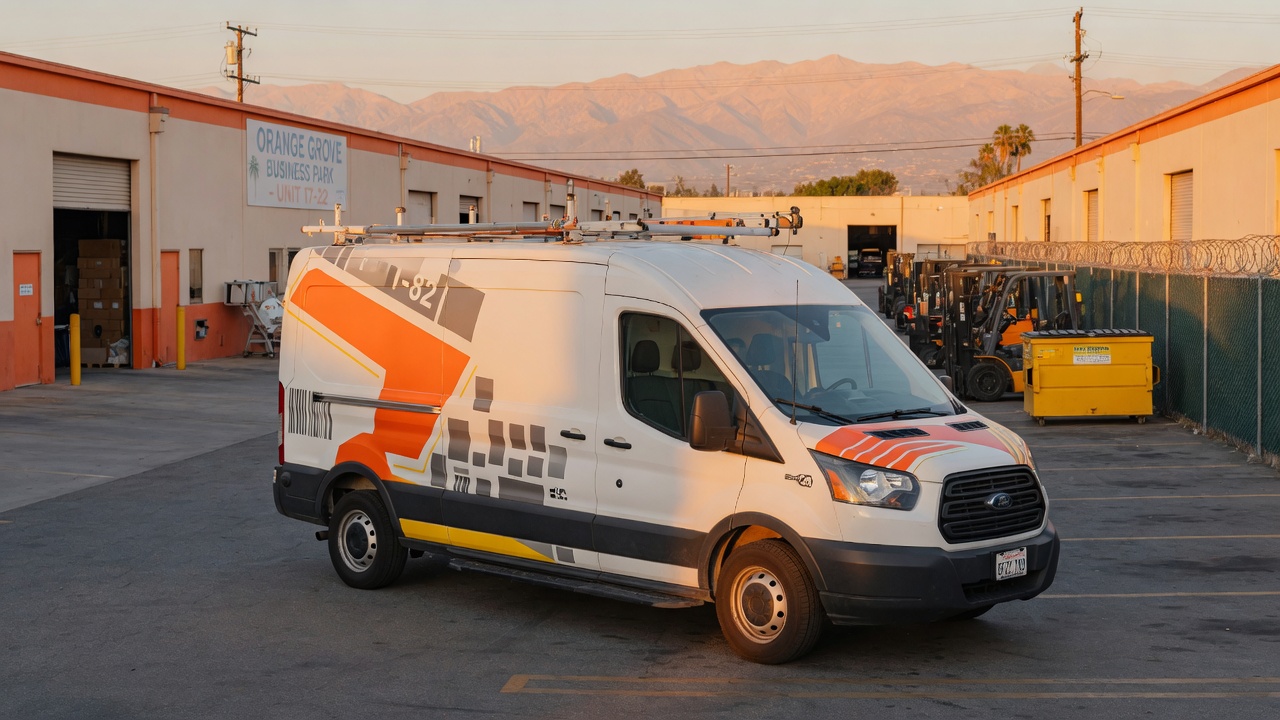
Fleet graphics in Orange County are vinyl on the van — door logos, rear-door kits, and partial wraps that ID a service vehicle at the curb. Most OC trades need door marks and side panels, a vinyl series that survives parking-lot sun, and an install that does not park the truck for two days.
The catalog shot is always a studio Sprinter with a seamless full wrap and a wet-look floor. Your van is more likely a Ford Transit with a ladder rack, a dent in the sliding door, last year’s phone number still on the rear barn doors, and a dispatcher who needs it back on the 405 by lunch. That is why we quote fleet graphics as a kit: year, make, model, coverage, vinyl series, laminate, quantity of vehicles, and the hours the truck can sit. Avanti Printing at 15321 Barranca Pkwy, Irvine, CA 92618 prints, cuts, and installs vehicle vinyl. Call (949) 387-0787 if you already have a template and only need doors done on a Saturday.
This is the estimator version of that conversation. It is written for Orange County owners who will actually drive the van after we peel the tape. It is about door logos, partial van wraps, install downtime, vinyl series, and fleet templates — not a full-wrap fashion catalog, and not a wrap-versus-magnets debate. Magnetic door signs are a different product and a different article. If you want vinyl that stays on the paint, stay here. Quotes still confirm size, material, quantity, finish, and date.
Who is ordering fleet graphics in Orange County
If you run a service company anywhere from San Clemente to Brea, the van is already a billboard whether you designed it or not. A white cargo van in an Irvine cul-de-sac is anonymous. The same van with a readable door logo, a phone number, and a license number is how a homeowner decides you are the plumber they called and not a stranger with a flashlight. Vehicle wraps and fleet graphics in Irvine are how we turn that decision into vinyl that will still be there after a summer on Barranca.
Typical buyers we talk to from Irvine, Tustin, Santa Ana, Costa Mesa, Newport Beach, Lake Forest, Laguna Hills, Anaheim, and Huntington Beach are not shopping “a wrap” in the Instagram sense. They are shopping a coverage map. HVAC and refrigeration shops want both front doors and the rear so the truck reads at a stop light and in a driveway. Plumbing and electrical contractors need the CSLB number large enough that it is not a rumor. Solar and roofing crews want side panels that still work around a rack. Restoration and remediation vans want a calm, readable mark, not a disaster-porn photo of a flooded kitchen. Pest, landscape, janitorial, IT, medical courier, and property-maintenance fleets want five or ten vans that match, not five versions of a logo somebody rebuilt in Canva on a Sunday.
This is for you if the graphic will live on paint, you can bring the van in (or schedule a staggered drop), and you can send a vector logo instead of a screenshot from the website header. It is also for you if the current doors are a mix of faded cut vinyl, a leftover subcontractor’s name, and a phone number that rings the former owner. It is the wrong spec if you need a rigid yard sign, a job-site vinyl banner, or a printed wall in the shop. Those are separate products under large format printing in Irvine and banner printing.
California buyers outside Orange County use the same films and the same Transit and Sprinter templates. The local twist is the climate and the calendar: west-facing office-park lots, heat that cooks a closed cargo bay in July, marine air if you park near Newport or Costa Mesa overnight, Irvine Company and HOA service-vehicle etiquette, and trades who cannot spare the whole fleet on a Monday. Those conditions change vinyl series, laminate, coverage, and whether we wrap into a body line or stop at a door edge. They do not change the fact that fleet graphics are pressure-sensitive vinyl on a vehicle, not a poster you tape to a panel van.
- HVAC, plumbing, electrical, and solar shops whose vans sit in Irvine and Tustin driveways and need the phone number readable from the sidewalk.
- Restoration, pest, landscape, and janitorial fleets that want a matched kit across five to twenty units, including the ugly spare van.
- Property-maintenance and facilities teams serving Spectrum-area retail and Irvine office parks who need a professional door mark, not a carnival wrap.
- Owner-operators with one Transit who will live with the graphic for years and should not cheap out on calendered film on a compound curve.
- Office and medical couriers who want rear-door ID for the 405 and I-5, and front-door logos for the suite entrance.
Door logos, partial wraps, and how much of the van you actually need
Coverage is the decision. Film, downtime, and price all follow it. “Wrap the van” is not a coverage map. Neither is “just do the doors” if you mean a printed photo that wraps the mirrors, the fenders, and the sliding door. Start with what a driver, a homeowner, and a cop at a glance need to read, then stop. Extra vinyl on a roof nobody sees from the street is not branding. It is film you will recook in Orange County sun.
Use the table as a shop filter, not a menu you must climb. Typical industry practice for Orange County service vans is door-first, then rear, then sides. Full color-change wraps exist; they are a different labor day and a different quote. Your ticket will lock panels, vinyl series, and whether the art is cut vinyl, printed panels, or both.
| Kit | What is covered | Typical film class | Typical shop downtime | Where it earns its keep in OC | Where it fails |
|---|---|---|---|---|---|
| Cut door logos | Front doors; often a matching rear mark | Cast or quality calendered cut vinyl | About 1–3 hours for a pair of doors | CSLB name and license, phone, URL | Hairline script, cheap calendered on a hot door |
| Printed door skins | Full front-door panels, usually around handles | Printed cast or calendered + laminate | About 2–4 hours | Photo plus logo when cut vinyl is not enough | Tiny type over a body line or handle |
| Rear barn / hinged door kit | Rear cargo doors, not the bumper lights | Cut, printed, or mixed | About 2–4 hours | Traffic behind you on the 405 and I-5 | Covering cameras, third-brake, or plate lamps |
| Partial side wrap | Sliding door and body, often below the glass line | Printed cast + laminate | Half day to a day, depending on curves | Brand block without wrapping the roof | Calendered film forced into deep body lines |
| Sides + rear (three-quarter style) | Both sides and rear; hood and roof usually open | Printed cast + laminate | A full shop day is the honest planning number | Most OC service fleets that want presence | Treating it like a two-hour door job |
| One-side / one-panel | One sliding door or one body side | Either class | Short | A leased restriction, a spare, a test layout | Looking half-dressed at a red light |
Door logos are the workhorse. Cut vinyl — solid-color letters, a mark, a phone number — is still the fastest way to make a white Transit look like a company truck. Printed door skins earn their keep when the brand is a photo, a gradient, or a mark that cannot be weeded as a single color. They are not automatically “more professional.” They are a different file, a laminate, and more edge. If your brand is a two-color wordmark and a phone number, cut vinyl on the doors is the grown-up kit, not a consolation prize.
Partial wraps are everything that is not a full vehicle skin. In this shop that usually means printed panels on the sides, often with the rear doors, often leaving the roof, hood, and bumpers in paint. That is the coverage most Orange County service fleets actually want. You get a color field and a headline from the next lane without paying to wrap a roof that lives under a ladder rack and a sun load that will fade first. If you later want the hood or the mirrors, we can add panels. Starting with a full wrap because a rendering looked dramatic is how you spend a second day in the bay for film the customer never sees from the driveway.
Rear doors are not an afterthought on Southern California freeways. The vehicle behind you on the 405 is staring at barn doors, not at your carefully kerned front fender. Put the phone number and the URL where that driver can read them at a glance, then keep legal marks and the license plate lamps clear. Do not run a photo through the third brake light and call it a wrap.
Bumpers, mirrors, and door cups are compound curves. Cast wrap film is built for those surfaces. Calendered film is built for flatter doors. If the quote is a partial that stays on the door skins and the sliding door’s relatively simple field, we can talk about an intermediate film. If anyone says “just stretch it around the mirror,” we are in cast territory whether the rest of the van is a simple door logo or not. Mixing a cheap calendered side panel with a cast mirror cap is possible. Mixing them without naming both series on the ticket is how you get two fade rates on one truck.
One more coverage rule: stop at hardware. Ladder racks, aftermarket steps, channel-style drip rails, and utility-body boxes are edges. Vinyl that is stabbed over a rack mount will lift. Vinyl that is asked to be a paint job on a dent will telegraph the dent. We cut to the panel, we relieve around handles, and we do not wrap over a license plate, a reflector, a sensor, or a lamp because a mockup ignored them.
Coverage is a map of panels, not a vibe. Door logos, a rear kit, and a partial side are three different kits. Tell us which panels. We will name the film. We will not guess a full wrap from the word “branded.”
Vinyl series: cast, calendered, laminate — name it on the ticket
Vinyl series is the part of the quote people skip because the rendering already looks done. It is also the part that decides whether a door logo is still a door logo in year four, or a shrunk, lifted edge with a dirt halo. “Fleet vinyl” is not a SKU. Cast and calendered are different manufacturing paths. Print film and cut film are different constructions. Laminate is a second film. Adhesive — permanent, removable, air-egress, high-tack — is a third decision. Put the series on the ticket the same day you put the van year on the ticket.
Cast versus calendered, without the brochure poetry
Cast vinyl is a thin film, typically about 2 mil, poured and cured so it stays dimensionally stable and will conform into shallow channels, rivets, and compound curves when you heat it correctly. It is the class used for long-term fleet marking and for wrap panels that have to go around a mirror, a bumper, or a deep body line. Calendered vinyl is thicker, typically in the 2.7–3.4 mil neighborhood depending on the mill, and is rolled rather than cast. It is stiffer. It wants flatter surfaces. It is the class used for many short- to medium-term graphics, simple door decals, and indoor-adjacent work. Those thicknesses are typical industry ranges, not a micrometer reading of the roll on our printer this morning.
On an Orange County service van, the practical split is this. Cut logos on a relatively flat front door can live on a quality calendered film if you accept a shorter outdoor life and you keep the letters off the most aggressive body lines. Printed partial wraps, anything that dives into a channel, anything on a bumper or a mirror, and anything you want to look like paint for years should be a cast print film with a matching overlaminate. The extra money is not a personality upgrade. It is conformability and shrink control after the van bakes in a Tustin lot.
Printable cast wrap films we actually talk about by name — not as a fake endorsement of one mill — include constructions in the same job as 3M Print Wrap Film IJ180mC, a conformable 2-mil cast with a slideable, repositionable adhesive and air-release, and Avery Dennison MPI 1105 SuperCast Easy Apply RS, a 2-mil cast print film aimed at fleet marking and wraps. Overlaminates are matched: 3M 8518 gloss or 8519 luster on a 3M print film, Avery DOL series on an Avery print film. Mixing a print film from one mill with a bargain laminate from a third vendor is how you void the manufacturer’s finished-graphic story and still own the edge-lift. We will name the pair on the quote.
Calendered print films in the 3M 40C / IJ40 class and similar Avery intermediate sheets exist for a reason. They are the right call for a flat door skin, a short promotion (“rate this month”), or a van you are selling in a year. They are the wrong call for a deep Sprinter channel, a full side that has to look painted, or a west-facing lot for five summers. If a quote is suspiciously cheap on a “partial wrap,” read the series. You may be buying intermediate film and calling it a wrap.
Cut vinyl is a series too
Door logos are often not printed at all. They are solid-color cast or calendered film, plotted, weeded, taped, and burned onto the door. Cast cut films (the 3M 50-class / Avery 700 and 900-class neighborhood) are the long-term fleet lettering films. Calendered cut films are the short-term and indoor cousins. Metallic, reflective, and translucent films are special orders, not a checkbox on a two-color logo. Reflective is a night-visibility conversation for some utility and contractor vehicles; it is also a different price and a different cut. Say if you need it. Do not assume the estimator will upgrade you because the van works after dark.
Color on cut vinyl is a film color, not CMYK. If the brand red is a coated PMS, we pick the closest film chip and you approve the chip, not a monitor. Printed CMYK on white print film can get closer to a weird brand color than a standard cut-vinyl library. That is one honest reason to print a door skin instead of cutting it. It is not a reason to print a simple black logo on a white door. Black cut vinyl on white paint is still the cleanest fleet mark we install.
Laminate, adhesive, and what a “warranty year” is not
Printed fleet graphics in Orange County get a laminate. The laminate is UV and abrasion insurance, and it is the surface you actually wash. Gloss pops color and shows swirl marks from a gas-station car wash. Luster or satin hides some of that and is the less annoying finish on a working van. We spec the laminate to the print film. We do not skip it on a printed partial because someone wanted to save a few dollars they will spend again when the ink scuffs off a brush guard.
Cut vinyl usually is not laminated. The color is in the film. An overlaminate on small lettering is extra edge and extra weeding. If the door takes a beating from racks and tool handles, we can talk about a printed-and-laminated panel instead of tiny cut letters that will nick.
Adhesives: air-egress (Comply, Easy Apply, and the other mill names for micro-channels) is how installers move air out of a large printed panel without a thousand pinholes. Slideable, repositionable adhesives are how a door-size panel gets registered to a handle before it locks down. High-tack exists for low-energy paint and certain bumpers; it is also harder to remove later. Removable adhesives exist for leased vans and short campaigns. Removable is not “leave no trace after five years in OC sun.” If the van is leased and the contract wants paint back, say the end date so we spec for removal, not for a decade of bond.
Manufacturer finished-graphic warranties (3M MCS, Avery ICS, and similar) are component systems: named film, named ink, named laminate, named printer, installed to bulletin. They are also zone-rated. Southern California is not the same UV zone as a Midwest bulletin that quotes a long vertical life. Horizontal surfaces — hoods, roofs — are rated shorter than vertical doors. We will not put a fake year count in this article. We will put the series on the quote and talk about vertical doors versus a hood you should probably leave in paint. Typical industry talk puts quality cast printed-and-laminated vertical fleet graphics in a multi-year window and calendered intermediate in a shorter one. Your parking lot, your wash habits, and whether the last installer stretched the film 40 percent around a bumper will move you inside that window.
Takeaway for the quote: say cast or calendered, print or cut, laminate gloss or luster, and whether the van is owned or leased. “The good vinyl” is not a series.
Fleet templates: Transit, Sprinter, ProMaster, and why a PNG is not a drawing
A fleet template is a technical drawing of a specific van — year range, wheelbase, roof height, door style — with the printable panels laid out so art lands on metal, not on a handle, a body line, or empty air. It is not a three-quarter marketing photo with a logo dropped on the door. It is not a screenshot of another company’s truck. If you design on a photo, the phone number will sit on the character line, the mark will collide with the fuel door, and the sliding-door handle will punch a hole through a letter. We see that file every week. We send it back.
Orange County service fleets are not a mystery set of vehicles. They are, over and over:
- Ford Transit: 130-inch, 148-inch, and 148 extended wheelbases; low, medium, and high roof; cargo sliding door on the passenger side, sometimes both; windows or no windows; aftermarket racks.
- Mercedes-Benz Sprinter: 144 and 170 wheelbases, high roof as the default work spec, a deeper body language than a Transit, and a lot of aftermarket bins.
- Ram ProMaster: 136 and 159, front-wheel-drive, a boxier side that is friendlier to large printed panels and less friendly if you borrowed a Sprinter template.
- Chevy Express / GMC Savana: the older cutaway-adjacent cargo vans still in plumbing and electrical fleets, with door skins and body lines that do not match a Transit file.
- Half-ton and three-quarter pickups (F-150, F-250, Silverado, Tacoma, Titan): usually door logos and a tailgate, not a partial wrap, unless you have a service body.
- Utility bodies and box trucks: a different panel map. Do not send a cargo-van template for a Knapheide body.
Year matters. A 2015 Transit and a 2023 Transit are not the same door. Camera packs, parking sensors, and revised character lines showed up in facelifts. A template labeled “Transit L2 H2” from a generic download may be a European body that is close enough to get you in trouble. We would rather you send year, make, model, wheelbase, roof, and a set of photos — all four sides, rear, and the door you care about, in daylight, with the sliding door closed — than a template you found on a forum. We have templates. We will pick the one that matches the metal, or we will measure the door.
Aftermarket equipment is part of the template even if the mill drawing ignores it. Ladder racks shade the roof and eat the top of a side panel. Fold-down steps sit on the sliding-door track. Brush guards and aftermarket bumpers change the front. Window packages turn a cargo side into glass, which is not a vinyl door. We do not put opaque film on glass the driver needs, and we do not pretend a window is a wall. If the van has windows in the cargo area, the graphic becomes a contour around glass or a perforated conversation — and perforated vehicle window film is a different product, with a different punch, and a legal one if you start covering driver sightlines. For this article, plan on paint and doors, not on treating glass as bonus wrap area.
Design inside the live panel, then keep a safe zone. Handles, fuel doors, body character lines, and sensor dimples are not decoration. They are physical objects. A 10-inch phone number that looks heroic on a side-view PNG will lose two digits to a handle. A logo that sits on a character line will kink. Put the mark on the flatter field of the door, the phone number where it can be large, and the legal line where it is still legal after we cut around the hardware. Bleed printed panels past the edge we will wrap; keep cut-vinyl letters away from that same edge so they are not hanging into a gap.
Fleets need a master and a kit list, not ten unrelated files. If you have six Transits and two Sprinters, that is two templates and, if the art is the same, two layouts. Version the phone numbers if each driver has a direct line. Version the CSLB number if you somehow have two licenses — most shops have one, and it belongs on every commercially registered contractor vehicle. Do not send “use the same file, we’ll crop.” Cropping a Transit side onto a ProMaster is how the logo sits on a wheel opening.
We can supply a template overlay with the no-go hardware marked. Use it. Designing in a 16:9 marketing deck and writing “put this on the van” is how you buy a second round of art while the van is already in the bay.
Install downtime: the hours the van is not on a job
Downtime is the hidden spec on every Orange County fleet quote. The vinyl can be ready. If the Transit is on a coil-change in Woodbridge, it is not getting graphics today. Plan the install like you plan a bay in the shop: a start, a finish, and a van that is empty enough to work on. We would rather you tell us Thursday 7 a.m. to 2 p.m. than “ASAP, but it has to be out for a 9 a.m. leak.”
Typical shop ranges — not a promise, a planning tool:
- Cut logos on two front doors, van already clean: often about 1–3 hours including wash, place, squeegee, and a heat pass on the edges.
- Printed door skins, two doors, handles relieved: often about 2–4 hours.
- Rear barn-door kit on top of the fronts: add a couple of hours, not a full second day, if the van is already here and dry.
- Partial side wrap (slider plus body, maybe both sides): plan a half day to a full day. Deep Sprinter channels, a dirty van, or old-graphic removal will eat the clock.
- Sides plus rear on a high-roof Transit or Sprinter: plan a full shop day. Overnight is the honest conversation if we are also removing failed vinyl or filling a surprise dent with “please hide this.”
- A small fleet of door kits: stagger. Three vans on door logos in a day is a different schedule from three partial wraps. Do not drop five units on Monday morning and expect five units out Monday night.
Those hours assume a van that is clean, dry, and here. They do not assume a van that just left a crawlspace, a van with a ladder rack still loaded, or a van whose old door logos were applied over wax in 2019 and have become a new geology. Removal of old graphics is a labor line. Budget it. A heat gun and adhesive eraser on sun-baked calendered film can take longer than putting the new kit on a bare door.
Where the van sits matters. Install at 15321 Barranca Pkwy, Irvine, CA 92618 is the controlled version: wash, bay, heat, lighting. Mobile install exists for fleets that cannot leave a yard in Anaheim or a shop in Santa Ana. Mobile is weather, slope, and wind. Orange County afternoon wind on an industrial park lot is a real limit on a large printed panel. We will not start a partial side wrap in a Santa Ana gust because the dispatcher is watching the clock. We will do door logos in more conditions than we will do a six-foot sliding-door panel. Say where the van will be. Do not make us discover a 6 percent grade and a leaf blower at 8 a.m.
After-hours and weekend installs are how trades keep the truck on the board. Saturday door kits are normal. Saturday full partials are possible if we booked the bay and the file is already approved. Sunday-night emergencies with a logo that is still a PNG are not a vinyl problem; they are a file problem that happens to have a van attached. Put the first available window on the quote, and put the first day the van must roll on the same line. Those are not the same date if the film still has to print and laminate.
Cure time is downtime you take with you. Pressure-sensitive vinyl wants time to wet out and for edges to set before you run it through a touchless wash or a brush tunnel. Typical industry practice is to keep a fresh install away from automatic car washes and pressure wands for at least a couple of days, often longer in cool weather. Hand wash, no harsh solvents on the film, no picking at an edge to “see if it stuck.” If the crew’s ritual is a $12 wash on the way back from a Newport job, tell them the new doors are closed for that ritual this week. We can put a care card in the glove box. We cannot follow the van to the gas station.
Empty the sliding door path. Shelves can stay. Ladders on the side, a refrigerator on a dolly, and a forest of conduit on the roof will slow a side-panel install. If we are doing doors only, we still need the doors to open and a place to stand. A van packed to the headliner with yesterday’s job is a van we will ask you to unpack. That unpack is your downtime, not ours, and it still counts against the dispatcher.
Stagger the fleet on purpose. The spare van gets graphics first and goes into rotation. The newest van can wait a week. The van you are selling next month does not get a cast partial wrap unless you like donating film to the next owner. If you have ten units and a busy season, we kit everything in the shop and install two or three at a time so you are never without a rolling stock of branded trucks. That is fleet thinking. That is also how you do not discover on Tuesday that every door in the company is in Irvine.
Paint, racks, sensors, and the prep that decides whether vinyl stays
Vinyl sticks to clean, cured, sound paint. It does not stick to dirt, silicone, rust, or a ceramic coating you forgot to mention. Prep is not a courtesy wipe. It is the first half of the install. Orange County service vans fail this test constantly because they work for a living: dust from drywall, overspray from a job-site sprayer, tree sap in Irvine parking lots, and a coat of wax from a well-meaning weekend detail.
Wash, decontaminate, inspect. We wash. We use a clay or equivalent if the paint is bonded with grit. We wipe with the solvent the film bulletin wants, not with a random degreaser from the van’s side box. Wax and many ceramic coatings reduce surface energy. If you coated the van last month, say so. We may need a more aggressive prep, a different adhesive, or a “this might not be the week” conversation. Fresh paint is the other trap. Typical industry guidance is to let new paint cure on the order of 30 days before you wrap or letter it, because solvents still leaving the paint will bubble vinyl. That is a typical range, not a chemistry lab on our floor. If the body shop delivered the van yesterday and you want doors today, we will say no or we will say wait. A reprint caused by outgassing is not a printer gift.
Rust and dents: we do not wrap over rust and call it sealed. Film on rust is a bandage that hides the problem until the film bubbles and you have rust plus adhesive. Small dings will telegraph through thin cast film. If the dent is in the middle of a printed door skin, you will see the dent in the photo. Fix the metal or put the art somewhere else. “Hide it with the wrap” is a sentence that belongs in a bumper sticker, not on a work order.
Old graphics: they come off before new graphics go on, with very few exceptions, and those exceptions are ugly. Stacking a new logo over an old logo that is already lifting is how you stack two failure modes. Sun-baked adhesive on a west-facing door can leave ghosting. We will tell you if the paint under a ten-year-old decal is a different color than the rest of the van — it often is — so the new, smaller logo does not sit in a weather print of the old one. Sometimes the honest kit is a printed door skin that covers the ghost. Sometimes it is a body-shop blend. We are not a body shop. We will not pretend vinyl is paint repair.
Sensors, cameras, and lamps are not optional chrome. Newer Transits and Sprinters are dotted with parking sensors, 360 cameras, lane hardware, and a third brake light in the rear doors. We cut around them. We do not wrap over a sensor “because the color is close.” We do not wrap the license plate, the plate lamps, the reflectors, or the required lights. If your mockup shows a seamless rear mural, the mockup is lying about the hardware. Bring the van; we will show you the cut lines on the metal.
Racks and utility bodies: the graphic stops where the rack begins, or it is designed around the mounts. Bolting a rack through a new side wrap is how you put eight holes and a leak path in a printed panel. If a rack is going on next month, install the rack, then the vinyl, or leave a clear field. Same for aftermarket windows, vents, and fans in the cargo side. Sequence the trades. Vinyl is last, like finish carpentry, except it is also first to get blamed when someone else drills it.
Temperature at the panel matters. Pressure-sensitive fleet films want a working range that is typically in the neighborhood of 50–90°F at the surface, depending on the adhesive bulletin. That is a typical industry range. A metal door that has been sitting in July sun in an Irvine lot is hotter than the air. A metal door at 7 a.m. in January in a shaded Santa Ana yard can be too cold for the adhesive to wet out. We schedule the metal, not only the calendar. If your only window is a 6 a.m. drop before a west-facing bake, we may start later than your dispatcher wanted, or we may do the install inside. That is still downtime. It is also why the vinyl stays.
Artwork, cut paths, and what belongs on an Orange County door
The file is not the Instagram grid and it is not the homepage hero. It is a door-size layout on a template, in vector for every mark we will cut, and in high-enough resolution for every photo we will print. Fleet graphics fail in prepress the same way every time: a 400-pixel logo, a phone number in 18-point type, a CSLB line somebody will “add later,” and a white door treated as if it were a poster.
Vectors, type, and the phone number at speed
Logos, license numbers, URLs, and headlines belong as vectors: AI, EPS, PDF with outlines, or a packaged file we can actually open. A PNG from the website header will stair-step at door size. We cannot “AI upscale” a wordmark that is also your legal name on a van parked at a Spectrum loading dock. If the brand team cannot find the vector, that is a brand-team problem, not a plotter setting.
Type size is a viewing-distance problem. A driver behind you on the 405, or a homeowner at the end of a driveway, is not reading a business card. Front-door phone numbers that work are large — think several inches tall, not a line of 24-point type under a busy photo. Rear-door numbers should be larger still, because the viewing time is a red light. Fine serifs, hairline scripts, and knockout type on a busy photograph all die at 30 miles an hour. High contrast on the door field beats a perfect brand-gray on silver paint.
If you are a licensed California contractor and the van is a commercially registered vehicle used in the business, the California Contractors State License Board expects your business name and license number on the vehicle, and it treats vehicle lettering as advertising. Letter-height rules are stricter for some classifications (plumbing C-36, sign C-45, and well-drilling C-57 have long had a taller side-mark requirement) and more general for others. We are not your lawyer and this paragraph is not a compliance opinion. Send the exact business name as it is registered, the license number, and any classification line you want on the door. We will cut it at a size you can see. Confirm current CSLB advertising rules yourself before you approve a door that is missing the number. A beautiful wrap with no license number is still a problem if the Board cares, and it is a reprint if we have to add the number later as a patch.
Printed panels, resolution, and white
Photographs on a sliding door are judged from a parking stall, not from a 300 dpi poster standard. For vehicle-size print, about 150 dpi at final size is a typical industry target that holds at a few feet. 100 dpi can hold a soft background. 72 dpi web heroes look like 72 dpi web heroes, even in traffic. Do the pixel math before you buy stock. A six-foot-wide side panel at 150 dpi is about 10,800 pixels wide. Phone shots and website banners rarely have it. If the photo is the product, shoot it for this size. If the photo is atmosphere behind a vector headline, the headline is doing the work — put the work in vector.
Color is CMYK unless we have a reason to match a coated chip. Van paint is a sixth color in the design whether you like it or not. A logo that “looks fine on white” can disappear on Oxford White versus a metallic silver versus a dark blue Transit. Tell us the paint color. Send a photo in daylight. If the brand red has to hit, approve on a printed chip or a film chip, not on a laptop in the shop office. Orange County sun will also shift what you think you approved; high contrast is the insurance policy.
White in a print file is unprinted white vinyl, not white ink, unless we spec a print-white construction. On a cut-vinyl door, white is the paint showing through. Do not send a file with a white box behind the logo and assume we will print a white panel on a white door. That panel is an extra rectangle you will see. If you need a color field behind the mark, that is a printed skin or a second color of cut vinyl, and it belongs on the quote as coverage.
Cut paths for logos and letters need to be clean, closed, and not 0.25-point strokes. We plot, weed, and tape. Tiny counters (the hole in an A or a 4) can fall out in weeding if the type is small and the font is delicate. If the mark is a hairline script, we will tell you to print it on a panel instead of cutting it. That is not us being precious. That is us having weeded that script before.
File delivery: PDF/X or a high-quality PDF with fonts outlined and images embedded is fine for printed panels if the template is right. Native AI with outlined logos is better for cut vinyl. RGB will be converted; neon blue will dull. Do not send a Canva link and a hope. Do not send a JPEG of a JPEG of a business card. If the only art you have is a brand-portal PNG, say so early so we can tell you whether it holds at door size.
Quote door logos and partial fleet wraps
Orange County sun, heat, and the parking lot that ages the film
Fleet graphics in Orange County do not age in a warehouse. They age on a closed metal box in a parking lot. West- and south-facing stalls at office parks along Barranca, Jamboree, and the Spectrum, asphalt that runs hotter than John Wayne’s official temperature, and a cargo bay that becomes an oven at 2 p.m. in July are the climate stack. Inland Tustin and Irvine bake harder than a morning marine layer in Costa Mesa, then the layer burns off and you still have a high-sun afternoon. If you park one van in Newport overnight and one in an inland lot, they will not fade on the same calendar. The inland west-facing door usually looks older first.
UV is the slow clock. Vertical doors last longer than hoods and roofs, which is one reason most service fleets should leave the hood in paint unless there is a real design reason. Magenta and yellow in printed photos tire first. A navy cut-vinyl wordmark can chalk. A laminate buys time on printed ink; it does not buy immortality. There is no honest single lifespan number for “fleet graphics orange county” as a search phrase, because a north-facing garage stall and a west-facing strip-center lot are different climates, and because a brush car wash will retire an edge faster than the sun. Give us a duration — two years until you sell the van, five years until you rebrand — and we will spec series and laminate to that, not to a brochure “up to” line.
Heat is the mechanical partner. Cast film that was stretched too far around a curve will try to shrink back when the door hits afternoon temperature. That shrink is how you get lifted edges on mirrors and bumpers. Calendered film on a hot door will also shrink and can tunnel. This is why we do not treat a cheap intermediate film as a wrap film, and why we post-heat edges on cast installs. It is also why we would rather stop a partial wrap at a factory gap than drag a single sheet around a deep Sprinter channel because the rendering was seamless.
Coastal air near Newport, Costa Mesa, Huntington, and Laguna is a hardware-and-edge climate more than a PVC-dissolving climate. Salt and damp sit on door bottoms, around wheel spray, and on rear doors that eat freeway grit. Edges that were not post-heated, or that were cut short of a wipeable margin, collect crud and then lift. Rinse the van when you rinse the tools. Do not storage-park a freshly installed van under a sprinkler. Irrigation spots on new vinyl look like a print defect until you wash them, and then they sometimes still look like a print defect if the mineral sat in an edge.
Washing is maintenance, not a personality trait. Hand wash, mild soap, no solvent, no green pad, no pressure-wand at an edge. Automatic brush tunnels are where fleet graphics go to scuff and lift. Touchless is kinder and still not a friend in the first days after install. If the company culture is “we wash at the same place every Friday,” look at that place. If it is brushes, change the culture or change the finish to a laminated printed panel that can take more abuse than a 2-inch cut letter at the leading edge of a door.
Parking and property rules are not film, and they still kill jobs. Irvine Company office parks, Spectrum-area retail, and a lot of HOA communities have opinions about what a contractor van may look like in a stall overnight, and about where it may idle at 7 a.m. A tasteful door logo is easier to defend than a full-side photograph of a grinning mascot. We will print the mascot if you insist and if it is legal on the road. We will also still say the door kit is the better neighbor. City sign rules generally care about signs on buildings, not about a van in motion, but a van used as a parked billboard on a street can wander into local parking and sign conversations. Do not plan a partial wrap as a substitute for a prohibited monument sign, and do not leave the van as overnight advertising in a lot that tows.
Dust and Santa Ana events scuff leading edges and pack grit into door handles we just wrapped around. After a blow, rinse. Inspect the leading edge of the sliding door and the rear barn doors. A starting lift is a five-minute heat-and-squeegee if you catch it. It is a reprint if you pick at it for a month. We would rather you call (949) 387-0787 and bring the van in for a ten-minute edge than live with a flag of vinyl on the 405.
Mistakes that turn into reprints
Most reprints we see on fleet graphics are not RIP errors. They are template mismatches, cheap film on a curve, phones in 18-point type, and vans that went through a brush wash on day two. This is the short list we would rather walk through before we print or plot.
- A photo instead of a template. The logo sits on a handle, the phone number eats a body line, the rear camera is in the headline. Design on the template for that year, wheelbase, and roof.
- Web-resolution marks. A 600-pixel PNG stretched to a 24-inch door logo is about 25 dpi. It will look soft from the sidewalk. Get the vector.
- Calendered film asked to be a wrap. Intermediate vinyl on a Sprinter channel or a mirror cap will lift and shrink. Cast on compound curves; calendered on simple flats, on purpose.
- No laminate on a printed panel in OC sun. Ink scuffs, UV gets a head start, the first brush wash writes on the graphic. Laminate printed fleet film.
- Tiny type and script logos. Hairline scripts weed badly and disappear at speed. Phone numbers that need a parked reader are not phone numbers. Go larger or print a panel.
- Missing CSLB name or number on a contractor van. Then a patch. Then a door that looks like a patch. Put the legal line in the first file.
- Old vinyl left underneath. Stacked failure, weather ghosts, and an edge that never had a chance. Remove, prep, then apply.
- Fresh paint or a ceramic coat nobody mentioned. Bubbles, fish-eyes, or a bond that never really happens. Cure times and coatings belong on the ticket.
- Wrapping sensors, lamps, plates, and glass the driver needs. We will cut around them. If the art cannot survive that, the art is wrong.
- A dirty, packed, or dripping van at drop-off. Prep time expands. Dirt becomes fish-eyes. Unpack and wash, or pay us to do both on the clock.
- Brush wash and pressure wand on a new edge. You will lift the leading edge and then blame the adhesive. Hand wash while it sets.
- All five vans on the same Monday. The fleet is now in Irvine and the phones are in the field. Stagger downtime.
- Designing one file for Transit, Sprinter, and ProMaster. Cropping is not a template. Two bodies, two layouts.
- A full-wrap rendering when you needed doors. You will wait on a bay you did not need and park a truck you needed. Match coverage to the job.
- Leased van, permanent adhesive, surprise end date. Removal is now a body-shop conversation. Say leased and say when it goes back.
Heat-stretching deserves its own paragraph because it gets blamed on “cheap vinyl” when it is often an install of the wrong series, pulled too far. Cast film has a stretch window. Installers use it to get into a channel. Past that window, the film remembers and tries to go home the first hot afternoon. You will see it as a lift on a mirror, a bumper, or a deep sliding-door pocket. The fix is the right film, relief cuts, and knowing when to panel-seam at a factory gap instead of building a one-piece mural. Orange County summer is the exam. Winter in a garage is not.
Leftover phone numbers deserve the other paragraph. Fleets keep old decals because “the vinyl is still on there.” The vinyl is still on there and it is still lying. A disconnected number on the rear doors is worse than a white door. When the offer, the area code, the domain, or the owner changes, reprint or recut. Do not stick a new number as a small rectangle over the old one unless you want the van to look like a van with a small rectangle on it. We can turn a replacement door kit quickly when the template and the vector already exist. We cannot make a rolling error look intentional.
What to send so the quote is real
A useful quote for fleet graphics names the vans, the coverage, the vinyl series, the quantity, the finish, and the date the trucks need to roll. “Need wraps for the fleet” is a voicemail. Send the following to Avanti Printing and we can price without twenty questions. Walk-ins at 15321 Barranca Pkwy, Irvine, CA 92618 are fine if you bring the van or a door. Phone is (949) 387-0787.
- Year, make, model, wheelbase, roof height, and door style for each unit. Photos of all four sides in daylight. Note racks, windows, sensors, and aftermarket bumpers.
- Coverage map: cut door logos, printed door skins, rear kit, partial sides, sides plus rear. Which panels, in words, not “make it pop.”
- Quantity of vehicles, and whether art is identical or versioned (phone numbers, English/Spanish, two divisions).
- Vinyl series: cast vs calendered, print vs cut, or “recommend from the panels.” Laminate gloss vs luster on printed work.
- Owned vs leased, and any return date. Old graphics to remove, yes or no. Paint condition, ceramic coat, recent respray.
- File status: vector logo, template already built, CSLB name and number, phone, URL — or a PNG and a deadline.
- Install window: drop-off at Barranca, mobile at your yard, after-hours, how many vans can sit at once, first day they must be on a job.
- Date: the day the first van must roll branded, not “ASAP.”
Quotes confirm size, material, quantity, finish, and date. On fleet work, size means panels and templates, material means series and laminate, quantity means vans and kit versions, finish means cut versus printed-and-laminated and the gloss, and date means both print-ready and install-window. If any of those is missing, the number you see is a guess. Rush exists when the film is in house, the vector is clean, and the van can sit. It does not exist when the logo is a screenshot and all five trucks are only free tomorrow morning.
If the same campaign also needs a job-site vinyl, a shop poster, or a retractable for a home-show booth, put those on the request as separate lines. Different media, different files, different finishing. Mixing them into one “just brand everything” instruction is how outdoor banner vinyl gets specified like a door graphic, or a van template gets treated like a poster. Start with partial wraps and fleet kits for the trucks, and keep the rest under the same PrintBig Irvine roof as their own specs.
Pickup versus install: cut-vinyl door kits can leave on transfer tape if your shop has someone who has burned vinyl before. Most printed partials should be installed by people who do this all week. A first-time dry-apply of a six-foot laminated panel on a windy lot is a wrinkle factory. Tell us who is on the van.
Send van year, coverage, and files for a quote
Frequently asked questions
Do I need a full wrap, or will door logos and a partial do the job?
Most Orange County service fleets need door logos, a rear kit, and sometimes partial sides — not a full color-change wrap. If homeowners read the phone number from the driveway and drivers behind you on the 405 can read the rear doors, the kit is doing the job. Full wraps are for a different coverage map, a different downtime, and a different vinyl spend. Start with the panels you can defend, then add. Do not start with a studio rendering of a wrapped roof under a ladder rack.
How long will a van sit for install?
Plan 1–3 hours for a clean pair of cut door logos, a few hours for printed door skins or a rear kit, a half day to a day for partial sides, and a full shop day for sides plus rear on a high-roof cargo van. Add time for old-graphic removal, dirt, and dents. Those are typical shop ranges, not a stopwatch guarantee. Stagger a fleet so you are not parking every truck on the same morning. After-hours door kits are how a lot of OC trades keep the board full.
What vinyl series should I put on an Orange County service van?
Cast print film plus a matching overlaminate for printed partials and anything that goes into curves. Quality cast cut vinyl for long-term door logos. Calendered intermediate for simple, flatter door decals and short campaigns. Name the mill series on the quote — constructions in the IJ180mC / MPI 1105 class for printed wraps, a fleet-grade cut film for lettering. Southern California sun is not the zone a Midwest brochure is bragging about. We will not give you a fake year count in a blog post. We will match series to panels and to how long you will keep the van.
Can you match graphics across Transit, Sprinter, and ProMaster vans?
We can match the brand: same mark, same colors, same hierarchy. We cannot use one template. Each body gets its own layout so the logo does not sit on a wheel opening or a handle. Send year, make, model, and photos for every unit. If you add a pickup later, that is a door-logo layout, not a cropped van side.
Will you install over my existing door decals?
Almost never, and never as a default. Old vinyl comes off, adhesive gets cleaned, then the new kit goes on. Stacking new film on lifting old film is a reprint with extra steps. If the paint under a decade-old decal is a different color, we will tell you before we put a smaller logo in the ghost. Removal is a labor line. Put it on the quote.
Are magnetic door signs an option instead?
No — not in this article. This page is vinyl that stays on the paint: door logos, printed skins, and partial wraps. Magnetic signs are a different product and a different request.
What should I do about the CSLB number?
Send the business name exactly as registered and the license number in the first file. We will cut or print it at a readable size. Confirm current CSLB vehicle-lettering rules for your classification; some trades have taller minimums than others. We are a printer and installer, not the Board. A van that advertises contracting without the number is a content problem, not a laminate problem.
What if I need the van back on a job tomorrow?
Call (949) 387-0787 with year, coverage, a usable vector, and the hours the van can sit. A clean door-logo kit on a stock cut film is a different rush than a laminated partial on a high-roof Sprinter that still has old vinyl on it. Quotes still confirm size, material, quantity, finish, and date — including a date that is soon, if we can meet it. We will say no if the honest answer is no.
Put the vinyl on the doors you actually drive
Fleet graphics in Orange County fail when you buy a full-wrap fantasy for a door-logo problem, when you put intermediate film on a curve, when the phone number is too small to read from the sidewalk, or when every van in the company sits in the same bay on the same Monday. They work when you map panels, name the vinyl series, build on a real template, and budget the hours the truck is not on a call.
Bring us the vans, the coverage, and the file. Avanti Printing, 15321 Barranca Pkwy, Irvine, CA 92618, will spec door logos and partial wraps against that metal, print or cut on a series that belongs on a working truck, and schedule install so the fleet still rolls. Call (949) 387-0787 or send the quote form with size, material, quantity, finish, and date. We will tell you if you should have ordered doors instead of a wrap. On a lot of OC service vans, you should have.