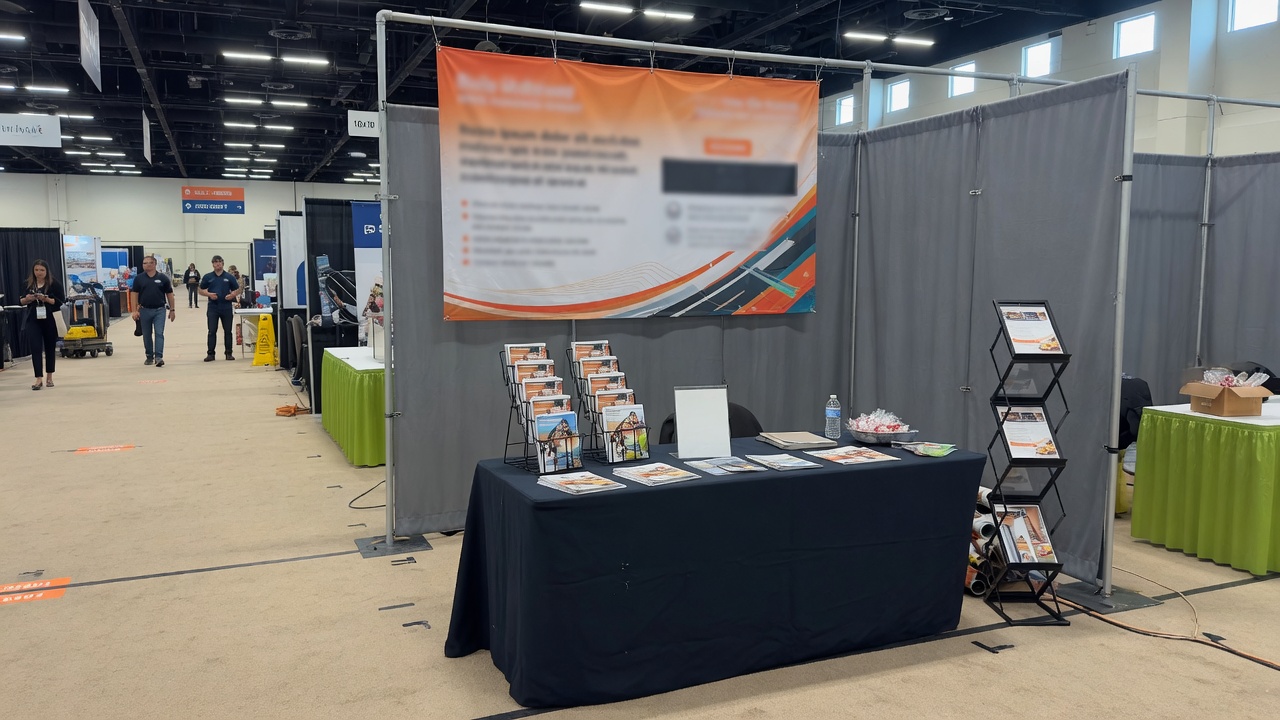
Trade show booth printing in Orange County is not the back wall. For Anaheim Convention Center, hotel shows, and OC halls, print the table throw, literature stand, floor graphic, hanging sign if the kit allows one, and the counter wrap. Guests touch those surfaces. The wall is the photograph behind them, not the whole booth.
The catalog shot is always a 20-by-20 island with a flying logo and a polished concrete floor. You are more likely to be in a 10-by-10 at the Anaheim Convention Center with a rented 8-foot table, a fire-hose column, and a carpet color you did not pick. That is why we quote booth printing as a kit: table throw, literature hardware, floor graphic, hanging sign if you are allowed one, counter wrap, plus the files that belong to each surface. The back wall is a different conversation. Avanti Printing at 15321 Barranca Pkwy, Irvine, CA 92618 prints the rest. Call (949) 387-0787 if you already own the hardware and only need new fabric.
This is the estimator version of that conversation. It is written for Irvine and Orange County buyers who will actually staff the booth. It is not a tour of backdrop sizes or frame systems, and it is not a substitute for the exhibitor kit. Quotes still confirm size, material, quantity, finish, and date.
Who is ordering the rest of the booth in Orange County
If you market a company, campus program, medical device, software line, or association anywhere from San Clemente to Brea, you already live on a calendar of rented rectangles: a 10-by-10 at the Anaheim Convention Center, a peninsula at a medical meeting in an ACC hall, a 6-foot table at a UCI indoor fair, a hotel ballroom in Irvine or Costa Mesa, a tabletop at a Spectrum-area office-park mixer. You already have a wall graphic in a case, or you have a purchase order for one. The booth still looks unfinished because the table is a gray rental, the literature is in a cardboard box, the floor is the hall carpet, there is no counter for lead capture, and the hanging sign you saw in a rendering was never legal for your booth type.
Typical buyers we talk to from Irvine, Tustin, Costa Mesa, Newport Beach, Santa Ana, Laguna Hills, Lake Forest, Huntington Beach, and Anaheim are not shopping “more graphics.” They are shopping the surfaces guests actually lean on, walk on, and take a brochure from. Marketing managers want a 4-sided throw that hides the crates. Sales directors want a locking counter so backpacks are not under a skirt. Exhibit coordinators want a hanging sign they are actually allowed to fly. Recruiters need a 6-foot throw that fits a campus table rule. Agency producers need floor graphics the venue will approve, not a vinyl they printed because it looked good in a mockup.
This is for you if you will set the booth up yourself, or hand it to a regional manager who has never steamed a throw. It is also for you if last year’s wall looked fine in photos and the booth still photographed like a storage unit. It is the wrong article if you need us to spec an 8-foot or 10-foot back-wall frame, a step-and-repeat, or an outdoor grommeted fence banner. We print those under the same roof. They are different jobs, different files, and in the case of backdrops a different article. Stay here for the furniture of the booth.
California buyers outside Orange County use the same 6-foot and 8-foot tables. The local twist is the venue mix: Anaheim Convention Center hanging and floor rules, hotel banquet packets that forbid adhesive on ballroom carpet, UCI table envelopes, Irvine Company interiors, and a freeway run from Barranca to Katella that will wrinkle a throw you stuffed in a grocery bag. Those conditions change product, not the fact that a table throw is not a wall, a floor graphic is not a rug you bought at a big-box store, and a hanging sign is not a wish you print and hope Encore will fly.
- In-house marketers at Irvine and South Coast office parks who exhibit two to six times a year at ACC, hotel meetings, and campus fairs.
- Medical, dental, biotech, and device teams walking into Anaheim halls with a 10-by-10 or a 10-by-20 and a rented table they forgot to brand.
- Software, industrial, and B2B firms with an island or peninsula who are allowed a hanging sign and have never ordered one with hanging points built in.
- Recruiters and campus teams who have a 6-foot table and no right to fly anything.
- Associations and nonprofits running a registration counter in a hotel pre-function, not a full exhibit hall booth.
- Agencies who already have the wall file and need honest specs for the throw, the floor, and the counter instead of stretching the wall PDF over a tabletop.
If the same show also needs a pull-up stand or an outdoor banner for a hospitality suite, put those on the request as separate lines. Mixing them into one “just make the booth look finished” instruction is how a table throw gets specified like outdoor vinyl, or a hanging fabric gets grommeted as if it were a fence. Start the kit conversation on trade show displays in Irvine and keep each surface on its own spec.
Anaheim, hotel shows, and OC halls write the rules
Start with the kit, then pick the print. A hanging sign that is legal over a 20-by-20 island at the Anaheim Convention Center is illegal over a 10-by-10 inline the next morning. A floor graphic ACC will approve on hall carpet can be a residue bill in a Newport hotel ballroom. A 4-sided throw that looks correct on an island table looks like a staff-in-a-bag trick when two people sit behind a 6-foot inline table. Read the exhibitor kit, the facility rules, and the general-service-contractor (GSC) manual. They are not the same document. We print to what you are allowed to install. We do not argue with floor managers.
Anaheim Convention Center
The Anaheim Convention Center is the largest indoor room most Orange County teams will ever exhibit in. Facility rules and show rules are not the same packet. The building controls public-area advertising, what you may attach to the premises, floor graphics on ACC carpet and exterior pavers, column protection, fire equipment sightlines, and who may connect to the ceiling. Show management — GES, Freeman, or the organizer — writes booth height, hanging-sign eligibility, aisle obstruction, and whether floor covering in the booth is mandatory. Encore is exclusive for certain rigging in the building. The GSC usually hangs exhibit-booth signs in the halls when the show allows it. Read both packets before you lock a flown logo.
Floor graphics on interior carpeted areas and exterior pavers must be approved by ACC. The material has to be anti-skid and non-residue. ACC’s event signage guidelines ask for a sample of the proposed material for testing and approval before install, and they list 3M Controltac Graphic Film IJ160 with an anti-skid laminate among approved constructions. That is a venue sentence, not a catalog nickname. If you want a floor graphic in an ACC public area or on a surface ACC controls, send the material so we can match a construction the building will test. If the graphic lives only on carpet you rented from the GSC inside your booth footprint, you still need the show’s floor-covering rules. Many Anaheim shows make professional floor covering mandatory in the booth and sell you aisle carpet only. A 3-by-4-foot logo decal in the middle of bare concrete is not “floor covering.” A peel-and-stick you bought because it was cheap is how you own a residue charge.
Floor graphics on interior carpeted areas and exterior pavers must be approved by the ACC. The material used must be anti-skid and non-residue. A sample of the proposed material is required for testing and approval prior to install.
Hanging signs are a booth-type privilege, not a print product you order because the rendering had one. Typical show language in this building follows the IAEE pattern: flown signs for island and peninsula booths, often with a square-footage floor (commonly 400 square feet, with some shows carving an exception for a 10-by-20 island), a setback from adjacent booths (commonly 10 feet), a maximum height to the top of the sign, and a ban on spanning the aisle. Linear and end-cap booths are usually told no. Halls and meeting rooms have no-fly zones and low-ceiling pockets. NAMM’s Hall E language is a useful warning even if you are not at NAMM: some rooms prohibit ceiling-suspended signs and cap height lower than the main halls. Encore’s rate language is also a useful warning: banners or signs over about 20 pounds may need a chain motor and truss; a scissor or boom lift is required to hang; connections to the ceiling are not a job for your regional manager with a ladder. Build hanging points when we make the sign. Label the hanging-sign case separately so it can go in before the booth is built.
Columns at ACC carry fire equipment. You may brand around a column. You may not adhere material to the column or hide a hose connection, strobe, or extinguisher. Tape, stickers, nails, and tacks on columns, walls, or the building floor are a damage bill. A printed column sleeve that stands on its own, leaves equipment visible, and does not glue to the building is a print conversation. A wrap you stick to the drywall is a facilities conversation you will lose.
Flame documentation is not a brochure line. Anaheim Fire & Rescue and the exhibitor kit will ask whether booth décor, upholstered items, and textiles are flame-retardant. Table throws, hanging fabric, and drape-like textiles are commonly asked to meet NFPA 701 test-method language, or to arrive with a mill certificate. That is a mill sheet, not a spray can in the loading dock. If the venue will ask, say so on the quote so we pull a fabric that has a sheet.
Hotel ballrooms and pre-function in Irvine, Anaheim, and Newport
Orange County business hotels — Irvine properties off the 405, Anaheim properties near the convention center, Newport and Costa Mesa meeting hotels — generally treat ballroom carpet and vinyl wallcovering as untouchable. No nails. No tape. Often no floor decals. A floor graphic that ACC will test on exhibition carpet can be a hard no on a patterned banquet carpet the hotel still has to rent next weekend. Ask the banquet event order before we print a floor. If the captain says no adhesive, we will not send you in with a roll of floor vinyl and a smile. Use a table throw, a counter, and a freestanding literature stand. Those leave no residue.
Hotel “booths” are often 6-foot tables in pre-function, not pipe-and-drape islands. The throw is the brand. The literature stand is a tabletop acrylic, not a 6-foot mesh tower. Hanging from the ceiling is hotel AV and a rigging yes you probably do not have. A retractable is a different product; if you need one, say so as its own line. Do not park a full-height pull-up on the table. Do not let the throw pool into the queue. Hotel event managers notice trip hazards faster than they notice your brand color.
Campus tables, office-park mixers, and indoor Spectrum-area events
UC Irvine indoor career fairs and similar campus events publish a table envelope, not a booth kit. Display space is commonly a 6-foot by 3-foot table. Freestanding banners, when allowed, are height-capped and must be weighted. You will not fly a hanging sign. You will not own the floor. You will own a 6-foot throw, a tabletop literature holder, and maybe a small counter or a tabletop graphic. Design the throw for a 6-foot table even if your ACC kit uses an 8-foot. Own two throws if you split venues, or own a convertible 6-to-8 throw with the hook-and-loop tabs actually used, not left in the bag.
Office-park conference rooms, Irvine Company interiors, and in-store pop-ups add landlord language. A throw on a table you take home is décor for a day. A floor graphic in a common corridor is a sign program. Spectrum common area is not your booth. If you are inside a lease line, a counter wrap and a throw are usually straightforward. If you want the piazza floor, start with the landlord, not the printer.
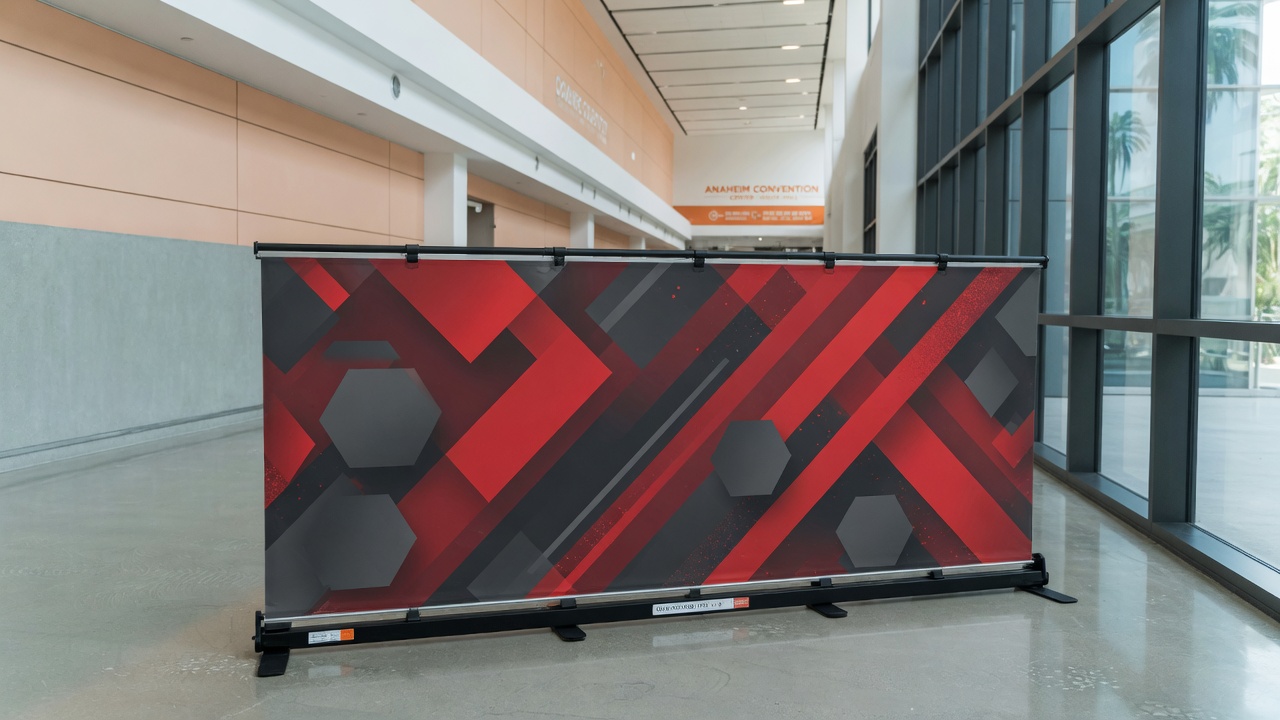
A map of the booth: print everything but the wall
Walk the rented rectangle before you design. A 10-by-10 inline has a back, two neighbors, and an aisle. The wall (whatever system you already specified) faces the aisle. The table or counter sits in the front third. Literature lives on the table or on a stand that does not eat the aisle. The floor is either GSC carpet, your overlay, or a graphic the venue will allow. There is no hanging sign. A 10-by-20 inline is the same logic, twice as wide, still no fly. A peninsula has aisles on three sides. An island has aisles on four. Those two geometries are where hanging signs, 4-sided throws, and counters that face more than one direction start to earn their keep.
Print the surfaces guests use. Do not print a second wall because the first one felt lonely. Two walls in a 10-by-10 is a closet. A throw, a literature stand, a counter, and a clean floor will photograph better than a second fabric panel you cannot set up in ninety minutes.
| Surface | What it is | Where it earns its keep in OC | Where it fails |
|---|---|---|---|
| Table throw / fitted cover / runner | Dye-sub fabric over a 4-, 6-, or 8-foot table | Almost every 10×10, hotel table, UCI 6-foot table | Wrong length for the rental table; 4-sided when staff sit behind it |
| Literature stand / brochure holder | Tabletop acrylic, mesh pocket rack, or graphic kiosk | Lead capture, catalogs, 8.5×11 sell sheets | Aisle obstruction; a 6-foot tower in a 10×10 |
| Floor graphic / carpet overlay | Anti-skid vinyl, printed carpet, or GSC-rented covering | Islands, ACC booths that require covering, wayfinding inside the footprint | Unapproved adhesive on ACC or hotel carpet; graphics in the aisle you did not buy |
| Hanging sign | Flown fabric or framed graphic with hanging points | Island and peninsula booths the kit allows, usually 20×20 and up | 10×10 inline; no-fly halls; signs with no points and no weight |
| Counter / podium wrap | Locking reception counter, portable case-to-counter, lectern graphic | Lead capture, storage, a writing surface that is not a folding table | A 6-foot throw on a 42-inch counter; logo on the worktop under laptops |
Read the table as a filter, not a shopping list. A UCI 6-foot table needs a throw and a tabletop holder. A hotel registration island needs a counter wrap and a 4-sided throw if people walk behind it. An ACC 10-by-10 needs a throw or a counter, literature that stays inside the pipe, and floor covering the kit requires — not a hanging sign. An ACC island needs the hanging sign, the floor, the counters, and throws on any tables you still use. If the job is to own the field of view at the back of the booth, that remains a trade show display conversation for the wall system. This page is the rest of the kit.
Quantity is part of the map. One 8-foot throw does not become a 6-foot throw. Two literature stands do not become a kiosk. Four floor circles do not become a floor covering. Order the unit that matches the rectangle, then order a spare throw if you split 6-foot and 8-foot venues. Do not order forty of anything because the wall quote “felt light.”
Table throws, fitted covers, runners, and 3-sided versus 4-sided
The table is the most touched surface in a small booth and the most often left as a gray rental. A throw is dye-sublimated fabric cut and sewn for a folding table. A fitted cover is the same idea with sewn corners so it looks like upholstery. Stretch (sometimes called flex) is a knit that hugs the table. A runner is a printed strip down the top, usually over a plain cloth you already own. None of these is a banner. None of them is a wall. Spec them as table products.
Standard North American exhibit tables are typically 29 to 30 inches high. Lengths we quote against every week:
| Table | Typical footprint | Cover style that usually fits | Typical OC use |
|---|---|---|---|
| 4-foot | About 48 in long by 24 in deep | 4-foot throw, fitted, or tall 36 in demo table cover | Side table, demo, hotel registration overflow |
| 6-foot | About 72 in long by 30 in deep | 6-foot 3-sided or 4-sided throw, fitted, stretch | UCI tables, many hotel tables, compact 10×10 |
| 8-foot | About 96 in long by 30 in deep | 8-foot 3-sided or 4-sided throw, fitted, stretch | Default GSC table in many ACC 10×10 packages |
| 6-to-8 convertible | Tabs convert an 8-foot throw down to 6-foot | Throw with hook-and-loop, not a fitted | Teams that split campus and ACC weekends |
Confirm the table in the kit. Many Anaheim 10-by-10 packages include an 8-foot table. Campus fairs include a 6-foot. Hotels mix both, plus 18-inch-deep classroom tables that will make a 30-inch-deep fitted cover look drunk. A 6-foot throw on an 8-foot table is short on the ends. An 8-foot throw on a 6-foot table pools on the floor and becomes a trip. Fitted and stretch covers do not forgive a wrong length. Throws forgive a little and still look sloppy if you are a foot off. Measure, or tell us which kit table you are taking. We will not guess from last year’s PO.
3-sided versus 4-sided
A 3-sided (economy, open-back) throw covers the front and the two ends and leaves the back short or open so staff can sit, store crates, and kick a bag underneath without wearing the graphic as a skirt. That is the correct default for an inline 10-by-10 where the table is against the wall or the staff live behind it. A 4-sided (full) throw covers all four drops. That is the correct default for an island table, a peninsula table guests walk around, a hotel registration island in the middle of a foyer, or any table whose back is visible from an aisle. A 4-sided throw on an inline table with two people in chairs behind it is a staff-in-a-bag look. A 3-sided throw on an island table is a view of folding-table guts. Pick from the walk-around, not from which SKU sounded premium.
Throw versus fitted versus stretch versus runner
Throws drape. They pack small. They hide a table that is not quite the size you expected. They wrinkle, they kick, and they look like tablecloths because they are tablecloths. Fitted covers have sewn corners and a cleaner line. They want the table they were cut for. Stretch covers look contemporary and fight wrinkles if the knit and the table agree. They can shine under hall lights and they can bag if the table is a cheap rental with a thinner top. Runners are a printed path down the center; they assume you already have a floor-length cloth in a brand color. A runner on a naked folding table is a place mat.
If you exhibit once a year on a GSC table, a 3-sided throw in the kit length is the honest product. If you exhibit monthly and photograph the booth, a fitted or stretch in the correct length is the honest product. If you own a black cloth and only need the logo, a runner is the honest product. Do not order stretch because a catalog called it wrinkle-free if you will stuff it in a backpack. Dye-sub polyester still takes a crease. Budget a handheld steamer in the crate. Hotel irons exist. Hotel irons also shine a logo if you crank the heat. Steam. Do not iron a face-down logo on a wood dresser.
Fabric, dye-sub, flame, and what to put on the drop
We typically print table throws on polyester made for dye-sublimation — a typical industry range is about 6 to 9 ounces per square yard, not a secret mill. Dye-sub dyes the fiber. The color is in the cloth, not sitting on top like a banner ink. That is why throws pack, why they can be steamed, and why they are the wrong product to grommet and hang on a fence. Indoor exhibit fabric is not outdoor vinyl. If you need a grommeted banner for a hospitality patio, that is banner printing in Irvine, a different media and a different finish.
Ask for a mill sheet if the hall will ask about NFPA 701. Treated fabrics and inherent-FR polyesters are not the same chemistry. Both can carry a sheet. A spray can in the marshalling yard is not a sheet. Do not tell a fire inspector you “think it was treated.” Bring the paper.
Design the throw as a box that gets unfolded, not as a poster that happens to be wide. The front drop is the hero — typically about 72 or 96 inches wide and about 29 to 30 inches high, minus sewn hems and the part that sits on the tabletop edge. The tabletop itself is a work surface. Laptops, water bottles, literature, and elbows will sit on the logo if you put the logo in the center of the top. Put the brand on the front drop, repeat a smaller mark on the ends if they face an aisle, and keep the top as a quiet field or a light pattern. Corners eat graphic. Fitted and stretch covers have seams at the corners; do not park a URL on a corner seam. Economy 3-sided covers have a short back; do not put legal copy on a back that does not exist.
Safe zones and bleed belong on the template for the size you ordered, not on a 10-foot wall file you cropped in the RIP. Dye-sub at this size is typically built at 100 to 150 dpi at final size. Vector logos. No 72 dpi web PNG of the homepage hero stretched across 126 inches of fabric. We will say no, or we will print a soft logo on the one surface every guest’s chair is two feet from.
Literature stands and brochure holders that do not eat the aisle
Literature is not décor. It is a stack of 8.5×11 sell sheets, 4×9 cards, catalogs, or a QR easel that has to live somewhere that is not the floor. The print job is the holder and any graphic on the holder. The paper inside is a commercial-print job. Do not send us a PDF of a brochure and ask us to “make a stand.” Send the stand spec and, separately, the brochure spec.
Three products get called a literature stand in the same email:
- Tabletop acrylic. Single or multi-pocket holders for 8.5×11, trifold, or 4×9. They sit on the throw. They are the right scale for a 6-foot table and a hotel registration cloth. They do not need a graphic wrap. They do need a weighted base or a wide foot so a hip does not walk them onto the aisle carpet.
- Mesh pocket racks. Floor-standing or tabletop black mesh with four to a dozen pockets. Cheap, light, ugly if you let them stand in the aisle, useful if you have many SKUs. They do not take a full graphic wrap. They take a small header if the model has a header panel. Weight the bottom. A mesh rack in a hall HVAC blast is a sail.
- Graphic literature kiosks. A rigid or fabric-wrapped body with pockets and a branded face. This is the print conversation: a panel guests see at arm’s length, so type and photos want about 150 dpi at size, not the 100 dpi you used on a hanging sign they read from forty feet. Footprint matters. A 20-inch-deep kiosk in a 10-by-10 that already has a table and two people is how you stand in the neighbor’s air.
Aisle etiquette is the product. If a guest has to stand in the aisle to take a sheet, the stand is in the wrong place. Keep the face of the holder inside the booth line. Inline booths have about ten feet of frontage and eight to ten feet of depth; the front two feet are for conversations, not for a rack. Islands can put literature on a counter in the middle. Do not line the entire aisle edge with pockets. Floor managers will ask you to pull it back. You will then have a rack with no home, and you will put it on the table, on top of the throw, on top of the laptop.
Header graphics on a kiosk are close-viewing surfaces. Vector logos, real type, a QR large enough to scan at arm’s length on a quiet field. Do not reprint the back wall at 20 percent on a 12-inch header. The wall is a silhouette. The header is a label. If you also need posters for a hotel foyer the night before the show, that is a poster spec, not a literature spec. Keep the holder on this list.
Hardware you already own: send a photo with a tape on the header panel. We can print a replacement face. We cannot invent pockets. If the rack is bent, replace the rack. A perfect new header on a leaning mesh tower still looks like a leaning mesh tower.
Floor graphics, carpet overlays, and what ACC will actually allow
The floor is either a covering or a graphic. Covering is the kit’s mandatory carpet, carpet tile, or vinyl you rent or bring so the booth is not raw concrete. Graphic is a printed message on that floor. Shows that say “professional floor covering is mandatory” are talking about covering. They are not asking you to sticker a logo on the GSC’s aisle carpet. Mixing those two sentences is how you buy a residue bill and still get forced carpet at show-floor rates.
Inside the contracted footprint, typical options we print or coordinate:
- Printed carpet or carpet tile. Dye or printed pile you roll or tile inside the booth. It is covering and graphic at once. It is freight. It is not a sticker. Edges still want a clean transition so the aisle lip is not a trip.
- Carpet overlay / floor vinyl with anti-skid laminate. Printed vinyl on a removable adhesive, laminated for scuff and slip, applied to a smooth or low-pile surface. This is the construction ACC’s public-area language is talking about when they name Controltac IJ160 plus anti-skid laminate. It is not automatically legal on every surface. Hotel ballroom carpet, plush GSC carpet, and unsealed concrete are different adhesions. Test. ACC wants a sample for surfaces they control.
- GSC-rented carpet plus a small decal. A logo circle or a runner inside your booth on top of rented carpet. Some GSCs and venues forbid adhesive on their carpet. Some allow a specified removable. Ask before we print an 8-foot circle you cannot put down. Damage to rented carpet is billed in minimum lots, not in the size of your logo.
Outside the footprint — the aisle, the lobby, the exterior pavers — you are in ACC or show-management advertising, not in booth furniture. ACC’s event signage guidelines require approval for floor graphics on interior carpeted areas and exterior pavers, anti-skid and non-residue material, and a sample for testing. Exhibitor kits commonly forbid applying decals to the building floor, columns, or walls. An arrow in the aisle pointing to booth 1247 is a sponsorship or a no. Do not print it as a surprise.
Slip is not a texture you add in Photoshop. Anti-skid laminate is a specified film. Bare printed vinyl is a skating rink in a hall with spilled water. Edges lift first. A lifted edge is a trip. Round corners, keep the graphic inside the booth, and do not run a 1/16-inch film up to the aisle line where every rolling bag will catch it. Raised platforms and thick overlays have their own bevel and height rules; those are construction, not a print we tape down at 7:40 a.m.
Removal is part of the spec. Removable adhesive on the wrong pile leaves a ghost or a sticky strip. Permanent adhesive on a floor you do not own is how you meet the GSC at close. Tell us the surface: ACC public carpet, GSC booth carpet, hotel ballroom, sealed concrete, exterior paver. Tell us the duration: a three-day show is not a six-month retail floor. Indoor floor-graphic programs are often quoted in months of wear, not in years. Show traffic in an ACC aisle is harder than a hotel foyer. We will spec a laminate for the traffic. We will not promise a sticker you pull off with one hand on Sunday afternoon if you put a permanent adhesive on plush carpet.
Copy on the floor is read by people looking at faces. A paragraph on the floor is a paragraph nobody reads. A logo, a product silhouette, a booth number if you are an island, a short claim. QR codes on the floor get stood on. Put the code on the counter or the literature. Keep floor type large. Viewing distance is two to eight feet and straight down. 100 to 150 dpi at size is a typical industry target for this product. Vector marks. No 72 dpi app icon blown up into a 6-foot circle.
Quote table throws, floor graphics, and counters
Hanging signs you may not be allowed to hang
A hanging sign is a graphic that flies over the booth, or that is supported from below to the same height, so it can be read down the aisle. It is not a back wall. It is not a retractable. It is not a pipe-and-drape banner you S-hooked to the crossbar. If the kit does not give you air rights, stop sketching one. We will still print a header for the wall system you already own. We will not sell you a flown circle for a 10-by-10 that the floor manager will ground.
Typical eligibility, said as typical show language rather than as a promise about your next ACC event:
- Island and peninsula booths are the usual yes, often only above a square-footage floor such as 400 square feet (a 20-by-20), with some organizers carving exceptions for true 10-by-20 islands.
- Linear, end-cap, and many split configurations are a no. Perimeter booths get height, not always a fly.
- Double-sided signs are commonly set back about 10 feet from adjacent booths so you are not advertising into the neighbor.
- Maximum height is measured to the top of the sign, not to the bottom of the drop. Sixteen to twenty feet to the top is a familiar range. Your kit is the number. Hall E and low-ceiling pockets can be lower or a full no-fly.
- Nothing spans the aisle. Nothing attaches to the building except through the official rigger.
At ACC, connections to the ceiling in designated areas go through Encore or through the GSC for exhibit-booth work in the halls, depending on the room and the show. Exhibitors do not bring a ladder and a fishing line. Submit drawings, weight, hanging-point layout, and the method of install on the organizer’s timeline — often 30 to 60 days out, sometimes earlier. Signs over about 20 pounds can pull chain-motor and truss language. Lifts have white non-marking tires. Carpet gets masonite. This is labor and facility, not ink. Budget it as a line, or do not order the sign.
What we actually print for a flown sign
Two constructions do most of the work. Tension fabric — a pillowcase or zipper skin over an aluminum frame — is the current default: light, packable, double-sided, sewn with hanging points or hardware plates the rigger can actually use. Vinyl or fabric banners with pole pockets, flown on a rod or a small truss, are the older construction; they still make sense for a simple two-face rectangle if the rigger wants a bar. Rigid panels (foam, PVC, ACM) only fly if they are framed, have rated points, and the weight is honest. An unframed 4-by-8 foam board on aircraft cable is how you meet a safety officer.
Build hanging points at manufacture. Do not send a finished pillowcase to the hall and ask the rigger to “find a place for carabiners.” Label the case “HANGING SIGN — INSTALL FIRST” with show name, booth number, and weight. Flown signs go in before the booth is built. A sign buried in the wall-system crate arrives on Tuesday afternoon.
Copy is a silhouette. People read a hanging sign from 40 to 80 feet, past truss, banners, and everyone else’s circle. Company name or mark, maybe one short claim, maybe a booth number. Body copy does not belong in the air. Photographs of faces at this scale only work if the file has the pixels and the face is not the size of a postage stamp from the entrance. 100 to 150 dpi at final size is a typical industry target for a sign this large; 150 is not a religion if the viewing distance is a hall length. Vector marks still win. Dye-sub fabric wants CMYK, outlined fonts, and bleed around the sewn edges and zipper. All faces print. A beautiful front and a white back is a billboard for whoever stands behind you.
If you do not have air rights, put the same short mark on a counter face and on the table throw. That pairing reads from the aisle without a lift. If you need a large indoor banner that hangs on hardware you already control inside the booth — a truss you brought, a header bar — say so. That can be a banner printing or fabric-graphic line, still not a facility-flown sign, and still not a back-wall size conversation.
Counters, reception pods, and podium wraps
A counter is a writing surface with storage, usually about 40 to 42 inches high, that faces the aisle so you can badge-scan without turning your back on the hall. A folding table is 29 to 30 inches high and asks guests to look down at your laptop. If you are capturing leads, a counter is the better piece of furniture. If you are demonstrating a small device, a 4-foot table or a pedestal may be better. If you are doing both, do not cover the counter with a 6-foot table throw. The drop length will be wrong, the top will bag, and the locking door will be under fabric.
What we print:
- Graphic wraps for portable counters. Many case-to-counter systems take a fabric or magnetic graphic on the front and sides. Measure the hardware you own. “Reception counter” is not a standard the way a #10 envelope is a standard. Send the make, model, or a tape on the panel.
- Rigid counter faces. Direct print or mounted graphic on a flat face, often with a laminate because this surface is hip height in a crowded aisle. Satin, not a mirror, under hall lights.
- Podium and lectern wraps. Hotel-owned lecterns often cannot be wrapped. Yours can. Keep copy off the reading shelf.
- Pedestal wraps. Small cubes or cylinders for a product. Four faces if guests walk around. Top is a product surface; do not put the only QR on the top under the device.
Storage is the reason to own a counter. Locking cabinets hide bags, literature overstock, samples, and the throw you are not using that hour. Open shelves facing the aisle hide nothing. If the counter is also the charging station, say so; cutouts and cable exits are a hardware problem we need to see before we print a full-bleed photo over the grommet hole.
Design at arm’s length. Guests stand two to four feet from a counter. That is closer than a hanging sign and closer than a back wall. 150 dpi at size is a reasonable target for photographs. Vector logos. Type that works as a label, not as a paragraph. Put the mark at standing eye line on the front face — roughly the upper third of a 40-inch counter — not on the kick plate and not on the worktop. The worktop gets water, badges, and laptops. A laminated worktop is a finish. A printed worktop is a coaster.
Footprint: a 4-foot-wide portable counter is a guest and a staffer. It fits a 10-by-10 without pretending to be a bar. A 6-foot or 8-foot reception is a peninsula or island piece. Two counters on an island can face two aisles. Do not clone a 10-foot bar into a linear booth and then complain you have no room for literature. Pick furniture that leaves a conversation space inside the pipe.
Hotel registration is a counter job even when the hotel gives you a 6-foot table. If you cannot bring a counter, a fitted 4-sided throw on that table plus a tabletop literature holder is the honest substitute. If you can bring a portable counter, bring it. Guests know the difference between a folding table and a desk even if they cannot name the hardware.
Files, dpi, and what belongs on each surface
Artwork is where otherwise careful exhibitors lose a day. The wall file is not the throw file, is not the floor file, is not the hanging-sign file, is not the counter file. Different crops, different viewing distances, different sewn edges, different hardware bites. Send each as its own layout at its own size, in CMYK, with fonts outlined or packaged, and with bleed as extra image — not as a white strip you assumed we would add.
Resolution is a viewing-distance problem, not a religion. Typical industry targets we actually use:
- Table throw, counter face, literature header: about 150 dpi at final size. People are at arm’s length. 100 dpi can hold a soft background. 72 dpi web images look like 72 dpi web images on a table guests rest their hands on.
- Floor graphic: about 100 to 150 dpi at size. People look down from two to eight feet. Huge type, simple mark. Anti-skid laminate will slightly soften fine serifs anyway.
- Hanging sign: about 100 to 150 dpi at size, judged from the aisle, not from your nose on the proof. A 10-foot-wide circle does not need 300 dpi. It needs a mark that reads at 60 feet and a file that will actually transfer.
Do the math before you crop a phone photo. A 6-foot 4-sided throw graphic is often on the order of 120-plus inches in one dimension once you unfold the box. At 150 dpi that is a large raster. Vector the logo. Photograph only what you can feed. A hanging-sign face at 8 by 8 feet at 150 dpi is 14,400 pixels on a side — also a large raster, and also wasted if the only content is a wordmark that should have been outlines.
Safe zones:
- Throws: keep URLs and legal off corner seams, off the tabletop, and off the short back of a 3-sided cover. The front drop is the live area.
- Counters: keep marks out of door splits, lock hardware, and the top two inches if a cap or a monitor arm sits there. Send a hardware template if you have one.
- Floor: keep copy out of the last inch of edge, off seams between tiles, and off any bevel. Round the art corners if we are rounding the cut.
- Hanging signs: keep copy off zippers, grommet lines, and the pocket for the frame. All faces need the mark. A silent back is a missed aisle.
Color is CMYK unless we have a reason to pull a spot. Hall lighting is mixed: metal halide, LED, warm hotel cans, daylight at open bay doors. A logo that looks correct on a calibrated monitor in an Irvine office park will shift. Contrast beats a perfect Pantone that disappears at 40 feet. Dye-sub on polyester, UV on a rigid counter, and latex or UV on floor vinyl will not spectro-match each other under two different lights. Send one brand mark and accept “close” across substrates, or pick one hero surface and keep the others as color fields plus the mark. Forcing the same photograph onto throw, floor, and counter is how you own three different versions of the same disappointment.
File delivery: PDF/X or a flattened high-quality PDF is fine if fonts are outlined and images are embedded. Native AI or INDD with packaged links is better if you want us to move a lock off a zipper. Do not send a Google Slides deck as a 12-foot document. Do not send a JPEG from a group chat. Do not send the wall file with a note that says “use this for the table too.” If the only art you have is a brand-portal PNG, say so early so we can tell you whether it is usable on a counter and unusable on a hanging sign.
This is booth-kit dpi for throws, floors, hanging signs, and counters, not a lecture on every wide-format file we take. A window film, a fleet graphic, and an 8-foot table throw do not share a pixel count. Keep those jobs on large format printing in Irvine as their own lines.
Mistakes that become reprints or a floor-manager conversation
Most reprints we see on booth kits are not RIP errors. They are the wrong table length, adhesive on a floor nobody approved, a hanging sign for a booth type that cannot fly, and leftover dates on a throw someone pulled from a closet. This is the short list we would rather walk through before we print.
- A 6-foot throw on an 8-foot GSC table. Short ends, exposed rental, photographs that look unfinished. Confirm the kit table. Own a convertible or own two sizes.
- A 4-sided throw on an inline table with chairs behind it. Staff sit inside the graphic. Order 3-sided when people live behind the table.
- The wall PDF stretched over the throw. Seams land on faces, the logo sits on the tabletop under a laptop, and the dpi story falls apart. Separate files, separate templates.
- A hanging sign over a 10-by-10 linear. The kit said no. The rendering said yes. The floor manager said pull it. Check booth type before we sew hanging points.
- A hanging sign with no points, no weight, and no rigger order. We can print a pillowcase. We cannot invent a fly program the day before open.
- Floor vinyl on ACC or hotel carpet without approval. Residue, a test you skipped, a covering mandate you did not meet. Sample the construction. Cover the footprint if the kit requires covering.
- Floor graphics in the aisle. You did not buy that space. Arrows pointing in from the aisle are a sponsorship or a no.
- Bare vinyl on the floor, no anti-skid laminate. Slip, scuff, lifted edges, a trip. Floor graphics are a laminate product.
- A 6-foot mesh literature tower in a 10-by-10. Guests stand in the aisle to take a sheet. Use tabletop acrylic or a shallow kiosk inside the line.
- A table throw used as a counter wrap. Wrong height, baggy doors, a lock you cannot find. Measure the counter. Print a counter graphic.
- Logo on the worktop and the kick plate, nowhere at eye line. Guests see a laptop and a vacuum mark. Put the brand on the front face.
- No mill sheet for a hall that asks NFPA 701. The throw sits in a crate while you argue with an inspector. Ask us for the sheet when you ask for the throw.
- Web-resolution photography on a close-viewing surface. A 1200-pixel hero on a counter or a throw is soft at arm’s length. Vector the mark. Replace the photo.
- Leftover old graphics. Last year’s booth number, an expired claim, a co-brand from a joint island. Label bags. Read the throw in the parking lot. Tape-over letters on fabric look like tape-over letters. Reprint.
- Stuffing a throw in a grocery bag for the Barranca-to-Katella run. Permanent creases. Steam is a tool, not a miracle. Pack it folded on the sewn lines in its bag.
- Adhering anything to an ACC column. Fire equipment, building finish, a damage bill. Sleeve, do not stick.
Dates and booth numbers deserve their own paragraph. Throws and hanging signs outlive the show they were printed for. Sales teams are loyal to “the black bag in the closet.” The bag does not know you moved from booth 412 to 1805. We have seen hanging circles flown with last year’s hall, throws with a discontinued product name, and counters with a QR that 404s. If you reprint often, keep a thumbnail taped inside the case. If you do not reprint often, read every surface in the marshalling yard. We can turn a replacement throw quickly when the file is already built to the template. We cannot fix a Tuesday open that is already using last year’s cloth.
Wrinkles deserve the other paragraph because they get blamed on the printer. Dye-sub polyester wrinkles in a crate, in a hot car, and in a bag that sat under a rolling case. Steam on site. Hang the throw over a chair in the hotel room overnight if you can. Stretch covers fight wrinkles better and still take a fold if you pack them wet. Deep creases from a rubber band are not a RIP error. That is a reprint, and it is usually packing.
What to send so the quote is real
A useful quote for booth printing besides the wall names each surface, the live size, the material, the quantity, the finish, the venue rules, and the date you need it. “Need booth stuff for Anaheim next week” is a voicemail, not a spec. Send the following to Avanti Printing and we can price without twenty questions. Walk-ins at 15321 Barranca Pkwy, Irvine, CA 92618 are fine if you bring the old throw or the counter. Phone is (949) 387-0787.
- Venue and date: ACC hall or show name, hotel, campus fair, office mixer, plus the first day you will set up. Attach the exhibitor kit pages for hanging signs, floor covering, and table size if you have them.
- Booth type and size: 10×10 inline, 10×20, peninsula, island, tabletop. This decides hanging, 3-sided versus 4-sided, and whether a counter fits.
- Table: 4-foot, 6-foot, 8-foot, convertible; 3-sided or 4-sided; throw, fitted, or stretch; runner yes/no. If the kit table is unknown, say so.
- Literature: tabletop acrylic, mesh rack, graphic kiosk, header size, pocket sizes (8.5×11, 4×9, trifold).
- Floor: covering versus graphic, surface (ACC public carpet, GSC carpet, hotel, concrete, paver), anti-skid laminate, whether a sample must go to ACC, dimensions inside the footprint only.
- Hanging sign: allowed or not, size and shape, double-sided, weight target, hanging-point drawings, rigger (Encore/GSC), deadline for the hanging-sign form.
- Counter: portable wrap, rigid face, podium, pedestal; make and model or a tape on the panel; locking door and cable exits.
- Finish: satin versus gloss on rigid and floor laminate, mill sheet for NFPA 701 if the hall asks, edge treatment.
- Quantity: identical versus versioned (English/Spanish, two product lines, two booth numbers).
- File status: vector logo, photos at the dpi above, or “we have a PNG and a hope.” Separate layouts per surface.
- Pickup or delivery: Irvine pickup is simplest. Advance warehouse and ACC exhibitor services need show labels, booth number, and a date the hanging-sign crate can arrive before the wall.
Quotes confirm size, material, quantity, finish, and date. If any of those five is missing on any surface, the number you see is a guess. The kit is how booth jobs miss the five even when the PDF looks done. Rush exists when the fabric is in house, the file is clean, and you can pick up in Irvine. It does not exist when the hanging-sign form was due last month and the logo is a screenshot.
If you need matching outdoor banners, window film, or a cassette stand for the same trip, put those on the same request as separate lines. Different media, different finishing, different files. Mixing them into one “just like the booth but bigger” instruction is how outdoor vinyl ends up specified like a throw, or a floor graphic ends up with fence grommets. Keep the kit under the same PrintBig Irvine roof, on separate specs.
Send booth kit notes and files for a quote
Frequently asked questions
What should I print besides the back wall for an Orange County show?
Print the surfaces guests use: a table throw in the kit table length, a literature holder that stays inside the booth line, floor covering or a floor graphic the venue will allow, a hanging sign only if the kit gives you air rights, and a counter wrap if you are capturing leads. A 10-by-10 inline at ACC usually needs a throw or a counter, literature, and covering — not a flown logo. A hotel table needs a throw and a tabletop holder. An island needs the hanging sign, the floor, and 4-sided furniture. Quotes still lock each surface separately.
Do I need a 6-foot or an 8-foot table throw?
Match the table in the exhibitor kit, not the table in last year’s photo. Many Anaheim 10-by-10 packages include an 8-foot table. Campus fairs and many hotel mixers use a 6-foot. Fitted and stretch covers do not forgive a wrong length. Throws forgive a little and still look short or pooled. If you split ACC and UCI weekends, order both lengths or a convertible 6-to-8 throw and use the tabs. Tell us 3-sided if staff sit behind the table, 4-sided if guests walk around it.
Can I install floor graphics at the Anaheim Convention Center?
Inside your contracted booth, follow the show’s floor-covering rule first — many shows make covering mandatory and sell aisle carpet only. Adhesive on GSC carpet may be restricted. On ACC-controlled interior carpet and exterior pavers, ACC requires approval, anti-skid non-residue material, and a sample for testing; their guidelines name constructions such as 3M Controltac IJ160 with anti-skid laminate. Do not print an aisle arrow. Do not assume a hotel ballroom will take the same adhesive. Send the surface and the kit page with the quote.
Can I hang a sign over a 10-by-10 booth?
Usually no. Typical IAEE-style language at Anaheim shows reserves flown signs for island and peninsula booths, often above a square-footage floor, with a setback from neighbors and a height cap to the top of the sign. Linear booths keep structure at the back and keep the aisle sightline. If the kit says no, put the mark on the throw and the counter. If the kit says yes, we will build hanging points, print all faces, and you will still need the official rigger and the hanging-sign form on their deadline.
Do table throws and hanging fabric need to be flame retardant?
Halls and Anaheim Fire & Rescue commonly ask for flame documentation on décor textiles. Table throws, hanging fabric, and drape-like cloth are the items that get asked. We pull mill sheets that speak to NFPA 701 when you tell us the venue will ask. A spray treatment in the marshalling yard is not a mill sheet. Rigid counters and laminated floor vinyl are a different fire conversation. Say the venue on the quote so we spec the cloth, not a hope.
What resolution do you need for a throw versus a hanging sign?
Vector logos and type on every surface. Photographs at about 150 dpi at final size for throws, counters, and literature headers — arm’s-length viewing. Floor graphics about 100 to 150 dpi at size with large type. Hanging signs about 100 to 150 dpi at size, judged from the aisle, not from your nose. 72 dpi web JPEGs fail first on the throw because guests sit two feet from it. CMYK PDF with fonts outlined, bleed past sewn edges, separate files per surface. If 150 dpi at size makes the photo look bad on your screen, it will look worse under hall lights.
Can you print new graphics for hardware I already own?
Yes. A large share of Irvine booth jobs are replacement throws, counter wraps, hanging skins, and literature headers, not new furniture. Bring the hardware or send the make, model, and a photo with a tape. Portable counters and literature kiosks do not share templates. If the counter is cracked or the mesh rack leans, replace the hardware first. A perfect new wrap on a leaning counter still looks like a leaning counter.
Should I use a counter or a 6-foot table in a 10-by-10?
Use a counter if you are scanning badges and you need locking storage. Use a 6-foot or 8-foot table if you are spreading devices, samples, or literature across a work surface and the kit already includes the table. Do not do both in a 10-by-10 unless one of them is a small side pedestal. Do not put a table throw on a 42-inch counter. Measure the piece you will actually staff. Hotel registration can go either way; a portable counter photographs like you meant it, a fitted throw on a hotel table is the honest substitute when you cannot freight a case.
Finish the booth guests actually stand in
Trade show booth printing in Orange County fails when you spend the budget on a wall and walk into Anaheim with a gray rental table, a cardboard literature box, a floor the kit required you to cover, and a hanging sign you were never allowed to fly. It works when you spec the throw to the kit table, the literature to the aisle line, the floor to ACC or hotel language, the hanging sign to air rights you actually have, and the counter to the conversation you want to have.
Bring us the kit, the hardware, and the files. Avanti Printing, 15321 Barranca Pkwy, Irvine, CA 92618, will spec table throws, literature headers, floor graphics, hanging skins, and counter wraps against that room, pull a mill sheet when the hall will ask, and leave the back wall as the back wall. Call (949) 387-0787 or send the quote form with size, material, quantity, finish, and date for each surface. We will tell you if you should have ordered a wall system instead. For the jobs in this article, you already have a wall. Print the rest of the booth.