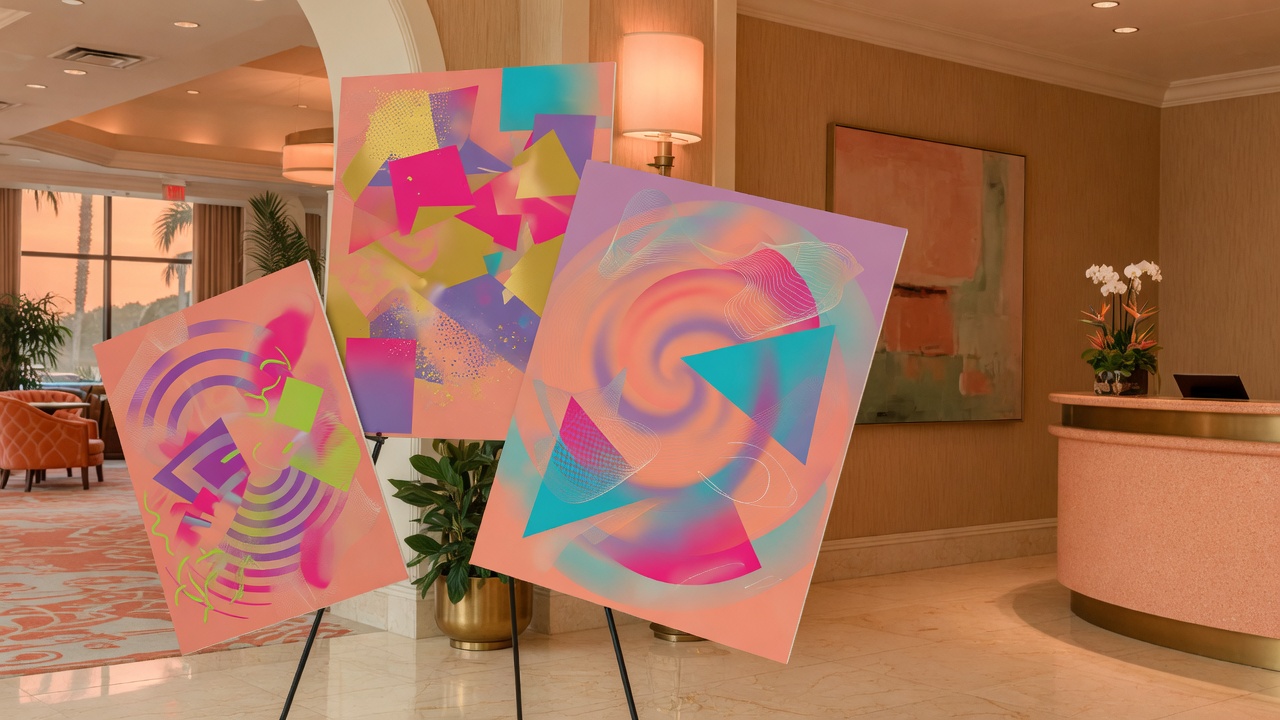
Poster printing in Orange County for events is usually an 18×24 or 24×36 sheet on paper, mounted to foam board, or printed on indoor fabric so you can hang it. Use 18×24 on UCI bulletin boards and tabletop easels. Use 24×36 on hotel floor easels. Pick the substrate from the hang method.
The catalog shot is always a 24×36 in a white gallery with a floating frame. You are more likely to clip it onto a hotel easel that is missing a rubber foot, pin an 18×24 to a cork board that already has six other 18x24s, or carry four boards from a Barranca parking space into a ballroom that will not let you touch the vinyl wallcovering. That is why we quote event posters as a system: live size, paper or board or fabric, thickness, laminate, hang method, quantity, and a file that survives the viewing distance. Avanti Printing at 15321 Barranca Pkwy, Irvine, CA 92618 prints and mounts them. Call (949) 387-0787 if you already know it is 24×36 foam board and only need us to match last quarter’s satin.
This is the estimator version of that conversation. It is written for Irvine and Orange County buyers who will actually carry the stack into a building. It is not a tour of every large-format product we print, and it is not a scientific-poster kit for a 42-inch session board unless that is the size you send. Quotes still confirm size, material, quantity, finish, and date.
Who is ordering event posters in Orange County
If you market a company, campus program, medical practice, nonprofit, or product line anywhere from San Clemente to Brea, you already live on a calendar of rooms that will not take a nail: a hotel breakfast briefing in Anaheim, a table at the UCI Student Center, a lobby day in an Irvine office park, a weekend activation inside a Spectrum shop, a user group in a Costa Mesa hotel ballroom. You need a graphic that reads from 6 to 12 feet, stands without becoming architecture, and comes down the same night. That is the job of an event poster — usually 18×24 or 24×36, usually foam-board mounted if it has to stand, paper if it has to pin, fabric if it has to hang from a pole.
Typical buyers we talk to from Irvine, Tustin, Costa Mesa, Newport Beach, Santa Ana, Laguna Hills, Lake Forest, and Anaheim are not shopping “a print.” They are shopping a portable indoor graphic they can reuse or throw away on purpose. Marketing managers want ten 18×24 paper posters for campus boards and four 24×36 foam boards for the hotel foyer. Recruiters need something that fits a 6-foot table rule without pretending to be a booth wall. Hotel-event planners need a unit that will not scuff marble or leave adhesive. Startup founders need two boards that fit in a hatchback with a tablecloth. Agency producers need a fabric hanging panel when the banquet captain has already said no tape and no easels in the sightline from the stage.
This is for you if you will set the poster up yourself, or hand it to a sales rep who has never seen an easel clip. It is also for you if you already own a dinged 3/16-inch board that still shows last year’s date on the foam edge. It is the wrong product family if you need an 8-foot photo wall, an outdoor grommeted vinyl, or a vehicle graphic. We print those too under large format printing in Irvine, but the hardware, media, and file setup are different jobs. A poster is a sheet you can carry under one arm. Treat it like that.
California buyers outside Orange County use the same 18×24 and 24×36 rectangles. The local twist is the venue mix: UC Irvine posting rules, hotel banquet packets, Anaheim-adjacent ballrooms, Irvine Company retail interiors, and west glass that will warp a foam board you left in a car. Those conditions change size, substrate, hang method, and whether we even recommend foam. They do not change the fact that a poster is not a banner, not a retractable cassette, and not a permitted building sign.
- In-house marketers at Irvine and South Coast office parks who live in hotel meeting rooms and need four boards, not a booth.
- Campus teams, student orgs, and recruiters who have to live inside UCI’s bulletin-board rules and a six-poster cap.
- Medical, biotech, and B2B firms putting a 24×36 on an easel in an Anaheim hotel pre-function, next to a registration table.
- Retail and CPG teams running an in-store pop-up inside the lease line at Spectrum or Fashion Island, not a windy piazza kiosk.
- Nonprofits, churches, and civic groups who need a stack of paper 18x24s for community boards and two mounted boards for the night-of program.
- Agencies who already have the PDF and need an honest substrate, not a rendering with a floating frame the hotel will not hang.
If the same event also needs a pull-up stand or a table throw, put those on the request as separate lines. Mixing them into one “just make us look big” instruction is how a foam board gets specified like a cassette graphic, or a fabric poster gets grommeted as if it were outdoor vinyl. Start the poster conversation on poster printing in Irvine and keep the other products on their own specs.
18×24 versus 24×36: pick the rectangle the room can hold
Two sizes do most of the indoor event work in this shop. 18×24 is the board you can pin, the board that fits a tabletop easel, and the board that still looks like a poster on a UCI general-purpose bulletin board. 24×36 is the board that earns a floor easel in a hotel foyer and still fits in most cars. Both are portrait by default in Orange County event use. Landscape is a choice you make because the art is a wide photo or a timeline, not because the printer prefers it. Hotel easels and campus boards are built around portrait. A landscape 24×36 on a tripod easel is a sail and a clip problem.
Catalogs will offer 11×17, 12×18, 16×20, 22×28, 27×40, 36×48, and “custom up to 64 inches wide.” Those sizes exist. They are not this article. 11×17 is a large flyer; it disappears in a foyer. 36×48 is the scientific-session default at a lot of medical and academic meetings; if the exhibitor kit says 36×48, that is the size — do not send a 24×36 and ask us to “print it bigger in the RIP” as if pixels were elastic. 48×96 is a wall, not a poster you carry up a hotel escalator. Stay on 18×24 and 24×36 unless the room or the kit vetoes them.
| Size | Area | Typical hang in OC | Typical substrate | Where it earns its keep | Where it fails |
|---|---|---|---|---|---|
| 18×24 portrait | 3 sq ft | Bulletin board, tabletop easel, window with permission | Paper, or 3/16 in foam if it must stand | UCI boards, 6-foot registration tables, stacks of 20 | Gets lost in a two-story hotel atrium as your only graphic |
| 24×36 portrait | 6 sq ft | Floor easel, pipe-and-drape Velcro, fabric hang if you switch substrates | 3/16 in foam board, sometimes 1/2 in or gator | Hotel foyers, ACC-adjacent registration, indoor shop pop-ups | Too big for many campus boards; too floppy outdoors |
| 18×24 landscape | 3 sq ft | Table run, low ledge, window transom | Paper or thin foam | Timelines, maps, a photo that is wider than it is tall | Campus boards and tripod easels that expect portrait |
| 24×36 landscape | 6 sq ft | Low easel, table array, hanging fabric instead | Foam if it sits; fabric if it hangs | A wide product shot on a 6-foot table | A tall foyer where you needed height, not width |
Read the table as a filter. If the guest is at a 6-foot table, 18×24 on a tabletop easel is the honest scale. If the guest is walking a hotel pre-function at 12 feet, 24×36 on a floor easel is the honest scale. Two 18x24s do not become a 24×36. Four 24x36s in a row do not become a back wall; you will see easel legs, gaps, and whoever is walking behind them. If the job is to own the field of view, that is a trade show display conversation — a frame, a fabric wall, a cassette — not a bigger poster.
Quantity is part of size. Paper 18x24s are a stack: campus runs, community boards, a leave-behind you roll. Foam 24x36s are a count of how many easels the hotel will allow, how many fit in the car, and how many corners you are willing to ding. Ordering forty foam 24x36s because the paper quote “felt light” is how you own a storage problem. Ordering four paper 24x36s for a foyer with HVAC is how you own a curl problem. Match quantity to substrate.
UCI’s campus-wide posting cap is three feet wide by five feet long. 24×36 is two feet by three feet. You are inside the envelope on size. You are not inside the envelope on count, glue, or location. That is a later section. Do not take “24×36 is legal at UCI” as “tape it to the Student Center glass.”
18×24 is a pin-up. 24×36 is an easel. Fabric is a hang. If you cannot say which of those three the room will allow, you do not have a size yet. You have a PDF.
Paper versus foam board versus fabric
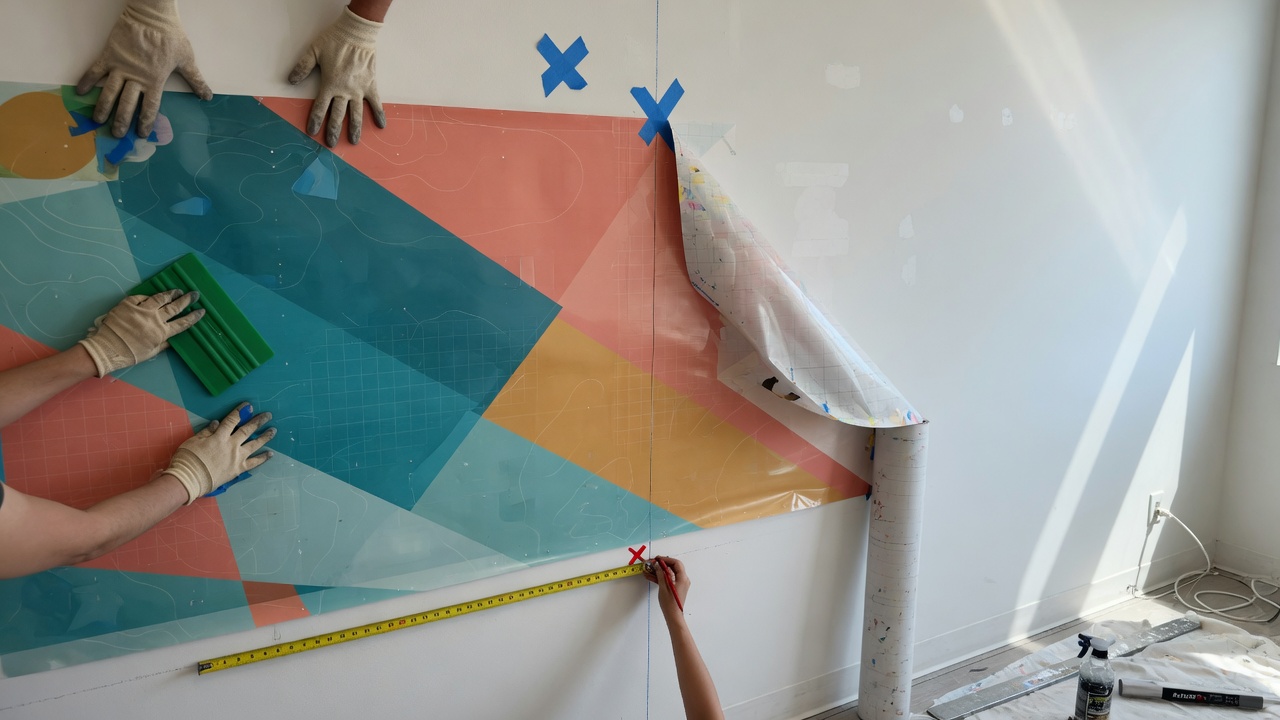
Three products get called “a poster” in the same email, and they are not interchangeable. Paper is a printed sheet. Foam board is that sheet (or a direct print) stuck to a polystyrene sandwich so it stands. Fabric is a textile graphic finished so you can hang it from a pole, a cable, or a pipe. Pick from the hang, the reuse plan, and what the venue will allow on the wall. Do not pick from which sample is shiniest on our counter.
This comparison is indoor event work in Orange County. It is not outdoor vinyl versus outdoor fabric. Outdoor scrim, mesh, and grommeted fence banners are a different product family with different UV, wind, and hem problems. If the poster has to live on a parking-lot fence through a Santa Ana, stop. You are not on this page.
| Product | How it lives in the room | Typical OC event use | Reuse | Pack / carry | Where it fails |
|---|---|---|---|---|---|
| Paper poster (unmounted) | Pins, tacks, clips, a hanging bar, a frame you already own | UCI bulletin boards, stacks for multiple sites, window clings’ paper cousin | One event to a season if you roll it and the date does not expire | Rolls. Light. Cheap to reprint when copy changes | Floor display, HVAC curl, hotel walls, outdoor sun |
| Foam-board mounted poster | Easel, lean (if allowed), Velcro to drape, adhesive strips (if allowed) | Hotel foyers, registration, indoor pop-ups, speaker rooms | A season of weekends if corners stay intact and copy stays true | Flat. Corners ding. A 24×36 is a two-hand carry through a revolving door | Outdoors, hotel wallpaper tape jobs, punching holes for S-hooks |
| Indoor fabric poster / hanging graphic | Pole pocket, grommets, cable, pipe-and-drape | Ballrooms that forbid tape and limit easels; stage-adjacent hangs | Years of indoor use if you steam wrinkles and the mill sheet satisfies fire | Folds or rolls in a bag. Wrinkles. Needs hardware the paper job did not | Bulletin boards, tabletop easels, any outdoor hang you have not spec’d as outdoor |
Paper is the right call when the surface is a bulletin board, when you need twenty of the same file, when the date will change, or when you will mail a tube. Heavyweight photo satin or a coated presentation sheet is what we print for event color. Uncoated is for a workshop poster people will write on. Thin office bond is not a poster; it is a plotter proof that cockles. If you pin paper, skip a heavy laminate that fights the tack, or spec a light laminate and accept that tacks leave a hole in the film.
Foam board is the right call when the poster must stand, look rigid from 10 feet, and come down without a mark on the hotel’s vinyl. It is the Orange County event default for 24×36 in a foyer. It is not a building material. It is paper faces on a foam core. A rolling bag in a Marriott foyer will take the corner off. That is not a print defect. That is why we talk about gatorboard when you are driving Irvine to Anaheim every weekend.
Fabric is the right call when the hang is a hang: a crossbar, a cable set, a pipe in a ballroom, a drape you can Velcro. It packs. It does not stand on an easel unless you build a frame, and then you are in display hardware, not posters. Hotels and convention halls often ask whether hanging textiles meet NFPA 701 flame-propagation testing. That is a mill sheet, not a spray can you apply in the loading dock. If the venue will ask, say so on the quote so we pull a sheet that matches the roll. Paper and foam board are a different fire conversation; do not assume a 3/16-inch foam core is “the same as plywood” because someone read a booth-construction note about 1/4-inch wood.
Canvas gallery wraps live on the same posters and large prints menu and are the wrong event tool. A wrapped canvas is décor. It is heavy for the size, slow to hang, and fussy in a room you have for six hours. Save canvas for the office wall you will still own on Monday. For Tuesday’s mixer, order paper, foam, or fabric.
Foam board mounting: 3/16, 1/2, gator, laminate, edges
Most Orange County event foam we quote is 3/16-inch paper-faced foam core, about 5 mm, white face, white core. That thickness is typical industry stock, not a secret mill. It is light enough to clip on a tripod easel and stiff enough that an 18×24 does not oil-can in hotel HVAC. A 24×36 in 3/16 is still the default. It will flex if you pick it up by one corner. Pick it up with two hands on the long edges.
1/2-inch foam is for the board that must feel like a panel, for a larger custom size, or for a 24×36 that will sit on a floor ledge without an easel and you do not want it to look like a playing card. It is thicker at the edge, heavier in the car, and still foam. It still dings. It still snaps if you fold it. Do not order 1/2-inch because it sounds more professional if the hotel easel clip was built for 3/16. Measure the clip. A fat board in a skinny clip is a cracked corner in the lobby.
Gatorboard (and similar wood-fiber-faced foam) is the upgrade when the board will travel, when corners have to survive a weekend, or when you want to put a standoff or a more aggressive hook in the face. The core is denser. The skin is not poster paper. It dents less. It still is not aluminum. Typical event thicknesses are 3/16 and 1/2, same conversation as foam, different skin. If last quarter’s 3/16 paper-face came back looking like a used shipping corner, say so. We will quote gator instead of lecturing you about packing.
Two print paths land on the same rectangle:
- Print on paper, then mount. Wide-format inkjet onto photo or presentation paper, adhesive to the foam, trim flush. This is the color path people mean by “photo-quality poster on board.” We can laminate the print before we mount it. Satin laminate is the hotel default because recessed cans turn gloss into a mirror. Gloss is fine in a matte ballroom if you like fingerprints. The paper-mount path is also how you get a wrap of image to the edge with a clean trim.
- Direct print on the board. UV flatbed ink onto the foam face (or onto a coated foam). No paper layer to peel. Scuff behavior is different. Short indoor events often skip laminate. Edge is still a foam edge unless we cap it. Direct print is a good path when you want the board itself to be the graphic and you are not married to a photographic paper surface.
Neither path makes foam waterproof. Neither path makes foam an outdoor product in Orange County sun. A foam board on a Spectrum patio for “just two hours” will take UV, wind, and a corner hit from a stroller. Indoor foam inks and paper faces are not a fence spec. If the event spills outside, we will try to talk you onto a different substrate. If you insist, we will still tell you the corner will fail first.
Edges are the part clients notice after the photo. A flush trim shows a white foam line. On a dark image that line is a frame you did not design. Options: live with the white edge; print a dark border in the file so the white line is less of a surprise; black foam (limited sizes); an edge tape or cap (a finishing line, not a free extra). Do not put the logo 1/16 inch from the trim and then complain about the white foam halo. Keep live matter inside a quarter-inch, more if an easel clip will bite the top.
Warping is an Orange County specialty. Foam is two paper skins on a plastic foam. Heat and humidity change the skins at different rates. A 24×36 that spent the afternoon in a closed car at John Wayne parking, or against west glass in an Irvine lobby, will greet you as a gentle potato chip. Store boards on edge in the air-conditioned room, not stacked under a bag on a sunlit back seat. If a board bows, it is often the storage, not the mount. We can sometimes flatten a mild bow under weight overnight. A crease or a snapped core is a reprint.
Double-sided foam is two prints or a wrap, plus a thicker conversation about show-through. 3/16 white foam is not a blockout. A dense image on the reverse will ghost if the front is a light field. If both faces must read — a hotel corridor island, a hanging two-face that you actually wanted as foam — say so. We may spec a denser board, a blockout mount, or tell you to buy fabric or a rigid with a real core. “Just print the back too” is not a spec.
Hanging: easels, bulletin boards, hotel walls, fabric hardware
The hang is the product. A perfect 24×36 with no way to stand it is a large greeting card. Decide the hang before we print, because the hang changes substrate, edge, file safe zone, and whether we drill anything (we usually should not drill foam).
Floor easels and tabletop easels
The Orange County hotel default is a tripod floor easel with a bottom ledge or a clip, holding a 24×36 portrait. Tabletop easels hold 18×24, sometimes 11×17, on a 6-foot registration table. Confirm which easel you are borrowing from the hotel AV list, buying, or bringing. A ledge easel hides the bottom inch. A clip easel hides a bite at the top. Design the safe zone to that hardware. A URL in the last 3/4 inch is how you display a truncated .com to the keynote speaker.
Easel etiquette is not optional. Hotel event managers notice trip hazards faster than they notice your brand color. Do not park a floor easel in the queue, in front of a fire extinguisher, or on the patterned carpet where a rolling bag will clip the board and the guest. Rubber feet help on stone; a light easel will skate. HVAC in pre-function space is strong enough to flutter a paper poster you tried to clip like foam. If the easel is hotel inventory, ask whether it is rated for 24×36 or for a 22×28 wedding-sign kit. The wrong ledge is a slide, then a corner ding, then a reprint you will blame on us.
Do not put a 24×36 foam board on a 6-foot table and call it a tabletop display. It will fall. Use 18×24 on the table and keep the 24×36 on the floor, to the side of the table, never in the aisle. UCI career-fair tables have a published footprint in the recruiter packet; a poster that eats the neighbor’s air is a staff conversation. Weighted bases belong to retractable hardware, not to foam. Foam sits. It does not get a sandbag tied through a grommet you punched with a pen.
Bulletin boards, pins, and paper
Paper 18×24 belongs on cork, fabric-covered campus boards, and any surface the building has already designated as a posting surface. Tacks and pins are the honest fastener. Staples show up on some campus boards and punch a hole you will see if you reuse the sheet. Tape is a residue conversation: painter’s tape is kinder than packing tape; neither is welcome on painted drywall, millwork, or glass that a facilities team considers a finish. UCI prohibits glue. Other campuses and office parks prohibit tape. Ask. A pulled poster is a zero-dollar reprint that still costs you the event.
If you laminate paper for scuff and then pin it, the hole is in the film. That can be fine for a one-week hang. It is ugly if you hoped to reuse the sheet in a frame later. Say the hang. We can skip laminate, use a light film, or mount a short run to foam so you stop pinning altogether.
Hotel walls, vinyl wallcovering, and the word no
Orange County business hotels — the Irvine properties off the 405, Anaheim properties near the convention center, Newport meeting hotels — generally treat guest-area wallcovering as untouchable. No nails. No tape. No Command strips unless the banquet captain says yes in writing, and even then you own the paint lift. Foam board does not get a sawtooth hanger like a framed print. It does not get a hole for a screw. It gets an easel, a stand the hotel already owns, or a lean against a millwork ledge if they allow a lean. A lean on stone is a slide. A lean on a sofa is a liability.
If the captain says no tape, that is not a negotiation. That is the wallcovering talking. We will not send you into a foyer with a roll of double-stick and a smile. Ask the hotel for their hanging rules in the banquet event order. If they will hang a fabric on existing hooks or a pipe, switch the substrate. If they will rent easels, stay on 24×36 foam and rent the easels. If they will hang nothing, you need a self-supporting unit — easel, retractable, or a frame — not a poster and optimism.
Installer access and insurance show up when you want us to hang, not when you pick up a stack. Certificate of insurance, additional insureds, and after-hours load-in are routine on hotel and campus jobs. We can provide insurance documents. We cannot invent a vendor number you were supposed to apply for last month. If your “hang” is you and a colleague at 7:40 a.m., order easels and foam. Do not order a cable system you will discover needs a lift.
Fabric: pole pockets, grommets, cables
Indoor fabric posters hang. Finish the textile for the hardware that actually exists in the room. A pole pocket is a sewn tunnel; you slide a rod or a pipe-and-drape crossbar through it. Measure the pole diameter. A pocket that is too tight peels. A pocket that is too loose gathers and looks drunk. Grommets are metal rings in a hem; they want even spacing and a cable, bungees, or S-hooks — indoor versions, not fence zip ties. Cable systems with rails or rods are a hotel and retail language; they want a hem and a specified insert, not a raw cut edge.
Velcro on pipe-and-drape is the booth version of hanging a poster. Loop on the drape, hook on the graphic, or the reverse, consistently. Foam can take adhesive-backed coins if the drape can take the weight. A 24×36 in 3/16 foam is light. A 1/2-inch gator 36×48 is a different coin count. Do not Velcro a foam board by two corners. The middle will belly, then the coins will peel, then the board will be on the aisle carpet.
Do not punch grommets in foam board. The foam tears, the paper face lifts, and the hole eggs out on the first tug. If you needed grommets, you needed fabric (or a rigid with a real screw-through). That sentence saves a lot of loading-dock surgery.
UCI: bulletin boards, six posters, no glue
UC Irvine is the one local venue that publishes a poster envelope you can actually design to. The campus posting policy — UCI Administrative Policies Sec. 900-12, Policy on Posting and Distribution of Literature and Materials — is the document, not a rumor from last year’s intern. Read the current text via Student Life and the campus-orgs summary of UCI posting and marketing rules before you order a stack you cannot hang. We print to the policy. We do not stamp posters, and we do not argue with Student Life.
The size and count rules that actually change a quote:
- A poster or flyer may not exceed five feet in length and three feet in width. 18×24 and 24×36 are inside that envelope. A 36×60 portrait is at the wall. A 48-inch-wide board is over.
- Only one poster or flyer per event per posting area.
- At any given time, no more than six posters or flyers may be posted on campus for a particular event.
- Posting with glue is expressly prohibited.
- Event posters must show a removal date and come down within 48 hours after the event. Non-dated material must bear a removal date not past the last day of the current academic quarter.
- Sponsor name must appear in English.
- Commercial literature — promoting private business or personal gain — is prohibited on campus posting surfaces. Non-university persons may post only for events or programs being held on campus, and only in designated areas.
A poster or flyer may not exceed five feet in length and three feet in width. At any given time, no more than six posters or flyers may be posted on campus for a particular event. Posting with glue is expressly prohibited.
Approved locations for posters, flyers, and announcements include university general-purpose bulletin boards; the interior and exterior concrete of the Crawford Hall / West Peltason Drive overpass; interior concrete of specified Ring Mall pedestrian bridges; interior concrete railings of the lower plazas (the surface not exposed to Aldrich Park); and sites controlled by the School of the Arts or Housing. That list is the policy’s list, not a creative brief. If the board is not a general-purpose board, assume no.
Prohibited surfaces include glass, wood, painted or finished surfaces, exterior walls, insides of classrooms, lecture halls, laboratories, interior building walls, stairwells, trees, trash cans, benches, construction fences, automobiles, building entrances, and campus artwork. “The Student Center glass would look great with a 24×36” is how a poster lasts twenty minutes. Indoor foam on an easel at a registered indoor event is a different conversation from posting. Posting is the bulletin-board job. The event-day display inside a booked room is the easel job. Do not mix the two in one “campus posters” line on the PO.
Schools can be stricter than the campus envelope. UCI Law’s bulletin-board policy, for example, caps printed materials at 11×14 and still bans glue. If your hang is a specific school, read that school’s board rules. An 18×24 that is legal on a general-purpose board can be oversized in a school corridor. We will still print 18×24 if you insist. We will also still say you should read the door.
Outdoor campus is not a foam-board climate. Aldrich Park lawn, Ring Road, and a breeze will treat a 24×36 like a sail. Retractable hardware is indoor hardware. Foam is indoor. If the fair is outdoors, ask us for a product rated for that, or a tabletop graphic that sits on the table. Do not stake a foam board in the grass.
Commercial brands recruiting on campus: your table display inside a booked fair is not the same as wheat-pasting 24x36s on Ring Mall concrete. The career-fair packet (table size, banner envelope, weighted displays) is a different document from Sec. 900-12. Read both. A 24×36 foam on a tabletop easel on your 6-foot table is usually the poster version of that packet. A 33×79 pull-up may overrun a 6-foot height cap — that is the retractable article, not this one. Keep the poster under the table rule and the posting under the six-poster rule.
Hotels, Anaheim-adjacent rooms, and indoor Spectrum pop-ups
Start with the room, then pick the board. A 24×36 that looks correct in a two-story hotel atrium can look like a stamp in Hall D, and can be illegal on a UCI board the next morning. The three Orange County rooms we quote posters against most often are hotel foyers and ballroom pre-function, indoor campus and conference rooms, and in-store pop-ups on the lease line.
Anaheim hotel foyers near the convention center, Irvine business-hotel lobbies, and Newport meeting properties share a few traits. Floors are carpet, stone, or a mix. Lighting is warm and directional. The hotel will not let you lean a board on a wallcovering or tape a poster to millwork. Fire exits and elevator banks stay clear. A foam 24×36 on a floor easel earns its keep here because it is freestanding, leaves no residue, and packs flat in a car the bell desk will not treat as freight. Paper does not belong on a floor easel in that HVAC. Fabric belongs if they will let you use a pipe or a cable, and if you brought the mill sheet.
Copy has to work at 8 to 15 feet in a foyer, which is how far most guests are when they decide whether to walk over. Headline, logo, one next step. Phone numbers and QR codes belong in the middle third, not in the easel clip and not in the last inch of foam edge. Hotel cans will punish a navy-on-black logo and a high-gloss laminate. Satin is the safer indoor finish when the only light is a recessed can over your board.
If you are also exhibiting at the Anaheim Convention Center, facility rules and show rules are not the same document. The building controls public-area advertising and what you may attach to the premises. Show management writes booth height and aisle obstruction for that event. A 24×36 foam on an easel inside your booth footprint is booth furniture. A row of easels in the aisle is a floor-manager conversation. Hanging fabric in a booth can pull fire paperwork. If the job has become a back wall, stop specifying posters and go to trade show displays. We will tell you. We will not upsell you a 10-foot frame because this page is about 18×24 and 24×36.
Irvine Spectrum Center is a mix of indoor shops, outdoor common areas, and Irvine Company retail rules. You do not get to set a promotional easel in the piazza because it looked good in a mockup. Common-area displays generally need written permission. If you are a tenant running an in-store demo, a 24×36 on an easel inside the lease line is usually straightforward. Wind on the outdoor common area is not a foam-board problem you can win. Indoor shop lighting is a poster’s home turf.
Office-park conference rooms and HOA clubhouses add landlord language. A foam board on an easel you take home is décor for a day. A poster you tape to the corridor side of a demising wall is a sign program. Irvine Company office and retail properties typically run written criteria. Village HOAs are not looking for a campaign on the clubhouse glass. Send the packet. We print to what you are allowed to install.
City of Irvine sign rules can enter if the poster is functioning as a sign visible from the public way — a storefront, a window, a temporary event sign — rather than as a board in a booked ballroom. If the graphic faces the street, check the City’s current sign-permit pages before we print. An indoor 24×36 on an easel at a ticketed hotel event is usually not that conversation. A 24×36 in the window of a Jamboree shop can be. We print to a permitted drawing. We do not issue the permit.
Quote 18×24 or 24×36 foam board posters
File dpi, type size, bleed, and what 150 actually means
Artwork is where otherwise careful marketers lose a day. The file is not a slide, not an Instagram export, and not a 72 dpi PNG of the homepage hero. It is a full-size sheet, viewed at 3 to 12 feet, with a strip of the design sacrificed to an easel clip or a foam edge. Build it at actual size or at a clean even scale (50 percent, 25 percent), in CMYK, with fonts outlined or packaged, and with bleed as extra image — not as a white strip you assumed we would add.
Resolution is a viewing-distance problem, not a religion. 300 dpi at final size is the desktop-publishing number people remember from letterhead. For an 18×24 or 24×36 event poster, 150 dpi at final size is a typical industry target that looks clean from a few feet away. 200–300 dpi is what you want when guests will stand at arm’s length and grade a photo — a scientific session, a product hero, a face. 100 dpi can hold a soft background. 72 dpi web images, stretched, look like mush. 300 dpi at full 24×36 makes a file that is painful to transfer and does not print sharper in any way a guest can see from the hotel carpet.
Do the math before you buy stock or crop a phone photo:
- 18×24 at 150 dpi is 2,700 × 3,600 pixels.
- 18×24 at 300 dpi is 5,400 × 7,200 pixels.
- 24×36 at 150 dpi is 3,600 × 5,400 pixels.
- 24×36 at 300 dpi is 7,200 × 10,800 pixels.
A 1200-pixel-wide Instagram export stretched to 24 inches is 50 dpi. It will look soft at arm’s length. We cannot “AI upscale” our way out of a soft wordmark that is also your legal name on the floor of a hotel foyer. Vector logos, icons, rules, and headlines: PDF, AI, or EPS with outlines, or a high-quality PDF from the layout file with fonts converted. A logo that looks sharp at 2 inches on a business card still looks sharp at 10 inches on a 24×36 if it is vector. The same logo, saved as a 400-pixel PNG from a brand portal, will stair-step.
Type size is the other viewing-distance problem. If guests read the board from 10 feet, body copy under about 18–24 points starts to fail on a 24×36, depending on the typeface and contrast. Headlines need to work as a silhouette. Fine serifs and hairline rules disappear under hall lighting. Do not put a paragraph of boilerplate on an 18×24 and expect it to recruit anyone in a UCI ballroom. One claim, one proof, one action. The table is for the leave-behind. These point sizes are shop rules of thumb, not a type code. If the board is a scientific poster that attendees will stand at, you can run smaller type — and you should raise the dpi and the lighting expectations with it.
QR codes need a quiet field, high contrast, a quiet zone, and enough physical size to scan at arm’s length — typically on the order of an inch or more on these sizes, not a 3/8-inch mark in a photo of a salad. Keep them out of the easel clip, out of the foam edge, and off a busy background. If the only reason for the board is a QR, you may want an 18×24 plus a printed card. A 24×36 that exists to hold a tiny code is a waste of foam.
Bleed and safe zone:
- Bleed past the trim — typically 1/8 to 1/4 inch of extra image — so we do not flash white if the knife shifts a hair. Mounted boards get trimmed to the board. If the file is exactly 24.00 by 36.00 with the logo on the edge, the foam halo will eat it.
- Safe type well inside the trim, and well inside whatever the easel hides. Ask whether the easel is a top clip, a bottom ledge, or both. A quarter-inch is not enough if the clip is an inch.
- Do not park a phone number in a corner a hand will hold. Foam is carried. Finger oil on an unlaminated dark field is a fingerprint gallery.
Color is CMYK unless we have a reason to pull a spot. Hotel lighting is warm. A logo that looks correct on a calibrated monitor in an office park will read redder under 2700K cans. If the brand red has to hit, say so and send a coated swatch or a prior printed piece. We still cannot reprint the hotel’s lamps. For most event posters, contrast beats a perfect Pantone match that disappears at 12 feet. RGB neons will dull. Transparent PNGs are not a white plate. White in the file on white paper is unprinted paper. On a colored foam face, unprinted is the foam color, which may not match.
File delivery: PDF/X or a flattened high-quality PDF is fine if fonts are outlined and images are embedded. Native AI or INDD with packaged links is better if you want us to move a logo off the clip zone. Do not send a Google Slides export as a 24-inch document. Do not send a JPEG saved three times from a group chat. If the only art you have is a brand-portal PNG, say so early so we can tell you whether it is usable or whether you need the vector from whoever drew the mark.
This is poster dpi for 18×24 and 24×36, not a lecture on every wide-format file we take. A wall mural, a window film, and a 24×36 board do not share a pixel count. Send the poster as its own file at its own size. Cropping a 10-foot mural file down in the RIP is how you get the wrong crop and the wrong dpi story.
Mistakes that turn into reprints or a pulled poster
Most reprints we see on event posters are not RIP errors. They are hang mismatches, dpi surprises, leftover dates, and foam that went outside. This is the short list we would rather walk through before we print.
- Web-resolution photography. A 1200-pixel hero stretched to 24 inches is about 50 dpi. Replace the photo or go type-forward. 150 dpi at size is the event default; 200–300 if people will nose up to a face.
- Raster logos. The wordmark is a PNG from the website header. At 24×36 it frays. Get the vector.
- Critical copy in the easel bite or the foam edge. The URL, QR, or “Ballroom B” sits in the last 3/4 inch. Guests see a nice photo and no way to act. Rebuild with a real safe zone.
- Foam board outdoors. Spectrum piazza, Aldrich Park, a Katella sidewalk “just for two hours.” Wind, sun, and a corner hit. Foam is indoor.
- Tape on hotel wallcovering. The banquet captain said no. The adhesive said yes. Now you own a vinyl repair. Use an easel.
- Grommets in foam. The hole tears. You needed fabric or a different rigid.
- Glue on a UCI board. Expressly prohibited. The poster comes down, and you may come with it. Pins on designated boards only.
- Seven campus posters for one event. The cap is six at a time, one per posting area, inside 3 by 5 feet. 24×36 is small enough; the count is not.
- Commercial posting on campus boards. Sec. 900-12 is not a coupon vehicle. Book the room or the fair. Do not wheat-paste the brand.
- Missing removal date. Event posters need a take-down date and have to come off within 48 hours after the program. Facilities will help if you forget — by throwing the board away.
- Paper on a floor easel in HVAC. It curls. Mount it, or clip fabric, or put paper on a board that pins.
- Gloss under a can light. The only thing guests can read is their own reflection. Spec satin for hotels and halls unless you have a reason not to.
- Hot-car warp. A 24×36 that baked in an Irvine parking lot is a potato chip. Store on edge, indoors, then set up.
- Folding foam. It snaps. The white core becomes the graphic. Carry it flat. If it cannot fit in the car, that is a fabric conversation or a smaller size.
- Leftover old graphics. Last year’s percentage off, an expired date, a former product name, a ballroom that changed. Foam does not know which campaign it holds. Read the board before you walk into the foyer. Tape-over letters on a mounted poster look like tape-over letters. Reprint.
- Calling 11×17 a foyer poster. It is a flyer. Order 18×24 or 24×36 for the easel, and print the 11×17 as the handout.
- One file for a mural, a window, and a poster. Different crops, different dpi, different safe zones. Separate files, separate sizes.
Corners deserve their own paragraph because they get blamed on the printer. Paper-faced 3/16 foam dings if it touches a door frame, a trunk latch, or another board. Stack boards face to face with a sheet between them, carry them vertical, and do not rubber-band a stack. Gator survives more of that. Neither survives a fold. If you are driving Barranca to Anaheim every Thursday, budget the skin that matches the mileage, or budget reprints as a cost of 3/16.
Dates deserve the other paragraph. Sales teams are loyal to “the boards in the closet.” The closet does not know the offer expired. We have seen 24x36s deployed with a webinar date that ended Tuesday, with a QR that 404s, and with a co-brand from a joint booth last year. If you reprint often, keep a thumbnail taped to the storage sleeve. If you do not reprint often, read the board in the parking lot before you walk in. We can turn a replacement graphic quickly when the file is already built to 18×24 or 24×36. We cannot fix a live mixer that is already using last year’s art.
What to send so the quote is real
A useful quote for event poster printing names the live size, the substrate, the quantity, the finish, the hang, and the date you need it. “Need posters for Anaheim next week” is a voicemail, not a spec. Send the following to Avanti Printing and we can price without twenty questions. Walk-ins at 15321 Barranca Pkwy, Irvine, CA 92618 are fine if you bring the old board. Phone is (949) 387-0787.
- Venue and date: hotel name, campus (UCI posting vs indoor booked room), Spectrum in-store, office lobby, plus the first day you will set up.
- Size and orientation: 18×24 or 24×36, portrait or landscape. If the kit says 36×48, say that instead of hoping we guess.
- Material: paper (stock if you care), 3/16 foam, 1/2 foam, gator, indoor fabric, or “recommend from the hang.”
- Quantity: how many units, and whether art is identical or versioned (English/Spanish, two dates, two product lines).
- Finish: laminate satin vs gloss vs none, flush mount, edge treatment, pole pocket vs grommets if fabric, easel-safe margins.
- Hang: floor easel, tabletop easel, campus bulletin board, Velcro on drape, fabric on a pole, “the hotel said no tape.”
- File status: vector logo, photo at 150 dpi at size (or 200–300 if arm’s length), or “we have a PNG and a hope.” Layout PDF at actual size helps.
- Pickup or delivery: Irvine pickup is simplest. A stack of 24×36 foam is a two-hand carry. Fabric in a bag is not.
- Permissions: UCI posting vs event-day display, hotel BEO hanging rules, landlord criteria if it faces a common area.
Quotes confirm size, material, quantity, finish, and date. If any of those five is missing, the number you see is a guess. The hang is how poster jobs miss the five even when the rectangle is clear. Rush exists when the board is in house, the file is clean, and you can pick up in Irvine. It does not exist when the logo is a screenshot and the hotel will not allow the hang you designed at 4 p.m.
If you need matching rigid signs, window film, or a cassette stand for the same event, put those on the same request as separate lines. Different media, different finishing, different files. Mixing them into one “just like the poster but bigger” instruction is how outdoor vinyl ends up specified like an indoor board, or a foam poster ends up with fence grommets. Keep posters on the poster spec under the same PrintBig Irvine roof.
Send size, board, and hanging notes for a quote
Frequently asked questions
What size poster should I print for an Orange County event?
Use 18×24 when the hang is a bulletin board, a 6-foot table, or a tabletop easel, and when you need a stack. Use 24×36 when the hang is a floor easel in a hotel foyer, a registration island, or an indoor shop pop-up and you have the height. Confirm portrait versus landscape against the easel and the board. If a scientific kit says 36×48, that is the size. If UCI posting is the hang, stay inside 3 feet by 5 feet, one per board, six on campus at a time. Quotes still lock the live size, not a round catalog nickname.
Should I mount it on foam board or leave it as paper?
Mount it if it has to stand on an easel or look rigid from 10 feet. Leave it paper if it has to pin to a designated board, roll in a tube, or reprint when the date changes. Fabric if it has to hang from a pole or a cable and the venue will not take tape or easels in that sightline. Paper on a floor easel in hotel HVAC curls. Foam on a UCI cork board is a waste of core and a problem for tacks. Match the substrate to the hang.
What dpi do you need for 18×24 and 24×36?
Vector logos and type. Photographs at about 150 dpi at final size for foyer viewing. 200–300 dpi at size if guests will stand at arm’s length and grade a photo. 100 dpi can hold a soft background. 72 dpi web JPEGs will look like 72 dpi web JPEGs. 18×24 at 150 dpi is 2,700 × 3,600 pixels; 24×36 at 150 dpi is 3,600 × 5,400. CMYK PDF with fonts outlined, bleed past the trim, safe zone for the easel clip. If 150 dpi at size makes the photo look bad on your screen, it will look worse at 8 feet in a hall.
Can I hang foam board posters on a hotel wall?
Usually no. Orange County hotels treat vinyl wallcovering as untouchable: no nails, no tape, often no adhesive strips. Foam board wants a floor easel or a tabletop easel, a millwork ledge if they allow a lean, or a switch to fabric on hardware the hotel already has. Ask the banquet event order before we print. If the captain says no tape, we will not send you in with double-stick. We will quote 24×36 foam and tell you to rent the easels.
What will UCI actually allow?
Read Sec. 900-12 and the campus-orgs posting page. Designated bulletin boards and listed concrete surfaces, not glass, not interior walls, not classrooms. No glue. One poster per event per area. No more than six on campus at a time for that event. Max three feet wide by five feet long — 18×24 and 24×36 fit. Event posters need a removal date and must come down within 48 hours after the program. Commercial advertising on campus boards is prohibited. An easel inside a booked fair or room is not the same as posting. School-level boards (UCI Law is 11×14) can be stricter. We print the rectangle. You hang it where the policy allows.
When is fabric better than foam for an indoor poster?
When the hang is a hang: pole pocket on a pipe, grommets on a cable, a ballroom that forbids easels in the sightline, a graphic you want to pack in a bag. Fabric wants a mill sheet if the venue asks about NFPA 701. It wrinkles; budget a steamer. It does not pin to a cork board and it does not stand on a tripod easel without a frame. Foam is the easel product. Fabric is the hanging product. Paper is the pin-up product. Do not order fabric because it sounds softer if you needed four easel boards for a foyer.
Will foam board last outdoors in Orange County?
Not as an event plan. 3/16 paper-face foam is an indoor sandwich. Sun, wind, irrigation, and a corner hit will retire it faster than the ink. A shaded north overhang for an hour is still a ding risk. If the event is outside, say so; we will spec a different substrate rather than grommet a foam board and wish you luck. Indoor foam in a sunlit lobby will also fade and warp over months. Indoor does not mean immortal. It means not a fence.
Can you match posters to a trade show display for the same show?
We can print both under the same roof at PrintBig Irvine, and we should treat them as two specs: poster paper or foam or fabric at 18×24 or 24×36, and whatever the booth system actually is. Color will be close, not a spectro match across paper, foam, and display textile under two different lights. Send both files with sizes. Do not assume the booth RIP will use the poster file enlarged. If the poster is the easel hero and the back wall is a color field plus a mark, that pairing usually looks more deliberate than forcing the same photograph onto two substrates.
Stand it, pin it, or hang it — then print it
Poster printing in Orange County fails when you buy foam for a bulletin board, paper for a hotel easel, or a 24×36 for a wall the banquet captain will not let you touch. It works when you pick 18×24 or 24×36 from the room, pick paper or board or fabric from the hang, and send a file with enough pixels and a safe zone the clip will not eat.
Bring us the room, the hang, and the file. Avanti Printing, 15321 Barranca Pkwy, Irvine, CA 92618, will spec 18×24 or 24×36 against that room, mount to 3/16 foam or gator when it has to stand, leave paper when it has to pin, and finish fabric when it has to hang. Call (949) 387-0787 or send the quote form with size, material, quantity, finish, and date. We will tell you if you should have ordered a display frame instead. Most of the jobs in this article should still be a poster — just not a taped poster on hotel vinyl, and not a seventh 24×36 on Ring Mall concrete.