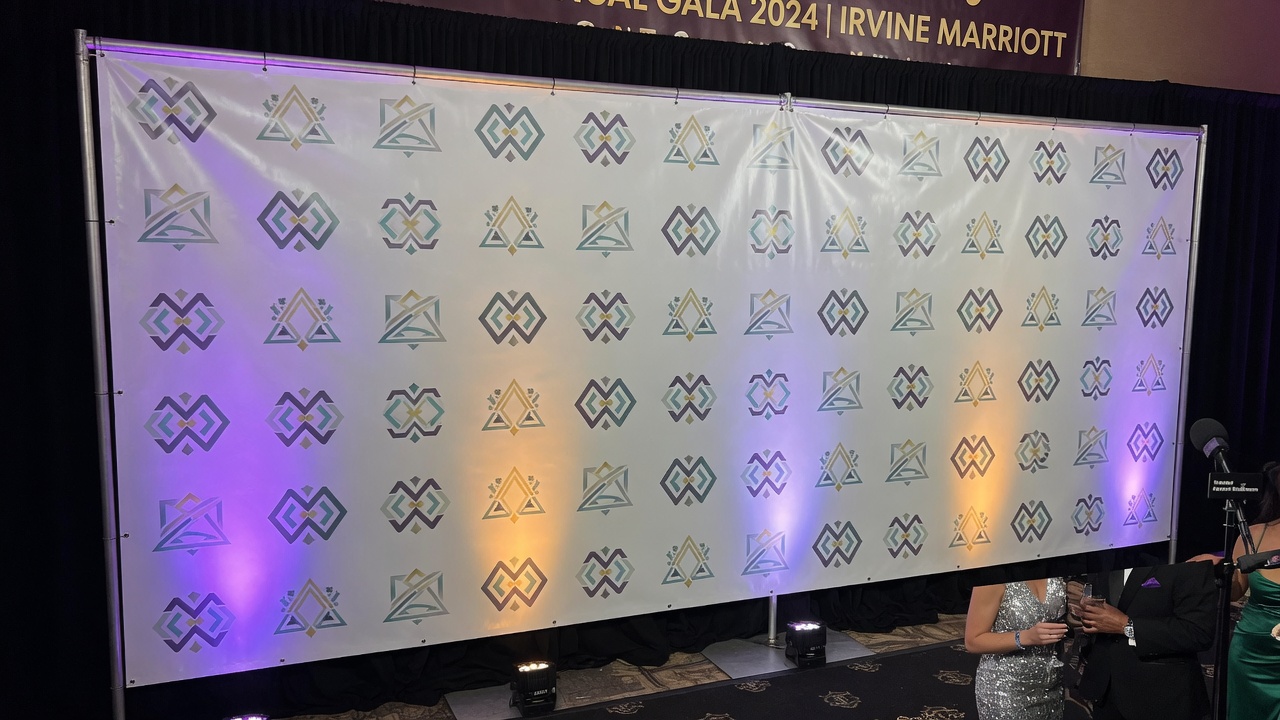
A step and repeat banner in Irvine is a logo wall for photographs at galas, press lines, and hotel red carpets. You print a repeating grid of sponsor marks, hang it on pipe and drape or a tension frame, and light it so flash does not glare. Spec spacing, fabric versus vinyl, and hardware to that room — not a catalog loft.
The catalog shot is always a seamless 20-foot wall in a white studio with a perfect wash of light. You are more likely to hang eight feet of fabric on hotel pipe in a ballroom that still has last night’s uplights on the walls, a patterned carpet, and a photographer who will stand 12 feet back with on-camera flash. That is why we quote a step-and-repeat as a system: live size, logo grid, material, finish, hang method, flame paperwork, and a file that still reads when a tuxedo is in front of it. Avanti Printing at 15321 Barranca Pkwy, Irvine, CA 92618 prints the wall. Call (949) 387-0787 if you already own the pipe and only need a new skin.
This is the estimator version of that conversation. It is written for Irvine and Orange County buyers who will actually stand people in front of the graphic. It is not a tour of outdoor fence banners, and it is not a booth-back-wall catalog. Quotes still confirm size, material, quantity, finish, and date.
Who is ordering a logo wall in Irvine
If you run development, marketing, or events for a company, hospital, campus program, association, or nonprofit anywhere from San Clemente to Brea, you already live on a calendar of photographed rooms: a gala in a Hotel Irvine ballroom, a press line in a Marriott pre-function, a product launch off Jamboree, a donor wall at a Costa Mesa arts dinner, a red-carpet arrival at an Irvine Spectrum-area hotel. You need a background that says who paid for the night, that photographs cleanly, and that comes down before the banquet captain starts stacking chairs. That is the job of a step-and-repeat.
Typical buyers we talk to from Irvine, Tustin, Costa Mesa, Newport Beach, Santa Ana, Laguna Hills, Lake Forest, and Anaheim are not shopping “a banner.” They are shopping a photo surface. Development directors need presenting-sponsor marks to survive a crop. Agency producers need a brick grid that still reads with three people in the frame. Hotel-event planners need a graphic that hangs on the house pipe-and-drape and does not tape to vinyl wallcovering. Startup founders need an 8-by-8 they can carry into a suite for a handful of press. Hospital and university teams need a wall that will satisfy a fire inspector and a brand office on the same night.
This is for you if you will hang the wall yourself, or hand it to a banquet setup crew who have never steamed fabric. It is also for you if last year’s vinyl still shows a sponsor who did not renew, and you keep meaning to reprint. It is the wrong product if you need an outdoor grommeted fence banner, a vehicle graphic, or the back wall of a 10-by-10 exhibit booth. We print those under the same roof. They are different jobs, different files, and in the case of outdoor vinyl a different weather conversation. Stay here for the wall people stand in front of with a camera.
California buyers outside Orange County use the same 8-foot and 10-foot photo walls. The local twist is the venue mix: Irvine hotel ballrooms off the 405 and Jamboree, Marriott Irvine Spectrum pre-function, Hilton Irvine meeting rooms, Hotel Irvine galas, Costa Mesa arts dinners that photograph like red carpets, UCI indoor donor events, and office-park product launches that still have to live inside Irvine Company interiors. Those rooms change height, hang method, flame paperwork, and whether gloss vinyl will turn the photographer’s flash into a white rectangle. They do not change the fact that a step-and-repeat is a repeating logo grid for photographs, not a slogan banner you hang over a stage.
- Development and events teams at Irvine and South Coast nonprofits who need a gala wall that still shows the presenting sponsor when two people stand in front of it.
- In-house marketers running a press line or product launch in a hotel foyer, not a convention-hall island.
- Agencies who already have a lockup PDF and need an honest grid, not a 72 dpi collage from a brand portal.
- Hotel and catering producers who will hang the graphic on house pipe and drape and need pole pockets that actually fit the crossbar.
- Campus and hospital communicators who will be asked for a mill sheet before the wall goes up in an assembly room.
- Founders who need one 8-by-8 for a suite and think a row of pull-up stands will photograph as a wall. It will not.
If the same night also needs a hanging stage banner, a table throw, or a retractable in the registration line, put those on the request as separate lines. Mixing them into one “just brand the gala” instruction is how a photo wall gets specified like outdoor vinyl, or a vinyl stage banner gets ordered as matte fabric with no grommets. Start the wall conversation on banner printing in Irvine and keep each surface on its own spec.
What the camera actually crops
Design the wall for the photograph, not for the ballroom. Guests will glance at it. The camera will keep it. A step-and-repeat that looks dense and impressive from the far side of a Hotel Irvine ballroom can photograph as two giant logos and a lot of tuxedo if the grid is wrong. Work backward from the crop.
Most gala and press photographs in this county are one of four crops:
- Head-and-shoulders. Interviews, quotes, a mic in the frame. The live area is roughly chest to a foot above the head. On an 8-foot wall that is about the band from 48 to 78 inches off the floor, give or take heels and a riser.
- Three-quarter. The classic step-and-repeat pose: knees or mid-thigh to above the head. This is the crop you should design for if you only design for one. Logos have to survive from about 36 inches off the floor to about 84 inches.
- Full-length. Red-carpet arrivals, gowns, a couple on a mark. The bottom of the wall is in the shot. Wrinkles, base plates, and a dirty hem will be in the shot too.
- Two- and three-person groups. Award photos, board photos, a presenting sponsor with the honoree. The wall has to read in the gaps between bodies, not only on an empty grid.
The center of interest is faces. Faces at a standing pose live around 60 to 66 inches off the floor for a typical adult, lower in a seated interview, higher on a 6-inch riser in heels. Put your strongest, cleanest logo field through that band. Do not park the only presenting-sponsor mark at 24 inches off the carpet because the grid “looked even” in Illustrator. Do not park it at 94 inches because you had a 10-foot wall and leftover space. The photographer is not shooting the ceiling pocket.
People occlude logos. That is the entire point of a repeating grid. A single large mark in the center of an 8-by-8 is a poster someone is standing in front of. A grid of smaller marks means that wherever the camera crops, some marks remain. Brick (offset) rows beat a strict column grid for this, because a head that covers a logo in row one leaves a logo visible over the shoulder in row two. Aligned columns give you the same hole stacked three high. We will still print aligned columns if a brand book forbids offset. We will also still tell you the photographs will have more empty fabric.
Press walls add hardware in the crop. Lavalier packs, handheld mics, a step-and-repeat behind a podium, a cluster of network cameras. Leave a quiet field at podium height if the wall is behind a lectern, or accept that the mark behind the speaker’s head is the only mark anyone will see on the livestream. Red carpets add motion. Walking shots are wider. You need more wall than a posed 8-by-8, and you need the grid to continue so a walking crop is not two-thirds drape.
If a person standing on the mark covers every logo in the frame, you do not have a step-and-repeat. You have a backdrop with a sponsorship problem.
Irvine hotels, ballrooms, and the rooms that photograph
Start with the room, then pick the wall. An 8-foot fabric graphic that looks correct in a 12-foot ballroom can bunch under an 8-foot pipe in pre-function. A 10-foot vinyl that looked heroic in a rendering can be illegal on house drape that only goes to 8 feet. The rooms we quote Irvine step-and-repeats against most often are hotel ballrooms, hotel pre-function and foyer press lines, suite and boardroom launches, and indoor campus or arts-adjacent galas.
Hotel Irvine, Marriott, Hilton, and Spectrum-area ballrooms
Hotel Irvine on Jamboree, Irvine Marriott, Marriott Irvine Spectrum, Hilton Irvine / Orange County Airport, Embassy Suites Irvine, and the Hyatt-family meeting hotels off the 405 share a few traits. Ballroom ceilings are usually high enough for 8-foot drape and often for 10-foot. Pre-function is lower. Lighting is warm and mixed: recessed cans, chandeliers, LED uplights the hotel sold as décor, and whatever the DJ brought. Floors are patterned banquet carpet. Walls are vinyl wallcovering the property will not let you tape. Fire exits, hose cabinets, and extinguishers stay visible. A step-and-repeat earns its keep here because it is a freestanding or pipe-hung graphic, leaves no residue, and photographs as the brand instead of as gold drape.
Ask the banquet event order three questions before we print: hanging height of the house pipe, whether you may bring your own frame, and whether they will ask for flame documentation on textiles. House pipe-and-drape is often 8-foot uprights with a crossbar you S-hook or pole-pocket onto. If the BEO says 8-foot drape, do not order a 10-foot graphic and hope the banquet captain will find taller uprights in the basement. If the BEO says you may bring a tension frame, measure the footprint of the feet against the mark on the carpet. Frame feet that stick into the queue are a trip the hotel will notice faster than they notice your brand color.
Uplighting is the silent crop killer. Hotels love washing the ballroom walls in the gala color. If those fixtures also wash your logo wall, a navy field turns purple and a white field turns pink. Tell the lighting vendor the step-and-repeat is a photo surface, not a color-wash surface. Keep colored light on the room. Keep white or daylight-balanced light on the wall. We cannot print a compensation curve for a magenta LED you have not rented yet.
Pre-function press lines and foyer red carpets
Press lines in Irvine hotels usually live in pre-function, not in the ballroom. The ceiling is lower. The HVAC is stronger. Rolling bags and hotels guests who are not on your list will walk the same carpet. Width matters more than height: an 8-foot-high by 16- or 20-foot-wide run is a typical industry range for a walking carpet. An 8-by-8 is a posed mark at the end of that run, not a substitute for the run. If you only buy the 8-by-8, walking shots will include a lot of house drape and a fire extinguisher.
Bases are trip hazards on a carpet with a runner. Weighted drape bases and tension-frame feet need to sit behind the mark, not in the walk. Cable for lights should not cross the carpet without a cover. None of that is print, and all of it shows up in the photographs if you ignore it. We will finish the graphic so it hangs. We will not design the queue.
Foyer stone and marble at some Irvine properties will skate a light base. Rubber on the feet. Do not drag pipe across stone to square the wall. Lift it. The property-damage email on Monday is not a print defect.
Suites, boardrooms, and office-park launches
A lot of Irvine “press walls” are eight people in a suite at Hotel Irvine or a conference room in an Irvine Company office park. There is no house pipe. There is a 9- or 10-foot ceiling, glass, and a landlord who treats vinyl wallcovering the way hotels do. A tension fabric frame that packs into a bag is the honest product. A 20-foot vinyl with grommets is not. Retractable stands in a row are not. You will see poles, gaps, and the city through the glass behind the gaps.
Window light on Jamboree- and Spectrum-facing glass changes through the afternoon. A wall facing west glass at 4 p.m. will flare. Place the frame perpendicular to the glass when you can. Indoor fabric still fades if the wall lives assembled in a sunlit lobby as décor. Indoor does not mean immortal. If the “press wall” is actually staying up for a quarter as office décor, say so; that is closer to an indoor mural conversation under large format printing in Irvine than to a one-night gala skin.
Campus, arts, and assembly rooms
UCI indoor donor events, hospital galas, and Segerstrom-adjacent arts dinners photograph like hotel galas and regulate like assembly occupancies. Decorative textiles — drapes, hangings, drops — are the items fire inspectors ask about. California’s Office of the State Fire Marshal states that in places of public assembly, decorative materials and fabrics must be nonflammable or treated with approved flame-retardant chemicals. Hotels and campuses in Orange County commonly ask for a mill certificate that speaks to NFPA 701 test-method language, or for California Title 19 paperwork. That is a mill sheet, not a spray can in the loading dock. If the venue will ask, say so on the quote so we pull a fabric that has a sheet.
The State Fire Marshal has the authority in drinking and dining establishments, places of public assembly and schools, to require decorative materials and fabrics — curtains, drapes, drops, hangings — be made from a nonflammable material, or treated with approved flame-retardant chemicals.
Read the current program language on the OSFM flame retardant chemicals and fabrics page if you are the person who has to hand paper to an inspector. We print to the sheet. We do not argue with the fire marshal.
Logo grid: size, spacing, brick versus columns
The grid is the product. Size and material are how it hangs. If the logos are wrong, you will reprint even if the fabric is perfect. Build the grid as a repeating tile, then fill the wall. Do not scatter marks by eye on a 96-by-120-inch artboard and hope it “feels even.”
How large each logo should be
Logo width on an Irvine gala wall is a typical industry range of about 8 to 14 inches for secondary sponsors, and about 12 to 20 inches for a presenting mark, on an 8-foot-high wall. Those are ranges, not a law. Smaller than about 6 inches and the mark dies in a three-quarter crop at 12 feet. Larger than about 24 inches and two people in a group photo cover entire sponsors. Press walls that will be shot on television can run a little larger because the camera is farther back and the crop is wider. Suite walls that will be shot on a phone at 6 feet can run a little smaller because the frame is tighter.
Hierarchy is allowed. A presenting sponsor can be larger, or can appear more often, or both. A media partner can be smaller. A “supported by” row can live lower in the wall if you accept that full-length shots will feature it and head-and-shoulders shots will not. What you should not do is put twelve sponsors at twelve different sizes and call it a grid. Pick two sizes, maybe three. Repeat them on a consistent pitch.
Clear space around each mark is a brand-book problem before it is a print problem. Many identity manuals want a quiet zone of a half-logo-height or more. Honor it. If you pack marks so tightly that the clear space is gone, the wall looks like a coupon mailer and the brand office will reject the proof. If you honor so much clear space that a three-person photo has no logos in it, the development office will reject the photograph. The honest compromise on an 8-foot wall is usually a pitch — center to center — in a typical industry range of about 16 to 28 inches horizontally and 14 to 24 inches vertically, adjusted to the mark and the crop. We will still build to your lockup. We will also still tell you when the lockup leaves a 4-foot hole at face height.
Brick versus aligned columns
A brick grid offsets every other row by half a pitch, like masonry. An aligned grid stacks marks on the same vertical centers. Brick is the default for photography because bodies are vertical. An offset row puts a mark in the gap next to a head. Aligned columns put the same gap next to every head in a group shot. Aligned columns look tidier in a PDF. Brick looks tidier in the photo.
| Grid | What it is | Where it earns its keep | Where it fails |
|---|---|---|---|
| Brick / offset | Each row shifts by half a logo pitch | Galas, group photos, red-carpet walking shots | Brand books that forbid staggered lockups; very wide horizontal logos that collide when offset |
| Aligned columns | Marks stack on the same centers | A single wordmark repeated; a wall that must match a printed program grid | Two- and three-person crops; tall people covering a whole column |
| Band / row hierarchy | Presenting row at face height, smaller rows above and below | Donor walls with a title sponsor you must not lose | A presenting row so large it becomes a poster behind the honoree |
| Single-center hero | One large mark in the middle, small marks around it | A brand-only wall with no sponsors | Any night with sponsors; the hero disappears behind the first person |
Read the table as a filter. A hospital gala with a presenting health-system mark and twelve table sponsors wants a band or a brick with two sizes. A product launch with one brand wants a brick of that one mark, not a giant logo in the middle. A press wall behind a podium wants a mark that survives at speaker-head height, which is often a brick with the pitch tightened in the vertical band from 54 to 78 inches.
How many unique logos, and who owns the lockup
Count the marks before you design the tile. One brand, repeated, is a simple tile. Four to eight sponsors is a common gala tile. Twelve to twenty is a program wall, and the tile has to be large enough that every mark appears in a three-quarter crop of two people — or you have to accept that some sponsors only appear in full-length shots. If a sponsor paid for “logo on the step-and-repeat,” put it in the face-height band, not only in the kick plate.
Every mark must arrive as a vector. AI, EPS, PDF with outlines, or an SVG from a brand portal that actually contains paths. A PNG exported from a slide deck is not a logo. A JPEG from a website footer is not a logo. One soft sponsor in a grid of sharp marks is the one everyone notices, because the camera is three feet from it. If a sponsor cannot find their vector, they do not go on the wall until they do. We cannot “AI upscale” a 400-pixel wordmark into an 11-inch print that sits behind the mayor.
Lockups — two marks with a rule or a plus sign — are a layout, not a favor we invent at 4 p.m. If the presenting sponsor and the venue must appear as a lockup, send the lockup. If eight sponsors must not lock up with each other, send that rule. Do not send a folder of eight JPEGs and a sentence that says “make it look expensive.”
Dates, hashtags, and URLs do not belong on a photo wall at type sizes people use on flyers. A hashtag at 18 points will not read in a photograph. A hashtag at 6 inches will date the wall and fight the logos. If you need a hashtag in the photos, give it to the emcee and the social team. If you need a URL, print it on the program. The wall is for marks that still make sense in five years, or at least in next year’s crop of the same event. Year-specific walls are a choice. Call it a choice. Do not hide “Gala 2026” at 2 inches in the footer and then try to reuse the wall in 2027.
Wall size by job: 8×8, 8×10, 10-foot, and carpet runs
Catalog sizes are nominal. An “8×8” might be 96 by 96 inches of fabric with sewn hems that eat an inch a side, or a 8-foot frame with a pillowcase that wraps the sides. Always design to the template for the hardware you will actually hang, not to a round number in an email. The ranges below are typical industry sizes we quote in Irvine. Your quote will lock live area, pole pocket, and hem for that hang.
| Format | Typical live size | Where it earns its keep in Irvine | Where it fails |
|---|---|---|---|
| 8×8 posed wall | About 8 ft high by 8 ft wide | Suite launches, small galas, one- or two-person marks | Walking red carpets; three-person board photos that spill off the edge |
| 8×10 or 8×12 | 8 ft high by 10–12 ft wide | Hotel gala posed mark; press line for two or three people | House pipe that is only 8 ft wide; 10-ft graphic on 8-ft uprights |
| 10 ft high | About 10 ft high by 8–12 ft wide | Tall ballrooms, full-length gown shots, rooms with 10-ft drape | Pre-function with 8-ft pipe; tension frames that will not fit the door |
| Carpet run | 8 ft high by 16–20+ ft wide | Arrival carpets, walking press, long pre-function walls | Seams through faces if you tiled poorly; bases in the walk |
8×8 is the compact posed wall. Two people fit. Three people start to lose shoulders. It is the right default for a suite, a boardroom, or a small nonprofit dinner in a breakout. It is the wrong default for a hotel arrival. Photographers will back up, include the room, and your 8×8 will look like a postage stamp on gold drape.
8×10 and 8×12 are the Irvine gala defaults when the house pipe can take them. Width is what group photos need. Height stays at 8 feet so it matches house drape and so you are not fighting chandeliers. If the photographer is shooting full-length gowns, ask whether 8 feet is enough. On a person in heels on a 6-inch riser, 8 feet of wall can crop at the hairline if the camera is low. 10-foot height fixes that in a tall ballroom and creates a puddle of fabric in an 8-foot pipe.
Match height to the uprights. Pipe-and-drape uprights in hotel inventory are commonly 8-foot or 10-foot, sometimes 12-foot in a main ballroom. Telescoping drape supports exist. Banquet staff may not have them on your load-in. Measure, or ask the BEO. A 10-foot graphic on 8-foot uprights is a sagging hem and a meeting with the captain. An 8-foot graphic on 10-foot uprights shows a strip of house drape above your wall unless you add a valance or raise the crossbar to the graphic height and live with open pipe above. Neither is a RIP error.
Carpet runs are a width problem. Seams are a photography problem. Dye-sub fabric is often seamed when the wall is wider than the roll — a typical industry dye-sub roll is in the 60- to 126-inch range depending on the printer and the textile. Plan the seam through a quiet field or along a grid line, not through a face-height logo. Vinyl can weld or sit as panels. Panels on a 20-foot run will read as panels if the hang is uneven. A tension frame with a sewn pillowcase can hide a seam better than grommeted vinyl on pipe. If the run is 20 feet, say 20 feet. Do not order two 8x8s and tape them together in the foyer. You will see the gap in every walking shot.
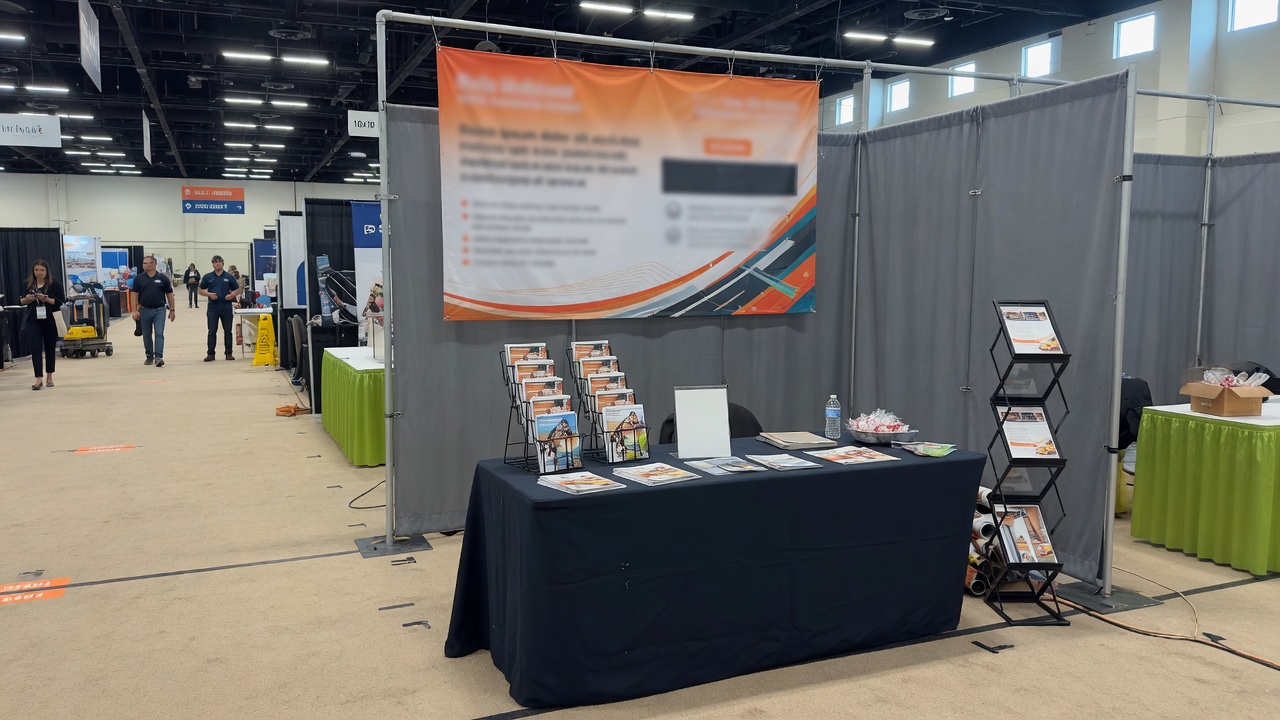
Quantity is part of size. One 8×8 does not become a 20-foot run. Two 8x10s with a 6-inch gap are not a wall. Order the unit that matches the mark on the carpet, then order a spare if you split a posed wall and a registration wall. Do not order a booth-width graphic because someone on the committee used to exhibit at Anaheim. A photo wall is not a trade show display back wall, even when the frame looks similar. Different crop, different grid, different night.
Fabric versus vinyl for a photo wall
This comparison is indoor photography in Orange County hotels and assembly rooms. It is not outdoor vinyl versus outdoor fabric. Outdoor scrim, mesh, and grommeted fence banners are a different product family with different UV, wind, and hem problems. If the “red carpet” is actually on a Spectrum patio or a hotel terrace with wind, stop. You are not on this page. Ask us for an outdoor-rated hang. Do not take an indoor dye-sub pillowcase into a breeze and then blame the ink.
| Material | How it photographs | How it hangs | Typical Irvine use | Where it fails |
|---|---|---|---|---|
| Dye-sub polyester fabric | Matte to low-sheen; flash does not glare; color in the fiber | Pole pocket, pillowcase on a frame, sewn hem with grommets | Galas, press, any night with a photographer and flash | Wrinkles if you skip the steamer; needs a mill sheet if fire asks |
| Smooth indoor vinyl | Can glare under flash and cans; sharper type at close range | Grommets, pole pocket, tape to a panel you own (not to hotel vinyl) | One-night walls on pipe when budget is the driver and lighting is controlled | Hotspots in photographs; heavier; creases can be permanent |
| Tension fabric on a frame | Taut, even, the cleanest photo surface we print | Pillowcase zipper over aluminum; feet on the carpet | Suites, repeating galas, brand-only walls you will reuse | Hardware cost; footprint of the feet; not a 20-foot carpet run unless you own a wide frame |
Dye-sub polyester is the default we recommend for Irvine photo walls. Dye-sublimation dyes the fiber. The color is in the cloth, not sitting on top like a banner ink. That is why fabric packs, why it can be steamed, and why it takes flash without turning into a mirror. Typical exhibit and event polyesters we print sit in a typical industry range of about 6 to 9 ounces per square yard, not a secret mill. Matte or a low-sheen knit is the photography choice. A shiny satin knit will still glare. Ask for the duller cloth if the night has a photographer. We typically print these as indoor fabric banners with sewn finishing, not as outdoor scrim.
Indoor vinyl still has a job. It is heavier, it hangs with fewer wrinkles if you tension the grommets evenly, and it can be the right call for a one-night pipe-and-drape wall when nobody is firing a speedlight at it. It is the wrong call when the photographer is using on-camera flash in a dark ballroom. Gloss vinyl is a disaster in that room. Satin vinyl is better and still brighter than fabric. If you insist on vinyl for a gala, we will print satin and tell you to keep lights off-axis. We will not promise the photographs will match a matte fabric wall from last year.
Tension fabric on a frame is fabric plus hardware. The pillowcase zips over aluminum. The surface is taut. Photographers like it because wrinkles are not the content. Event producers like it because it packs and because you are not borrowing hotel drape. It fails when the frame is too small for the group photo, when the feet sit in the carpet run, or when you expected a 20-foot arrival wall out of an 8-foot kit. Many Orange County teams own an 8-foot or 10-foot frame for the posed mark and still print a pipe-hung fabric run for the arrival. That pairing is honest. A row of retractable stands is not a substitute for either one. You will see bases, poles, and vertical gaps. Guests will also see whatever is behind those gaps — house drape, a service door, another event’s signage.
Blockout versus single layer matters when light sits behind the wall. Hotel pre-function with glass or with house lights behind gold drape can ghost a single-layer fabric. A blockout or a lined pillowcase keeps the grid as the grid. Single-layer dye-sub in front of black drape is usually fine. Single-layer in front of a window at 4 p.m. is a silhouette of the parking structure. Tell us what is behind the wall.
Flame paperwork rides with the textile. Fabric is the item inspectors ask about. Ask for the mill sheet if the hall will ask about NFPA 701 or California Title 19. Treated fabrics and inherent-FR polyesters are not the same chemistry. Both can carry a sheet. A spray treatment in the marshalling area is not a sheet. Vinyl films are a different fire conversation; some indoor vinyls carry their own documentation and some do not. Say the venue on the quote so we spec the cloth, not a hope.
Hems, pockets, and grommets are finish, and finish is on the quote. A pole pocket is a sewn tunnel. Measure the crossbar. A pocket that is too tight peels. A pocket that is too loose gathers and photographs as a wave. Two- to four-inch pockets are a typical industry range; oversized drape pipe wants a larger pocket. Grommets in a sewn hem, typically every 12 to 24 inches, are for S-hooks and bungees on pipe. Do not mix “grommets like a fence banner” with a photo wall unless the hang actually is S-hooks. Tension frames want a sewn pillowcase with a zipper, not grommets. We will not put fence-spacing grommets in a pillowcase and wish you luck.
Quote fabric or vinyl for your Irvine logo wall
Pipe and drape, frames, and how the wall actually hangs
The hang is half the photograph. A perfect grid on a sagging, wrinkled, off-center hang still looks like a sagging, wrinkled, off-center hang. Decide the hang before we print, because the hang changes pocket size, grommet count, file safe zone, and whether we sew a pillowcase or a flat panel.
House pipe and drape
Orange County hotels often provide black, white, or gold drape on uprights with a crossbar. Your graphic hangs in front of that drape, or replaces a bay of it. Confirm which. If you hang in front, the house drape is a liner — useful as blockout, dangerous if it bunches and prints a ridge through your fabric. If you replace a bay, the width of the graphic must match the bay. Bays are not always 8 feet. Telescoping drape supports make bays that are “about 8” until they are 7-foot-6. Measure the installed pipe, or give us a range and a little extra width with a finished edge that can wrap.
S-hooks through grommets are the banquet-crew default. They are fast. They also create scallops between grommets if the fabric is light and the spacing is wide. Closer grommets, a bottom pocket with a bar, or clips along a rail will flatten the hang. A bottom bar is the difference between a photo wall and a shower curtain. If the photograph is full-length, budget the bottom bar. If the photograph is head-and-shoulders, you might get away without it. Might.
Pole pockets on the top (and sometimes the bottom) are cleaner than grommets when you control the crossbar. You slide the pipe through the pocket, set the uprights, and the hang is a sleeve, not a series of points. You need access to slide the pipe. You need a pocket diameter that matches. You need to tell us whether the uprights bite into the pocket ends — they often do — so we leave a quiet hem there instead of a logo.
Do not tape a step-and-repeat to hotel wallcovering. Do not Command-strip it to millwork. Do not staple it to house drape. The captain said no. The adhesive will say yes until it takes the vinyl with it. Freestanding or pipe-hung only, unless you own the wall.
Tension frames you bring
An aluminum frame with a zipper pillowcase is the hang we recommend when you will reuse the wall, when the hotel will not guarantee pipe, or when the room is a suite with no drape. The graphic is sewn to that frame’s template. “8-foot frame” is not a standard the way a #10 envelope is a standard. Send the make and model, or a photo with a tape on the upright. We can print a skin for hardware you already own. We cannot guess a corner radius.
Setup time is part of the product. A trained person can skin an 8-foot frame in a few minutes. A volunteer who has never seen a pillowcase graphic can spend twenty, put a twist in the fabric, and leave a wrinkle across face height. Pack a printed diagram in the case. Label the top. Zippers usually go at the bottom or a back corner; do not face a zipper at the camera.
Feet and lights compete for floor. Frame feet need carpet. Light stands need carpet. The posed mark needs carpet. Draw the footprint. An 8-foot frame is not only 8 feet wide; the feet often sit outside the graphic. In a suite doorway, confirm the case and the assembled frame will pass. Hotel freight elevators are kinder than a suite corridor with a low soffit.
This is photo-wall hardware, not a lecture on exhibit back-wall systems. If you need a booth kit for Anaheim, that is a different conversation on the trade show displays page. If you need a gala wall that happens to use a similar frame, stay here. We will tell you when you are about to order the wrong skin for the right frame.
What not to use as a step-and-repeat
A row of retractable banner stands is not a logo wall. You will see every cassette, every pole, and a vertical gap of room between panels. The grid will not align across stands unless you designed six separate files to a cassette template and the stands are perfectly plumb, which they will not be on banquet carpet. Pull-ups belong in a registration line. They do not belong behind the honoree.
Foam boards on easels are not a logo wall. They are posters. They clip, they ding, and they photograph as posters on easels. Pipe-and-drape with no graphic is gold fabric. That can be a look. It is not a sponsorship fulfillment.
Outdoor A-frames, mesh, and fence banners are not a photo wall. If the arrival is on a terrace, we will spec a weighted outdoor frame or a different media. We will not grommet indoor knit and send you into the wind.
Lighting, flash, and what the photographer needs
Ink is not lighting. A matte fabric wall still fails if the only light is a warm can directly over the pipe, or a speedlight firing straight into vinyl. Talk to the photographer before we lock gloss, and talk to us before the photographer assumes the wall is a 18-percent gray. It is not. It is a grid of marks at whatever contrast you designed.
On-camera flash on glossy or satin vinyl is a hotspot in the shape of the flash. The hotspot sits on a logo. That photograph is the one that goes to the newspaper. Spec fabric, or spec satin vinyl and keep flash off-axis, bounced, or replaced with a pair of LED panels at 45 degrees. Two lights, one on each side, a little above face height, even wash, no colored uplight on the same surface. That is the typical industry setup for a press wall, not a studio manifesto.
Hotel cans are often 2700K to 3000K. Television crews bring 5600K. If both are on at once, the wall is two colors and the faces are two colors. Pick a white balance and light the wall to it. We print CMYK. We cannot print “whatever the news crew does at 6:10 p.m.” Dark navy fields drink light and drop the logos into the floor. Pure white fields blow out next to a black tuxedo. A mid-value field — charcoal, midnight with enough lift, a brand color that is not a cave — holds both the marks and the people. If the brand book insists on navy-on-navy, we will print it and tell you to add light.
Do not put the posed mark opposite uncovered west glass in late afternoon. Do not put it under a disco effect the DJ aimed at the dance floor. Do not let moving-head fixtures sweep the wall during posed photos. None of that is in the RIP. All of it is in the Flickr album.
Wrinkles photograph as wrinkles. Dye-sub polyester takes a fold in a crate, in a hot car, and in a bag that sat under a rolling case. Steam on site. Hang the wall as early as the hotel will let you and let gravity help. A handheld steamer in the kit is a tool, not a miracle. Hotel irons exist. Hotel irons also shine a logo if you crank the heat. Steam. Do not iron a face-down mark on a wood dresser. Deep creases from a rubber band are a reprint, and they are usually packing.
Phone cameras and news stills are not the same crop, but both hate glare and both hate a grid that disappears behind one person. If the only photographer is “whoever on the committee has a good phone,” design as if the camera is 8 feet away, slightly above eye level, with a hallway can for light. Larger logos, more contrast, brick grid, matte fabric, steam the wall. That sentence saves more galas than a 4K lighting plot you will not rent.
Files, vectors, dpi, and sponsor lockups
Artwork is where otherwise careful event teams lose a day. The file is not a slide, not a Canva export at 1920 pixels, and not a folder of PNG logos dropped onto an 8.5×11 board. It is a full-size wall, viewed at 8 to 20 feet in person and at arm’s length in a photograph, with strips of the design sacrificed to pockets, zippers, and feet. Build it at actual size or at a clean even scale (50 percent, 25 percent), in CMYK, with fonts outlined or packaged, and with bleed as extra image — not as a white strip you assumed we would add.
Resolution is a viewing-distance problem. For a step-and-repeat, 100 to 150 dpi at final size is a typical industry target that looks clean in a photograph from a few feet away. 150 dpi is what you want if there is a photographic texture or a fine pattern in the field. 100 dpi can hold a flat color field plus vector marks. 72 dpi web images, stretched across 96 inches, look like mush, and the mush will be behind the honoree. 300 dpi at full 8×20 size makes a file that is painful to transfer and does not print sharper in any way a guest can see from the carpet.
Do the math before you place a raster. An 8-by-10-foot wall at 150 dpi is 14,400 by 18,000 pixels if you rasterized the whole thing. You should not rasterize the whole thing. Vector the marks. Fill the field with a color or a vector pattern. Photograph only what you can actually feed. A photographic marble texture behind logos needs the pixels. A solid charcoal field does not.
Safe zones for this product:
- Keep marks out of pole pockets, typically the top 2 to 4 inches and any bottom pocket.
- Keep marks off zipper paths on pillowcases, and off the sides that wrap a frame.
- Keep the strongest band of logos in the photograph crop — about 36 to 84 inches off the floor for three-quarter poses, tighter at 48 to 78 inches for head-and-shoulders.
- Keep URLs, hashtags, and legal out of the live photo. If legal must exist, put it in a hem the camera will not keep.
- Keep seams out of face height when we have to sew panels.
Color is CMYK unless we have a reason to pull a spot. Hotel lighting is warm. A logo that looks correct on a calibrated monitor in an Irvine office park will read redder under 2700K cans. If a presenting sponsor’s red has to hit, say so and send a coated swatch or a prior printed piece. We still cannot reprint the hotel’s lamps. For most photo walls, contrast beats a perfect Pantone that disappears at 12 feet. Dye-sub on polyester and UV or latex on vinyl will not spectro-match each other under two different lights. If last year’s wall was vinyl and this year’s is fabric, tell the photographer, not just the brand book.
File delivery: PDF/X or a flattened high-quality PDF is fine if fonts are outlined, logos are vectors, and images are embedded. Native AI or INDD with packaged links is better if you want us to move a mark off a zipper. Do not send a Google Slides deck as an 8-foot document. Do not send a JPEG from a group chat. If the only art you have is a brand-portal PNG, say so early so we can tell you whether it is usable at 6 inches and unusable at 14.
Sponsor intake is a project, not a prepress trick. Set a deadline for vectors that is a week before our file deadline, not the same afternoon. Name the files. Convert spot colors to the wall’s color space or we will. Check each mark at the size it will print, not at the size it appears in email. One sponsor will send a mark with a tagline that is illegal at 8 inches because the tagline becomes the content. Crop it with permission or print it and live with a paragraph behind the honoree’s ear.
Mistakes that become reprints or a bad photograph
Most reprints we see on step-and-repeats are not RIP errors. They are grids that fail in the crop, gloss that fails in the flash, 10-foot skins on 8-foot pipe, and leftover sponsors. This is the short list we would rather walk through before we print.
- Logos so large a person covers them. A 30-inch presenting mark behind the honoree is a poster. Shrink it, repeat it, brick it.
- Logos so small they die in the photo. A 4-inch mark at 12 feet is texture. Size to the crop, not to how many sponsors you want to pack.
- Aligned columns on a group-photo wall. Every head covers a column. Offset the rows.
- The only important mark at the kick plate or in the ceiling pocket. Faces live around 60 inches off the floor. Put the paid marks there.
- Gloss vinyl with on-camera flash. A white hotspot on a logo. Spec matte fabric, or light off-axis.
- A 10-foot graphic on 8-foot house pipe. Sag, puddle, a captain conversation. Match height to the uprights.
- Two 8x8s taped as a 16-foot run. A gap through every walking shot. Print the width you need, with planned seams.
- A row of retractables as a “wall.” Poles, gaps, and house drape in the crop. Buy a wall.
- Raster sponsor logos. One soft mark in a sharp grid. Get the vector or omit the sponsor.
- No mill sheet in an assembly room. The wall sits in a crate while you argue with an inspector. Ask for the sheet when you ask for the fabric.
- Tape on hotel wallcovering. The BEO said no. The vinyl repair is yours.
- Hashtags, dates, and URLs as the content. They date the wall and they do not read in a three-quarter crop unless they are huge, in which case they fight the logos.
- Last year’s presenting sponsor. Sales teams are loyal to “the black bag in the closet.” The bag does not know who renewed. Read the wall in the parking lot.
- Wrinkles from a hot car and no steamer. Dye-sub polyester remembers a fold. Steam on site. Pack on the sewn lines.
- Colored uplights on the photo wall. Navy becomes purple. White becomes the gala color. Light the room, not the grid.
- Seam through face height. On a wide run, plan the sew line through a quiet field or along the grid, not through a mark at 62 inches off the floor.
- Pillowcase on the wrong frame. Corner radii and zipper sides vary. Measure the hardware you own.
- Outdoor duty on indoor knit. A terrace breeze lays the wall down and creases it. Indoor walls are indoor.
Leftover sponsors deserve their own paragraph. Development teams reprint menus and forget the wall. We have seen photo walls deployed with a title sponsor who dropped out, with a co-brand from a joint gala, and with a QR that 404s. If you reprint often, keep a thumbnail taped inside the case. If you do not reprint often, read every mark on the floor of the ballroom before guests arrive. We can turn a replacement skin quickly when the file is already built to the template. We cannot fix a livestream that is already using last year’s cloth.
Wrinkles deserve the other paragraph because they get blamed on the printer. Dye-sub polyester wrinkles in a crate, in a trunk on the 405, and in a bag that sat under a lighting case. Steam. Hang early. Stretch covers and tension frames fight wrinkles better and still take a fold if you pack them wet. Deep creases from a rubber band or a fold-for-the-hatchback are not a RIP error. That is a reprint, and it is usually packing. Vinyl remembers a fold as a white break in the ink. Do not fold vinyl. Roll it.
What to send so the quote is real
A useful quote for a step and repeat banner in Irvine names the live size, the grid, the material, the hang, the quantity, the finish, the flame paperwork, and the date you need it. “Need a logo wall for the gala next week” is a voicemail, not a spec. Send the following to Avanti Printing and we can price without twenty questions. Walk-ins at 15321 Barranca Pkwy, Irvine, CA 92618 are fine if you bring last year’s wall or a photo of the hotel pipe. Phone is (949) 387-0787.
- Venue and date: hotel name and room (Hotel Irvine ballroom, Marriott pre-function, suite, campus assembly), plus the first time you can hang.
- Hang: house pipe and drape (upright height and bay width), tension frame make and model, or “recommend from the room.”
- Size: 8×8, 8×10, 8×12, 10-foot high, carpet run width, or a tape on the installed pipe.
- Material: dye-sub fabric, satin indoor vinyl, tension pillowcase, or “recommend from the photography plan.”
- Finish: pole pocket diameter, grommet spacing, bottom bar, zipper side, satin versus any gloss you still think you want.
- Grid: brick versus columns, presenting-sponsor size, count of unique marks, who must appear at face height.
- Flame: mill sheet for NFPA 701 or Title 19 if the venue will ask.
- Quantity: identical versus versioned (English/Spanish, posed wall plus arrival run, a spare skin).
- File status: vector logos for every sponsor, or “we have PNGs and a hope.” Layout at actual size helps.
- Pickup or delivery: Irvine pickup is simplest. Hotel delivery needs a dock time, a banquet contact, and a wall that is labeled for the room.
Quotes confirm size, material, quantity, finish, and date. If any of those five is missing, the number you see is a guess. The hang and the grid are how step-and-repeat jobs miss the five even when the rectangle is clear. Rush exists when the fabric is in house, the vectors are clean, and you can pick up in Irvine. It does not exist when the presenting sponsor’s mark is a screenshot and the hotel will not confirm pipe height.
If you need matching stage banners, window film, or a cassette stand for the registration line, put those on the same request as separate lines. Different media, different finishing, different files. Mixing them into one “just like the wall but smaller” instruction is how outdoor vinyl ends up specified like a photo fabric, or a tension skin ends up with fence grommets. Keep the wall under the same PrintBig Irvine roof, on its own spec.
Send size, logos, and hanging notes for a quote
Frequently asked questions
What size step-and-repeat do I need for an Irvine hotel gala?
Use an 8×8 for a posed mark in a suite or a small dinner. Use 8×10 or 8×12 for a hotel gala posed wall where two or three people will stand. Use 10-foot height only if the house pipe or your frame is actually 10 feet and you need full-length gown shots. Use a separate 16- to 20-foot run for a walking carpet. Match height to the uprights in the banquet event order. Quotes still lock live size, pockets, and hems, not a round catalog nickname.
How far apart should the logos be?
Build a brick grid so a person does not cover every mark in a three-quarter crop. A typical industry range on an 8-foot wall is about 8 to 14 inches wide for secondary marks, 12 to 20 inches for a presenting mark, with center-to-center pitch often around 16 to 28 inches horizontally. Put the paid marks in the face-height band, about 48 to 78 inches off the floor for head-and-shoulders and 36 to 84 for three-quarter poses. Honor brand clear space. If the lockup leaves a 4-foot hole at face height, the photograph will too.
Should I print fabric or vinyl for a photo wall?
Fabric, if a photographer will use flash or if you will reuse the wall. Dye-sub polyester is matte, packs, and steams. Indoor satin vinyl can hang wrinkle-tighter on grommets and still glare. Gloss vinyl is the wrong gala surface. Tension fabric on a frame is the cleanest photograph if you own or will rent the hardware. This is an indoor photography choice. It is not an outdoor fence choice. Terrace wind needs a different spec.
Can the hotel’s pipe and drape hold the graphic?
Usually yes, if you match height to the uprights, match width to the bay, and finish for the hang: pole pocket to the actual pipe diameter, or grommets for S-hooks, ideally with a bottom bar so the wall does not scallop. Ask the BEO for upright height and whether you may bring a tension frame. Do not tape anything to wallcovering. Do not assume 10-foot drape in pre-function because the ballroom has it.
Do I need a flame certificate?
If the room is a hotel ballroom, a campus assembly space, a hospital venue, or any place of public assembly, budget the mill sheet. California’s State Fire Marshal can require decorative fabrics in those rooms to be nonflammable or treated. Hotels commonly ask for NFPA 701 language. That is a mill certificate, not a spray can. Tell us the venue on the quote so we pull a textile that has paper. Rigid hardware and laminated vinyl are a different fire conversation.
What files do you need for sponsor logos?
Vectors for every mark: PDF, AI, or EPS with outlines. Build the wall at actual size or an even scale, CMYK, fonts outlined, bleed into pockets. Photographs and textures at about 100 to 150 dpi at final size. 72 dpi PNGs from a website footer will look like 72 dpi PNGs behind the honoree. One soft sponsor ruins a sharp grid. If a sponsor cannot find a vector, they wait. We will not upscale a screenshot and call it a presenting mark.
How should we light a step-and-repeat in a hotel?
Even white or daylight-balanced light from both sides, slightly above face height, no colored uplight on the wall, no on-camera flash into vinyl. Matte fabric forgives more than satin vinyl. Do not face the wall into west glass in late afternoon. Steam the fabric before guests arrive. If the only camera is a phone, raise logo contrast and size; do not rely on a lighting plot you did not rent.
Can I reuse last year’s wall if a sponsor changed?
Not honestly. Tape-over marks on fabric look like tape-over marks. A leftover title sponsor is a development problem that will be photographed. Reprint the skin. Keep the frame or the pocket spec if the hang did not change. If only one secondary mark changed and you own a tension frame, we can often reprint the pillowcase to the same template quickly. Read the wall on the ballroom floor before doors. The closet does not know who renewed.
Hang a wall the camera can use
A step and repeat banner in Irvine fails when you buy gloss vinyl for a dark ballroom, a 10-foot skin for 8-foot pipe, or a single giant logo that disappears behind the honoree. It works when you spec the grid to the crop, the height to the uprights, the cloth to flash and to fire paperwork, and the hang to a hotel that will not let you touch the wallcovering.
Bring us the room, the pipe or the frame, and the vectors. Avanti Printing, 15321 Barranca Pkwy, Irvine, CA 92618, will spec an 8×8, 8×10, 10-foot, or carpet-run logo wall against that room, print on matte fabric unless you have a reason not to, and leave the presenting mark where faces actually are. Call (949) 387-0787 or send the quote form with size, material, quantity, finish, and date. We will tell you if you should have ordered a stage banner or a booth wall instead. For the nights in this article, you needed a photo wall. Print it like one.