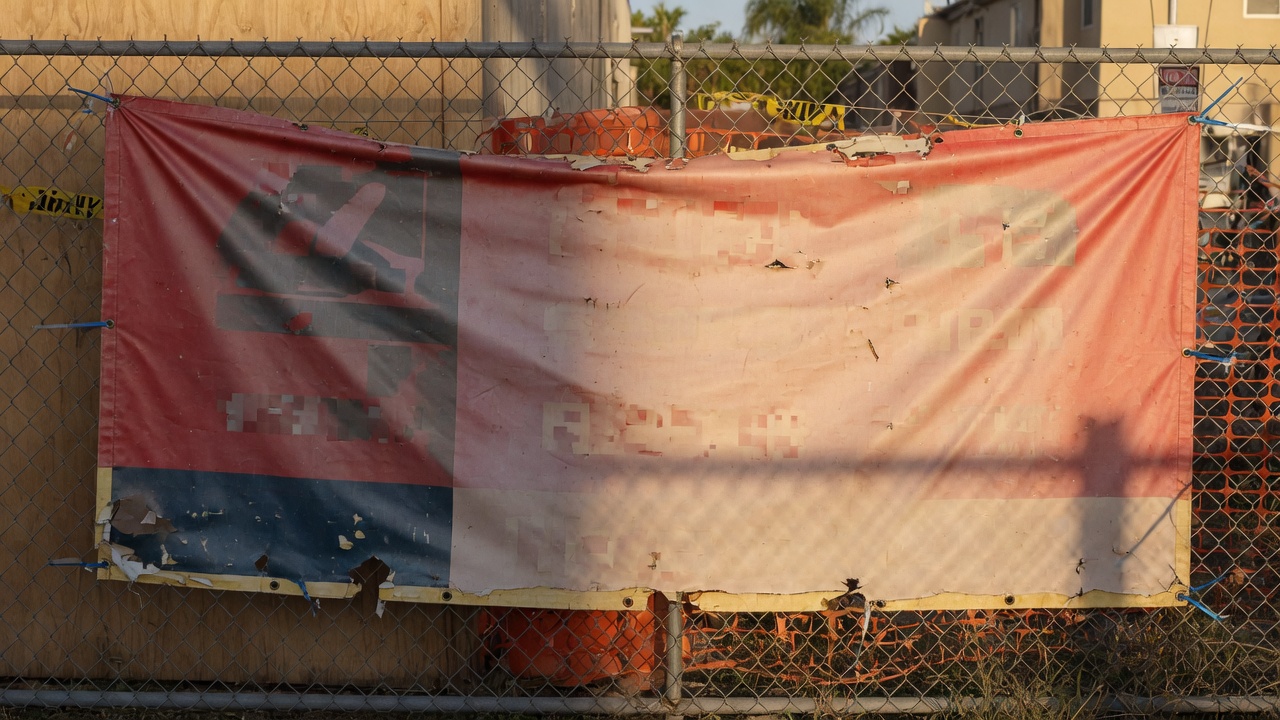
An outdoor vinyl banner in Orange County typically lasts one to three years in full sun on 13-ounce scrim, and often two to four years on 18-ounce, if you weld the hems, space the hardware, and keep the panel from flogging. Santa Ana winds, west-facing UV, and marine air near Newport Beach usually retire the banner before the vinyl itself expires. Reprint when color, hardware, or copy fail — not when a catalog promises five years.
Those ranges are typical industry figures, not a warranty. A 3-by-10-foot grand-opening banner on a shaded north wall in Irvine can look fine at month eighteen. The same 13-ounce panel, hung by four corner grommets across a gap in Santa Ana Canyon, can be a shredded flag after one wind event. Avanti Printing at 15321 Barranca Pkwy, Irvine, CA 92618 prints outdoor vinyl for both jobs. Call (949) 387-0787. Quotes confirm size, material, quantity, finish, and date. They should also confirm facing, hang method, and whether you will take the banner down between events.
This page is the estimator version of outdoor banner lifespan in Orange County. It is about 13-ounce and 18-ounce scrim vinyl, UV-stable inks, hems, grommets, pole pockets, and when to reprint. It is not a fabric comparison, not a mesh-versus-solid catalog, and not a tour of every large-format product we print. If you need a hanging vinyl for a fence, a storefront, a construction rail, or a pair of poles, stay on outdoor vinyl banner printing.
Who hangs outdoor vinyl in Orange County
If you run a shop, a job site, a leasing office, or a campaign anywhere from San Clemente to Brea, you already use outdoor banners as temporary architecture. They go on chain-link, on a storefront header, between two posts in a parking lot, or along a construction rail while the building still looks like a hole. You are not shopping a décor object. You are shopping a printed sail that has to survive Orange County sun and, a few times a year, air that comes down a canyon like it has somewhere to be.
Typical buyers we talk to from Irvine, Tustin, Santa Ana, Costa Mesa, Newport Beach, Huntington Beach, Anaheim, Lake Forest, and Laguna Hills are not asking “what is a banner.” They are asking how long this one will look like the brand if it lives on a west wall until the lease is signed, the unit is rented, or the grand opening is no longer grand. Marketing managers want one panel they can leave up for a season. Property teams want a fence run that still reads after a Santa Ana. Contractors want a permit board that does not bleach into a rumor. Restaurant and retail owners want a sale banner that comes down on Monday without taking the awning with it.
This is for you if the graphic will live outdoors, or in a window that behaves like outdoors. It is also for you if you already own a faded 13-ounce panel that is held by two zip ties and a prayer. It is not the right spec if you need an indoor pull-up stand, a rigid aluminum panel, or a graphic that is applied to glass as film. We print those too — large format printing in Irvine covers the wider menu — but the vinyl, the finishing, and the failure modes are different jobs.
California buyers outside Orange County use the same 13-ounce and 18-ounce scrims. The local twist is the climate stack: high summer UV, hot parking lots, dry canyon winds named after the river, and salt air if you are close enough to smell the harbor. Those conditions change weight, hardware, and reprint timing. They do not change the fact that a banner is a flexible PVC panel with a polyester scrim, finished so you can hang it, not a painted wall.
- Retail and restaurant operators along Barranca, Jamboree, PCH, and the Spectrum who need a sale or coming-soon panel on a header or fence.
- Contractors and developers hanging company ID, safety, and leasing copy on Irvine and Tustin job-site fencing.
- Leasing and property teams who keep a “now leasing” vinyl up longer than anyone admits in the original quote.
- Churches, schools, and civic groups putting event dates on poles or playground fences, then leaving them up because taking them down is nobody’s job.
- Coastal businesses in Newport, Costa Mesa, and Huntington who hang vinyl within a few miles of marine air and then wonder why the grommets rusted before the ink faded.
A working lifespan table, not a warranty
Ask five printers how long outdoor vinyl lasts and you will hear five confident numbers. The honest answer is a range, because sun dose, wind, hardware, and whether anyone used all the grommets matter more than the ounce number on the mill tag. Use the table as a decision frame for Orange County installs. Your quote still has to lock size, material, quantity, finish, and date — and we will still ask which way the wall faces.
| Install | Typical 13 oz range | Typical 18 oz range | What usually fails first |
|---|---|---|---|
| Event, 30–90 days, any OC city | The ink will outlast the event | Overkill unless the site is a wind tunnel | Installer haste: four corners, zip ties, no tension |
| Seasonal, 6–12 months, inland shaded or north wall | Usually still presentable if hung on every grommet | Extra tear margin you may not need | Dirt, irrigation spots, leftover dates |
| 12–36 months, south or west wall, full sun | Fade and chalking show; plasticizer gets tired | Color often holds longer; hems still need inspection | Ink and PVC face, then hem weld |
| Fence or gap in a Santa Ana corridor | One bad wind event can retire it | Tougher, not immortal | Corners, grommets, ties, then a zipper tear |
| Newport / Costa Mesa salt air, long hang | Fade similar to inland; metal suffers more | Same story; spec better hardware | Rusty grommets, then the hem fold |
| Stored indoors between uses | Years, if you roll it, do not fold it | Years; stiffer to roll | Creases, leader dirt, leftover campaign copy |
Read the table as “what we see,” not as a guarantee you can take to a landlord. Mill sheets for 13-ounce scrim often market a few years of outdoor life. Some 18-ounce blockout sheets market longer. Those numbers assume the panel is tensioned, the ink is outdoor-rated, and nobody turned the banner into a drumhead in a 50-mile-per-hour gust. Orange County will test all three assumptions.
If you need the graphic to look like a wall for five years, you are not in vinyl-banner territory. You are in rigid signage, applied film, or a permitted building sign under large format printing. A banner is the right product when you need size fast, you may change copy, and you can live with a reprint cycle. That is most of the outdoor vinyl we print on Barranca.
Fade is slow; hardware failure is fast
Buyers talk about outdoor banner lifespan as if the only clock were UV. In this climate, two clocks run at once. The slow clock is sunlight cooking pigment, plasticizer, and the PVC face. The fast clock is mechanical: wind, flogging, bad tension, cheap ties, and a hem that was never a hem. Most emergency reprints we see are the fast clock. The banner did not “expire.” A corner pulled out on a Tuesday night and the rest of the panel became a flag.
Flogging is the ugly verb. If a banner can slap itself, it will. Each slap fatigues the hem, elongates grommet holes, and scuffs the ink where the face hits hardware or fence wire. A panel that is drum-tight with no give will tear at a grommet when a gust hits. A panel that is laundry-line slack will beat itself to death in a breeze that would not bother a tensioned install. The useful middle is even tension with a little travel — bungees or springs, not a ratchet strap and not a grocery-bag knot.
The slow clock still matters. Orange County sun is not a museum lamp. West and south faces on Barranca, Jamboree, and PCH take a long, hard dose from late morning through afternoon. Magenta and yellow are usually the first hues to look tired. A navy field can chalk. A photograph that looked rich at pickup can look like a washed postcard at month fourteen if it faces west with no shade. That is ink and UV, not a printer who “used cheap toner.” We do not use toner on banners.
Water is the supporting actor. Vinyl scrim is PVC. Rain does not dissolve it. What water does is sit in a sewn hem, wick along stitch holes, freeze-thaw is not your problem here, and feed mineral spots from irrigation. Sprinkler overspray on an Irvine office-park fence will leave a white crust that looks like fade and is actually calcium. Wash it before you order a reprint. If the color still looks anemic after a rinse, then you are in UV territory.
Dirt is not a material defect. Exhaust, pollen, and restaurant grease on a PCH banner will gray a white field. Mild soap, a soft cloth, no solvents, no pressure washer on turbo. If you scrub with a green pad you will dull the ink and then blame the shop. We would rather you leave a little dust than sand the graphic off.
Orange County sun, orientation, and heat
Lifespan talk that ignores facing is marketing. A north-facing header under an awning in an Irvine courtyard is a different UV diet from a west-facing panel on a stucco wall that also reflects light. The EPA UV Index scale treats readings of 8 and above as very high to extreme, with extra protection needed late morning through mid-afternoon. Inland Orange County spends a lot of the warm season in that band. That scale is written for skin. Pigment is not skin, but it is not immortal either. More dose, more fade. There is no honest way around that sentence.
Orientation, in the order that actually changes a reprint date:
- West. Afternoon sun plus heat. The worst common storefront facing for color. A “now open” banner on a west wall in July is taking the full late-day blast after the vinyl has already warmed up.
- South. Long daily exposure. Not as brutal as a summer west wall in late afternoon, still a full outdoor spec. Do not talk yourself into indoor ink because “it’s only a south fence.”
- East. Morning sun. Often gentler on fade, still real UV. Marine layer can delay the start near the coast, then burn off into a bright late morning.
- North. Least direct sun. Dirt, irrigation, and wind still apply. North is where people hang a banner and forget it until the phone number is two owners ago.
Heat is the quieter partner of UV. Parking-lot asphalt, dark stucco, and a closed-in courtyard will run hotter than a thermometer at John Wayne Airport. PVC gets more limp in heat. A hem that was tensioned at 8 a.m. can sag at 3 p.m. and then flog. An 18-ounce panel still sags less than a tired 13-ounce, which is one reason we spec heavier vinyl for long, hot, west hangs — not because 18-ounce is magic, because it has more mass and a denser scrim.
The marine layer along the coast looks like shade and is not a UV vacation. May gray and June gloom cut morning dose near Newport and Huntington. When the layer burns off, you still have a high-sun afternoon. Inland Irvine, Tustin, and Anaheim Hills often skip the gloom and go straight to clear. If your company has one banner at a Newport location and one at an inland office park, do not assume they will age on the same calendar. The inland panel usually looks older first if both face south or west.
Reflected light counts. A banner hung six inches off a white wall is getting bounce. A banner over a light-colored parking lot is getting bounce. Glass near the panel can throw a hot spot. None of that requires a laboratory. Stand where the customer stands at 2 p.m. If you squint, the ink is squinting too.
Through-window sun is a cousin of outdoor sun. A vinyl banner taped inside a west-facing storefront is not “indoors” in any way the pigment respects. Heat also builds between glass and the panel. If the job is actually a window, stop using a grommeted banner as a giant sticker. That is a window graphics conversation — perforated, opaque, or frosted film made to live on glass — not a banner with extra tape.
Santa Ana winds and the sail problem
A solid vinyl banner is a sail. The bigger the rectangle, the more air it tries to stop. Orange County does not need a hurricane for that to matter. It needs a Santa Ana.
The National Weather Service describes Santa Ana winds as dry air that flows east to west through Southern California mountain passages, most common in the cooler months from September through May, often feeling warm because the air compresses as it descends. See the NWS note on mountain and valley winds, including Santa Ana winds.
Santa Ana winds occur when air from high pressure over the desert Southwest flows west toward low pressure off the California coast. They are most common from September through May, and they often feel warm because descending air is compressed.
Local hazard planning in south Orange County has long treated canyon-accelerated Santa Anas as a real windstorm class, not a folk tale. Gusts in passes and canyons can reach the kind of speeds that peel patio furniture. Fremont Canyon near Tustin and the Santa Ana River basin have a reputation for a reason. You do not need the peak gust on your particular fence for a banner to fail. You need enough cyclic loading to work a grommet out of a cheap hem.
Where that hits installs:
- Foothill and canyon-adjacent sites: Anaheim Hills, parts of Tustin, Orange, and the Santa Ana Canyon corridor. Air gets squeezed. A fence banner becomes a drum.
- Open parking lots and car dealerships. Nothing upwind. A 4-by-20-foot panel on two posts is a rectangle the wind can see from the 5.
- Construction perimeters. Long runs, temporary posts, and whoever hung it used the corner grommets only.
- Gaps. Hung across a driveway, a scaffold opening, or between two buildings. That is the worst geometry. You built a kite.
Hardware beats ounce-weight in a wind event if the hang is wrong. An 18-ounce banner with four corner ties will still start a tear at a corner. A 13-ounce banner on bungees at every grommet, with the panel close to a fence so air cannot get behind it as a sail, will often ride out a blow that destroys the “heavier” job. Put the panel on the fence, not in front of a hole in the fence, when you can. If you must span a gap, say so on the quote. We may talk about a heavier spec, more attachment points, a pipe in a pole pocket, or a different product. We will not pretend 13-ounce on four zip ties is an engineered wind design.
Wind slits are a religious argument in this trade. Some shops cut holes so air can pass. Those holes are also the start of a tear, and they punch the graphic. We do not treat slits as a default on outdoor vinyl in Orange County. If the site is that windy, the grown-up options are more attachment points, a closer mount to a fence, a pipe rail, or a mesh panel — and mesh is a different quote, not a paragraph that turns this article into a mesh catalog. Tell us the site. Do not DIY a row of holes with a hole saw on a finished print.
After a Santa Ana, walk the install before you schedule a reprint. Look at corners, elongated grommet holes, hem lift, and whether the panel now has a memory wave. A slightly stretched banner can still sell cars. A corner that has started to unzip will not make it through the next event. Repair is rarely honest on outdoor vinyl once a tear leaves the hem. Budget a reprint, and this time use every grommet.
Marine air near Newport Beach
Newport, Balboa, Costa Mesa near the water, Huntington, and Laguna do something inland Irvine does not: they throw salt and moisture at hardware all year. Morning damp, fog drip, then sun. PVC itself does not dissolve in that air. The metal in your grommets, the steel in your S-hooks, and the stitch line in a sewn hem will have an opinion.
Salt air failures we actually see:
- Steel or low-grade grommets rust, stain the hem, then crumble. The hole gets oval. The next gust finishes the job.
- Brass holds up better than bare steel. Stainless hardware is the coastal adult choice when the banner is staying up for a season or more.
- Sewn hems wick. Thread is a wick. A welded hem on 13-ounce is usually the cleaner outdoor edge because you are not inviting capillary water into a stitch line.
- Bottom hem can hold grit and salt if it is a pocket with no drain. Pole pockets at the bottom need a way to not become a salt trap.
- North-facing coastal panels grow a film of dirt and, in shady courtyards, biological crud that looks like fade until you wash it.
Distance from the water is not a moral ranking. A banner two blocks off PCH in Newport is still in marine air. A banner at 15321 Barranca is not. If you have both locations, spec the coastal hardware as if it were coastal. Do not reuse the inland leftover grommet kit because it is in the truck.
Marine air does not cancel UV. It sequences it. Damp morning, bright afternoon, salt on the face. Rinse the banner when you rinse the windows. If you would not leave a steel patio chair untreated on that patio, do not leave steel grommets as the only plan for a year-long hang in Newport. Say “coastal, long hang” on the quote so we do not default to the same finish we use for a weekend sale in an Irvine strip center.
Wind at the coast is often a different wind from a Santa Ana. Onshore afternoon breeze is frequent and lower drama, but it is daily. Daily flogging on a slack storefront banner will scuff a hem as surely as one named wind event. Tension still matters when the air smells like the harbor.
13-ounce versus 18-ounce scrim
The ounce number is weight per square yard, not a thickness you can read with a ruler in the parking lot. Thirteen-ounce scrim is the default outdoor banner in this shop and in most of the industry: a polyester mesh buried between PVC layers, flexible enough to roll, printable, and finished with a welded hem and grommets. Eighteen-ounce is a heavier, stiffer cousin, often with a blockout core. It resists tearing and abrasion better. It is not a different species. It is more vinyl and, usually, a denser scrim.
Choose 13-ounce when the hang is weeks to a year, the site is not a wind tunnel, you want the panel to roll into a box, and you may reprint when the offer changes. Grand openings, sale weekends, leasing fences that will come down when the building opens, school events, and most storefront headers live here. It is also the right call when you are going to take the banner down and store it. Rolling 13-ounce is a one-person job. Wrestling 18-ounce into a hatchback is a worse afternoon.
Choose 18-ounce when the panel will stay up through a summer and a Santa Ana season, when people walk into it, when you need blockout for a double-sided pole hang, or when the span is long and you do not want the face to oil-can in heat. Street-pole style hangs, long-term “now leasing” on a west wall, and banners that get brushed by carts or backpacks earn the extra weight. You pay more. You also reprint less if the hang is competent.
What 18-ounce will not do: forgive four corner grommets, survive a gap-spanning kite, or keep cheap steel hardware from rusting in Newport. Weight is tear and abrasion insurance. It is not a substitute for finishing or for using all the attachment points.
Double-sided work wants a blockout. Two 13-ounce panels taped back to back is a sloppy sandwich that ghosts in the sun and peels at the edge. If both faces must read, say so. We will spec a blockout 18-ounce or a true double-sided construction. A single 13-ounce in front of a bright sky will show as a silhouette, not as a second page.
Matte versus gloss is a finish choice on top of weight. Gloss pops color and shows every wipe mark. Matte reads easier in afternoon glare, which is most of Orange County retail after 2 p.m. For a west-facing sale banner, matte is the less annoying outdoor face. If brand guidelines demand gloss, we can print it. You will still have a mirror at sunset.
Flame rules show up when a banner hangs in a public-assembly interior or some outdoor events that ask for a certificate. Many banner vinyls are tested to NFPA 701. If a venue or city inspector will ask, tell us before we print so we pull a mill sheet that matches the roll on the printer. Do not hang a leftover promotional vinyl in a ballroom and hope. That is a different conversation from outdoor lifespan, and it still belongs on the quote.
We can share the mill sheet for the vinyl on your job. Those sheets often list tensile and tear using coated-fabric methods such as ASTM D751. We will not pretend a generic number off the internet is your roll. If you have an engineer or a general contractor who wants the sheet, ask. It is a better document than a blog paragraph.
What “UV inks” actually buy you
People say “UV ink” and mean three different things. One is UV-curable inkjet, ink that is cured with lamps as it prints. One is “the ink is UV-resistant,” a fade claim that can apply to latex, eco-solvent, or UV-cured systems. One is a laminate with UV inhibitors. Outdoor vinyl banners at this plant are typically printed with outdoor-rated inkjet — latex or UV-curable depending on the job — onto scrim that is itself made for sun. We do not, as a default, laminate outdoor grommeted vinyl the way we might laminate an indoor panel. A laminate on a flogging banner can edge-lift. Durability comes from the ink system plus the vinyl, not from a gloss film you hope is a raincoat.
What outdoor-rated ink buys you is time on the slow clock. It does not buy you a pass on west-facing summer sun. It does not buy you a pass on flogging. Accelerated weathering in a QUV cabinet is a lab story. Your parking lot is not a cabinet. Typical industry talk puts noticeable fade on a full-sun outdoor vinyl somewhere in the one-to-three-year window depending on pigment, facing, and how dirty you let it get. Inland west walls trend earlier. Shaded north walls trend later. We will not give you a fake month count for your exact magenta.
Color choices change the fade you notice. A white field with black type still reads when it is a little chalky. A photo-real sunset, a pastel brand, or a thin gold on navy will look “old” sooner even if the vinyl is intact. High contrast is not only a design lecture. It is how a slightly faded banner still sells from the second row of the parking lot. If the art is a soft gradient hero, budget an earlier reprint or a less brutal facing.
Ink adhesion on dirty vinyl is not an outdoor-lifespan problem; it is a reprint-on-day-one problem. We print on clean roll stock. If you bring a banner to reprint over, that is not how this process works. We print a new panel. Do not ask us to “just hit the logo again” on a two-year-old fence banner. The old face is oxidized, dirty, and already a different color.
Takeaway for the quote: say outdoor, say facing if you know it, say how long you want it to look intentional. We will pick an outdoor ink system and a vinyl weight. We will not print an indoor film, grommet it, and call it a two-year outdoor banner. That mismatch is how you get a pretty panel that chalks before the lease is signed.
Grommets versus pole pockets
Finishing is where outdoor banner lifespan is won or lost. The print can be perfect. If the edge cannot take load, you own a poster with holes. The two hardware languages on outdoor vinyl are grommets and pole pockets. Many long hangs use both: a pocket on the top for a pipe, grommets on the sides and bottom for ties. Tell us how it will hang before we finish it. “Standard banner” is not a hang method.
Grommets
A grommet is a metal ring set through a hem so a tie can load the hem, not a raw hole in the face. We typically set them at corners and then every 18 to 24 inches along the edges. That spacing is shop practice, not a building code. On a tall, skinny panel, or on a site we know is windy, we tighten the spacing. On a small indoor-adjacent header, we may not need a grommet every 18 inches. The rule you should not break: use all of them. Loading only the two top corners is how a 10-foot banner becomes a 10-foot tear.
Size is usually a #2 or #3 grommet. Bigger is not automatically stronger if the hem is still a single fold of 13-ounce. The hem has to be wide enough and welded well enough that the grommet sits in a reinforced edge. Corner patches or doubled hem at corners are the difference between a banner that rides out a gust and a banner that starts unzipping at the top left, which is where they always start unzipping.
Ties: ball bungees are the default we recommend for fences and frames because they give. Rope works if you can keep even tension and you are not sawing the grommet with a thin, sharp line. Zip ties are a trap. They have no give, they cut vinyl when the panel moves, and they become brittle in UV. If you already zip-tied last year’s banner, look at the holes. They are ovals. That is the post-mortem.
Mount the panel close to the fence or wall so wind cannot balloon it. A six-inch standoff turns a fence banner into a sail. Banner tape (the webbing with hooks) distributes load better than a single S-hook at each corner. Whatever you use, match corrosion resistance to the site. Newport does not want the same steel kit you used in an Irvine warehouse park.
Pole pockets
A pole pocket is a welded or sewn tunnel along an edge, usually 2, 3, or 4 inches depending on the pole. You slide a pipe, a dowel, or a banner arm through it. Load is spread along the pocket instead of concentrated at rings. That is why street-pole style hangs and many header hangs prefer a pocket on the top — and often the bottom — instead of a row of grommets that all try to be the top edge.
Measure the pole. A 1-inch pocket on a 1.25-inch pole is a wrestling match that peels the weld. A 4-inch pocket on a skinny dowel will gather and look drunk. Tell us the outside diameter of the pole and whether the ends of the pocket should be open or closed. Closed ends keep the pole from walking out. Open ends are easier to feed. We can also leave a center gap in a long pocket so you can bolt the pole to a wall cleat. That is a drawing, not a guess in finishing.
Pole-pocket failures are specific. The pole is rough and saws the inside of the tunnel. The banner flogs around a loose pole and the weld peels. Water and salt sit in a bottom pocket with no drain. Someone uses the pocket as a hem but still hangs the banner from two corner grommets, so the pocket never does any work. If you paid for a pocket, put a pole in it.
Pockets and grommets together are the grown-up outdoor spec for many Orange County jobs: pole in the top pocket so the header stays straight, grommets on the vertical edges so you can tension to posts or a fence, grommets or a second pocket at the bottom so the panel cannot kick. That finish costs more than “grommets all around” and it is why some banners still look square in month ten.
Do not mix this up with an indoor retractable cassette. A pole pocket on outdoor scrim is a tunnel for a pipe. It is not a roller mechanism. If you need a pull-up stand, that is indoor media and different finishing. If you need outdoor vinyl, we are on this page.
How hems actually fail
The hem is a fold of vinyl welded or sewn so the edge is two or more layers. Grommets live in that stack. Pole pockets are a hem that became a tunnel. When people say a banner “ripped,” they usually mean the hem let go, then the scrim unzipped along the weave.
Welded hems (RF or hot-air, depending on the shop path) are the outdoor default on 13-ounce. The PVC face is fused to itself. There is no stitch line to wick water and no thread to UV-rot. A good weld is even, wide enough for the grommet, and not so hot that it starves the scrim. A cold weld looks closed on Tuesday and opens on the first gust. A weld that is only in the center of the fold, not out to the edge, gives you a pocket for wind to get under. We inspect that. You should still not treat a banner as if the hem were structural steel.
Sewn hems show up on some heavier builds and on some mesh jobs. Thread is a UV item. Stitch holes are perforations. For outdoor 13-ounce in Orange County, we would rather weld. If a spec sheet you were handed says sew, we can sew, and we will talk about UV-rated thread and whether you also want a weld. Tape-only hems — adhesive banner tape folded over the edge — are for indoor short-term and for emergencies. They are not a one-year west-wall plan. The tape lets go in heat, then you have a raw edge and a grommet in one layer of vinyl, which is a tear waiting for a name.
The failure sequence is boring and preventable:
- Load concentrates at a corner because only two ties were used.
- The grommet hole eggs out.
- The weld or stitch starts a zipper down the hem.
- The scrim takes over and the tear runs into the graphic.
- Someone cables-ties the wound and leaves it up, which looks worse than a blank fence.
Single-layer grommets with no hem fail faster than that. If you ever trimmed a banner in the field with a utility knife and then punched holes with a hole saw, you did not create a new finish. You created a tear pattern. Bring it back. We can sometimes recut and rehem a panel if there is enough spare image. Usually there is not, because the file had no bleed into the hem and the logo sat on the edge.
Hem width matters. A half-inch fold does not give a #3 grommet enough meat. A 1-inch to 1.5-inch hem is the kind of boring spec that makes outdoor vinyl last. Corners want more: a triangular weld, a webbing patch, or a doubled fold. That is finishing time on the quote, not a free extra we “just do.” If your last banner died at the top corners, say so. We will finish this one like we believe the wind.
Bottom hems fail in a quieter way. They scrape the ground, collect water, and get hit by weed trimmers and shopping carts. If the banner is sized to the fence, leave a little daylight at the bottom. A panel that puddles on asphalt will look dirty in a month and torn in a season. Measure the hang, not only the fence panel opening.
When to reprint
Reprint when the banner stops doing the job, not when a mill sheet’s year-count runs out. The job is: readable from the distance that matters, hardware intact, copy still true. Outdoor banner lifespan in Orange County is a maintenance question as much as a materials question.
Walk the panel from the parking lot, not from a phone photo taken five feet away. If you can still read the offer, the phone number, and the name, and the corners are round holes not slots, you can keep hanging it. If you have to explain the color, or if a corner is flapping, you are in reprint territory. Customers do not give you credit for a banner that is “still pretty good if you stand to the left.”
Hard reprint triggers:
- A date, price, phone number, or URL that is wrong. Tape-over letters on outdoor vinyl look like tape-over letters. Print a new panel.
- A tear that has left the hem. Field tape is a weekend, not a strategy.
- Grommets that have torn out at two or more corners.
- Fade you can see as a brand problem from the street — washed reds, a chalky field, a photo that has gone gray.
- Rust stains and rotten hardware on a coastal hang, even if the ink is acceptable. Replace the panel and the metal together.
- A Santa Ana or a pole-pocket peel that wrinkled the face. Creases in PVC do not iron out in the sun. They become the new graphic.
- You are tired of looking at last year’s campaign and so is everyone who drives Barranca.
Soft reprint triggers — the ones people ignore until Open House:
- Irrigation spots that will not wash.
- A hem that has started to lift but has not torn.
- A banner that has been up so long the company logo in the file is the old one.
- A “coming soon” that became “we live here” eight months ago.
Take seasonal banners down. A 13-ounce panel that works three weekends a year and lives in a roll in an air-conditioned office will outlast a 13-ounce panel that lives on a west fence from January to January. Roll it, print side out or at least without a tight print-to-print fold, keep it off a hot car trunk, and do not stack boxes on it. Folding outdoor vinyl is how you put a white crack through a logo. We will reprint that. We will also tell you it was the fold.
If the copy still works and only the hardware is tired, we can sometimes recut, rehem, and regrommet a panel that still has image to spare. That is a maybe. It is not cheaper than a new print if the face is already faded. Send a photo in daylight. We will say reprint or rehem. We will not charge you for optimism.
Plan the reprint before the fail if the date is fixed. A grand opening, a permit inspection, a holiday sale — those are calendars. Outdoor vinyl is not a same-hour business-card counter product when you need 18-ounce, pole pockets, and a 4-by-20-foot panel. Put the date on the first email.
Quote an outdoor vinyl banner for Orange County
Mistakes that turn into reprints
These are the repeats. They come from competent people who were in a hurry, and from files that were built like a social post.
- Four corner grommets on a long panel. Wind loads the middle. The middle has nothing. Use the spacing we set, or ask for more.
- Zip ties, no give. Oval holes, then tears. Bungees or a pocket and a pole.
- Hung across a gap like a billboard. You built a sail. Mount to a fence or a frame, or spec for a span on purpose.
- Indoor ink or indoor film, outdoor hang. It will look heroic at pickup and tired after a west-facing month.
- Tape hem on a year-long hang. Heat and UV will tell on it.
- Steel grommets in Newport for a long stay. Rust is not a printing defect.
- Critical copy in the hem. Phone numbers, QR codes, and legal lines sitting in the last inch vanish into the fold or the pocket. Keep live matter inside a safe zone.
- Web-resolution art on a 4-by-8-foot face. Outdoor viewing distance is forgiving. It is not that forgiving. Vector logos. Photos with actual pixels at size.
- Wrong size because someone measured the chain-link panel, not the opening, and ignored the hem. A finished 3-by-8 with a 1-inch hem all around started larger. We will ask whether your size is live image or finished size. Answer that.
- Leftover dates and old logos. The banner is still physically fine. It is still lying. Reprint.
- Pressure washing. You will drive grit through the ink. Rinse, don’t sandblast.
- Folding for the trunk, then hanging the crease in the sun. PVC remembers. Roll it.
- A banner used as window film. Tape residue, heat between glass and vinyl, and a graphic that will not last like film. Use window graphics on glass.
- Ignoring the landlord, HOA, or city. A perfect banner on a monument it was not allowed to occupy is a perfect banner in a dumpster. Irvine office parks and retail centers have rules. Coastal cities have rules. Construction sites have permit boards. Check before we print a 4-by-16 you cannot hang.
File setup is not this article’s job, but it still reprints banners. Build at finished size plus bleed that continues through the hem. Keep type out of grommet spots. Outline fonts or package them. CMYK. If the only art is a PNG from a website header, say so early. We can tell you whether it holds at fence distance. We cannot invent a vector wordmark from a 400-pixel logo the night before a grand opening.
Landlord and city rules are not print defects, and they still end outdoor banner lifespan at day zero. Irvine Company retail and office criteria, City of Irvine sign permits for some wall and temporary signs, Newport and Costa Mesa temporary-banner rules, HOA architectural committees — none of those boards grade on color gamut. If you need a permitted wall sign, that may be a rigid panel, not a grommeted vinyl. Ask them, then ask us.
What to send so the quote is real
A useful quote for outdoor vinyl names size, vinyl weight, quantity, finish, and the date you need it. “Need a banner for the fence” is a voicemail. Send the following to Avanti Printing and we can price without twenty questions. Walk-ins at 15321 Barranca Pkwy, Irvine, CA 92618 are fine if you bring the dead banner. Phone is (949) 387-0787.
- Finished size, width by height, and whether that number is the opening or the vinyl after hems.
- Where it hangs: city, fence, wall, poles, storefront header, construction rail. Facing if you know it. Coastal or inland.
- How long you want it to look intentional: a weekend, a quarter, a year, “until it dies.”
- Material: 13-ounce, 18-ounce, or “recommend.” Single-faced or blockout double-sided.
- Finish: grommets (spacing), pole pockets (which edges, pole diameter, open or closed), or both. Matte or gloss.
- Quantity and whether art is identical or versioned (English/Spanish, two addresses, two dates).
- File status: vector logo, photo that actually has pixels, or a PNG and a deadline.
- Date: first day it must be on the fence, not “ASAP.”
- Pickup in Irvine versus delivery to a job site. A rolled 18-ounce 4-by-20 is a two-person carry.
Quotes confirm size, material, quantity, finish, and date. If any of those five is missing, the number you see is a guess. Rush exists for many standard 13-ounce grommeted sizes when the file is clean. It is a different conversation for custom pole pockets, 18-ounce blockout, and a file that is still in a group chat. We will say no if the honest answer is no.
If the same campaign also needs posters, rigid boards, or glass film, put those on the request as separate lines. Mixing them into one “just make it big” instruction is how outdoor vinyl gets specified like an indoor poster, or a window gets a grommeted banner taped to it. Start with banner printing in Irvine for the hanging vinyl, and keep the other products on their own specs under the same PrintBig Irvine roof.
Send size, vinyl weight, and hang method for a quote
Frequently asked questions
How long does an outdoor vinyl banner last in Orange County?
Plan on about one to three years of presentable life for a 13-ounce scrim banner in full sun if it is welded, grommeted on a sensible spacing, and tensioned with a little give. Eighteen-ounce often stretches that toward two to four years on the slow UV clock. A Santa Ana, a four-corner hang, or marine-air rust can retire either one in an afternoon or a season. Those are typical industry ranges, not a warranty. Facing, hardware, and whether you take it down between events will move you inside the range.
Is 18-ounce always better than 13-ounce?
No. Eighteen-ounce is better at tear, abrasion, long hot hangs, and double-sided blockout. It is heavier, stiffer, and easier to hang badly if you still use four corners. Thirteen-ounce is the right outdoor vinyl for most seasonal Irvine jobs and anything you will roll and reuse. If the site is a canyon-adjacent fence or a year-long west wall, we will push 18-ounce. If the site is a two-week sale, we will not upsell you weight you will not use.
Should I spec grommets or pole pockets?
Grommets if you are tying to a fence, a frame, or existing eyes, and you will use all of them. Pole pockets if you have a pipe, a header rod, or a street-pole arm and you want a straight edge. Many outdoor jobs want both: pocket on top, grommets on the sides and bottom. Send a photo of the hang and the pole diameter. Do not order grommets and then try to slide a pipe through them. Do not order a pocket and then hang the banner from two nails.
Will Santa Ana winds destroy the banner?
They will if the panel can balloon, if only the corners are tied, or if it spans a gap. They might not if the banner is close to a fence, tensioned on bungees at every grommet, and finished with a real hem. Watch NWS wind headlines in the September–May pattern and walk the site after a blow. Replace a starting tear. Do not wait for the zipper to reach the logo. Weight helps. Geometry and hardware help more.
Does marine air near Newport ruin vinyl?
It ruins hardware first. PVC scrim handles damp; steel grommets and cheap hooks rust, stain, and then tear out. Spec better metal, prefer welded hems, rinse salt when you can, and do not leave a bottom pocket as a standing bath. Fade still follows sun. A Newport west wall is still a west wall. Coastal just adds corrosion to the list.
What does UV ink mean on a quote?
Ask which meaning they are using. UV-curable inkjet is a print process. UV-resistant is a fade claim that several ink families make. Neither is a five-year outdoor contract by itself. We print outdoor vinyl with outdoor-rated inks on outdoor scrim. We still want facing, hang time, and finish on the ticket. If someone offers “UV ink” on an indoor film with grommets, that is not an outdoor banner.
Can I wash it, patch it, or take it down and reuse it?
Wash with mild soap and a soft cloth. Do not solvent it, do not pressure-wash it on turbo, do not green-pad it. Small hem issues can sometimes be rewelded if the face is still good. Tears in the field of the graphic are a reprint. Reuse is the hidden lifespan trick: roll it, store it cool, hang it again. Folding, hot trunks, and stacking tiles on the roll are how reuse becomes a crease through the wordmark.
What if I need it on the fence this week?
Call (949) 387-0787 with finished size, 13-ounce versus 18-ounce, grommets or pockets, a usable file, and the date. Clean vector art on a standard 13-ounce grommeted size is a different rush than a custom 18-ounce double-sided pole pocket. Quotes still confirm size, material, quantity, finish, and date — including a date that is soon, if we can meet it. We will tell you if the finish you want does not fit the calendar.
Hang it like the wind is coming
Outdoor banner lifespan in Orange County is not a mystery number on a vinyl sample. It is 13-ounce or 18-ounce scrim, outdoor ink, a weld you can trust, hardware that matches the site, and a hang that assumes Santa Ana air and west sun. Fail the hem and the banner dies young. Face it west and the color ages. Hang it in Newport on steel grommets and the metal goes first. Do those things on purpose and a vinyl banner is still the fastest large graphic you can put on a fence, a header, or a pair of poles.
Bring us the wall, the wind, and the file. Avanti Printing, 15321 Barranca Pkwy, Irvine, CA 92618, will spec weight and finish against that site, print on outdoor vinyl, and leave the phone number out of the hem. Call (949) 387-0787 or send the quote form with size, material, quantity, finish, and date. We will tell you when you should have ordered a rigid sign or a window film instead. Most of the jobs on this page should still be a banner — just not a four-corner banner in a wind event.