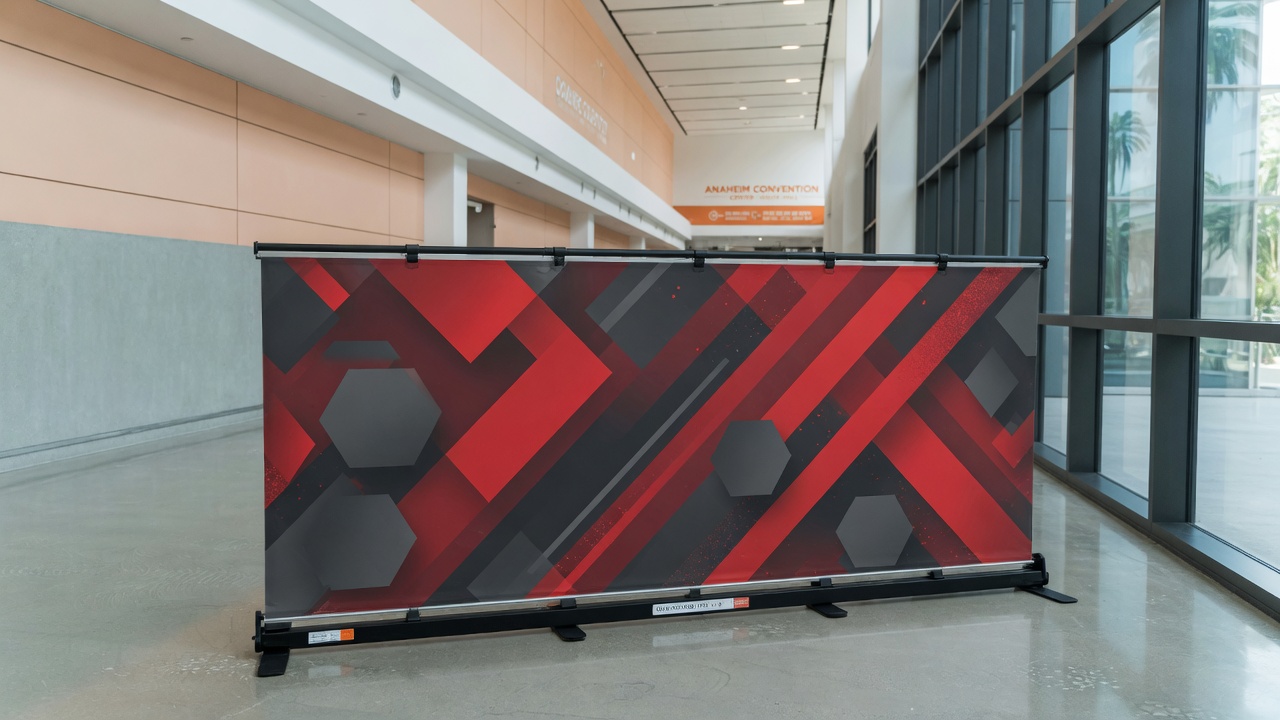
A retractable banner stand — pull-up, roll-up, same object — is a weighted cassette with a printed graphic you raise on a telescoping pole. Orange County marketers use 24×63 and 33×79 indoor stands for hotel foyers, Anaheim Convention Center aisles, UCI events, and Spectrum pop-ups. Pick size, hardware, and artwork to the room, not the catalog photo.
The catalog photo is always a white loft with a skylight. You are more likely to set up on patterned hotel carpet under one can light, next to a luggage cart, or in an aisle that a show manager will ask you to keep clear. That is why we quote retractable banners as a system: live size, cassette type, base weight, media, finish, and a file that survives the roller. Avanti Printing at 15321 Barranca Pkwy, Irvine, CA 92618 prints the graphic and can supply or match hardware. Call (949) 387-0787 if you already have a stand and only need a new cassette.
This guide is the estimator version of that conversation. It is written for Orange County buyers who will actually carry the case into a building. It is not a roundup of every large-format product we print, and it is not a substitute for the show’s exhibitor kit. Quotes still confirm size, material, quantity, finish, and date.
Who actually orders pull-up stands in Orange County
If you market a company, campus program, medical practice, or product line anywhere from San Clemente to Brea, you already know the calendar: a hotel breakfast briefing in Anaheim, a table at the UCI Student Center, a weekend activation near Irvine Spectrum Center, a user-group in a Spectrum-area office lobby. You need a graphic that travels in a car, stands without touching the wall, and comes down in ninety seconds. That is the job of a retractable banner stand.
Typical buyers we talk to from Irvine, Costa Mesa, Newport Beach, Santa Ana, Tustin, Laguna Hills, and Anaheim are not shopping “a banner.” They are shopping a portable indoor display they can reuse. Marketing managers want one stand they can recassette each quarter. Recruiters need something that fits a 6-foot table rule. Hotel-event planners need a unit that will not scuff marble or leave adhesive. Startup founders need two stands that fit in a hatchback with a tablecloth and a box of printed literature. Agency producers need a double-sided unit for a hotel corridor where traffic walks both ways.
This is for you if you will set the stand up yourself (or hand it to a sales rep who has never seen it). It is also for you if you already own cheap hardware and keep reprinting graphics that wrinkle, curl, or still show last year’s offer in the cassette. It is not the right tool if you need an 8-foot or 10-foot photo wall, an outdoor street-facing banner, or a vehicle graphic. We print those too under large format printing in Irvine, but the hardware, media, and file setup are different jobs.
California buyers outside Orange County use the same sizes. The local twist is the venue mix: convention-center aisles, university career-fair height caps, Irvine Company retail rules, and hotel ballrooms that run warm downlights all afternoon. Those conditions change width, height, base weight, and whether a glossy panel will glare. They do not change the fact that a retractable is an indoor, self-supporting, roll-up display.
- In-house marketers at Irvine and South Coast office parks who live in hotel meeting rooms.
- Recruiters and campus teams who exhibit at UCI indoor fairs and need a weighted, height-capped stand.
- Exhibitors walking into Anaheim Convention Center with an inline booth and no hanging-sign rights.
- Retail and CPG teams running a Spectrum or Fashion Island in-store pop-up, not a windy piazza kiosk.
- Medical, biotech, and B2B firms that keep one travel case in the trunk for unexpected foyer time.
Hotel foyers, Anaheim aisles, UCI rooms, and Spectrum pop-ups
Start with the room, then pick the stand. A 33×79 pull-up that looks correct in a two-story hotel atrium can violate a campus height cap the next morning. A 24×63 that fits UCI’s published banner envelope can disappear against a convention-hall truss. The four Orange County rooms we quote against most often are hotel foyers, Anaheim Convention Center aisles, UCI indoor events, and indoor Spectrum-area pop-ups.
Hotel foyers and ballroom pre-function
Anaheim hotel foyers near the convention center, Irvine business-hotel lobbies off the 405, and Newport meeting properties share a few traits. Floors are carpet, stone, or a mix. Lighting is warm and directional. The hotel will not let you lean a board on a wall or tape a poster to millwork. Fire exits and elevator banks stay clear. A retractable earns its keep here because it is freestanding, leaves no residue, and packs into a case the bell desk will not treat as freight.
Watch the live height against chandeliers, art niches, and the sightline from the front desk. A 79-inch panel is about 6 feet 7 inches of graphic plus the base footprint. That is usually fine in a foyer and too tall if you try to hide it under a low soffit. Watch the base on polished stone: rubber feet help; a light plastic sled will skate if a rolling bag clips it. HVAC in hotel pre-function space is strong enough to flutter a thin panel if the cassette spring is tired or the media is too limp.
Copy has to work at 8 to 15 feet, which is how far most guests are when they decide whether to walk over. Headline, logo, and one next step. Phone numbers and QR codes belong in the middle third, not the last 8 inches. Those last inches are where the roller eats graphic. Hotel lighting will also punish a navy-on-black logo and a high-gloss laminate. Satin or a low-glare film is the safer indoor finish when the only light is a recessed can over your stand.
If you are running a registration table in the same foyer, do not park a full-height 33×79 on the table. Use a tabletop retractable on the cloth and keep the floor stand to one side of the table, never in the queue. Hotel event managers notice trip hazards faster than they notice your brand color.
Anaheim Convention Center aisles
The Anaheim Convention Center is the largest indoor room most Orange County teams will ever exhibit in. Facility rules and show rules are not the same document. The building controls public-area advertising, hanging in concourses, and what you may attach to the premises. Show management — GES, Freeman, or the organizer — writes booth height, hanging-sign eligibility, and aisle obstruction rules for that event. Read both before you lock a 48-inch-wide retractable.
For a standard linear booth, many Anaheim shows follow the familiar inline pattern: higher structure at the back half, lower profile toward the aisle so neighbors keep a sightline. A typical 33×79 retractable (about 6.6 feet of graphic) belongs in the rear half of an 8-foot-deep booth, not planted on the aisle carpet like a sandwich board. Small booths are often barred from hanging signs above the booth. That is exactly why exhibitors show up with pull-ups: they are floor-supported, they stay inside the booth footprint, and they do not need a rigging call.
Aisle etiquette is not optional. If the stand, a literature rack, and two conversations spill into the aisle, floor managers will ask you to pull it back. Budget the base depth. Economy stands with skinny bases look neat in a product shot and wander when the hall doors open. A heavier metal base with a wide footprint holds in the HVAC blast you get when Hall D bays are open. Double-sided units make sense at an end cap or a peninsula where two aisles meet. They are wasted if the back of the stand faces your own table and a pipe-and-drape wall.
Do not plan a retractable as outdoor wayfinding on Katella or as a sidewalk sign outside the building. Exterior commercial signage on the convention center is tightly controlled. Inside the hall, treat the pull-up as booth furniture, not as a roaming A-frame. If you need a full back wall, a hanging sign, or a fabric popup, that is a different trade show display conversation — not a bigger retractable.
UCI events and campus career fairs
UC Irvine indoor career fairs in the Student Center are one of the few local venues that publish a banner envelope you can design to. The Division of Career Pathways states that display space is limited to a 6-foot by 3-foot table and freestanding banners at 3 feet wide by 6 feet high by 1 foot deep, that banners must be weighted at the bottom, and that materials which exceed the assigned space or block neighboring booths or fire exits can be removed. Sponsors may get more room. Standard exhibitors should assume 3 feet by 6 feet by 1 foot until the logistics packet says otherwise. Read the current packet on the UCI Career Pathways career fair page before you order a 79-inch panel.
Display space is limited to a 6’x3′ table and 3’W x 6’H x 1’D freestanding banners. Sponsors may have extended displays. All banners must be weighted at the bottom and may not exceed 3 feet in width or 6 feet in height.
Translate those numbers to hardware. A 24×63 retractable is about 24 inches wide and 63 inches tall — inside 3 feet by 6 feet, with a base that usually stays inside the 1-foot depth if you set it behind the table, not in the aisle. A 33-inch-wide stand is still under 3 feet wide (36 inches), but a 79-inch live height is about 6 feet 7 inches. That overruns a 6-foot cap. If UCI is your primary venue, do not buy a 33×79 as your only stand and hope staff will not measure. Order a 24×63, a tabletop unit for the 6-foot table, or a custom height we confirm against that year’s packet.
Electricity is not a given at standard UCI fair tables. Clip-on LED lights that need a plug are a poor plan. Battery lights exist; most recruiters skip them and design for ballroom overheads. Outdoor UCI events on Ring Road are a different climate. A retractable is a sail. Wind, stakes, and lawn are not what the spring and cassette were built for. Use a weighted indoor stand indoors. If the fair is outdoors, ask us for an outdoor-rated frame or a tabletop graphic that sits on the table, not a pull-up in the grass.
Irvine Spectrum and indoor pop-ups
Irvine Spectrum Center is a mix of indoor shops, outdoor common areas, and Irvine Company retail rules. You do not get to set a promotional stand in the piazza because it looked good in a mockup. Distributing commercial materials and running displays in common areas generally needs written permission from center management. Pop-up leasing through Irvine Company Retail is a separate program with its own creative specs. If you are a tenant running an in-store demo, a retractable inside the lease line is usually straightforward. If you want a kiosk in common area, start with the landlord, not the printer.
Wind is the practical filter. Outdoor common area at Spectrum funnels breeze between buildings. Retractable hardware is indoor hardware: a spring, a thin panel, a base meant for carpet or smooth indoor floors. A gust lays it down and can crease the graphic permanently. Indoor shop lighting, by contrast, is a retractable’s home turf. A 24×63 near a cashwrap, a 33×79 in a wide aisle inside the store, or a tabletop unit on a demo table will read without fighting the weather.
If your “Spectrum pop-up” is actually a hotel-adjacent activation or an office-lobby day in the Irvine Spectrum office market, treat it as a foyer job: indoor media, satin finish, heavy base, and a case you can store in a suite. Do not leave the stand assembled overnight in a window with afternoon sun baking the cassette. Orange County sun through glass will heat a rolled graphic and can print a curl into the leader.
Size and format: 24×63, 33×79, tabletop, and double-sided
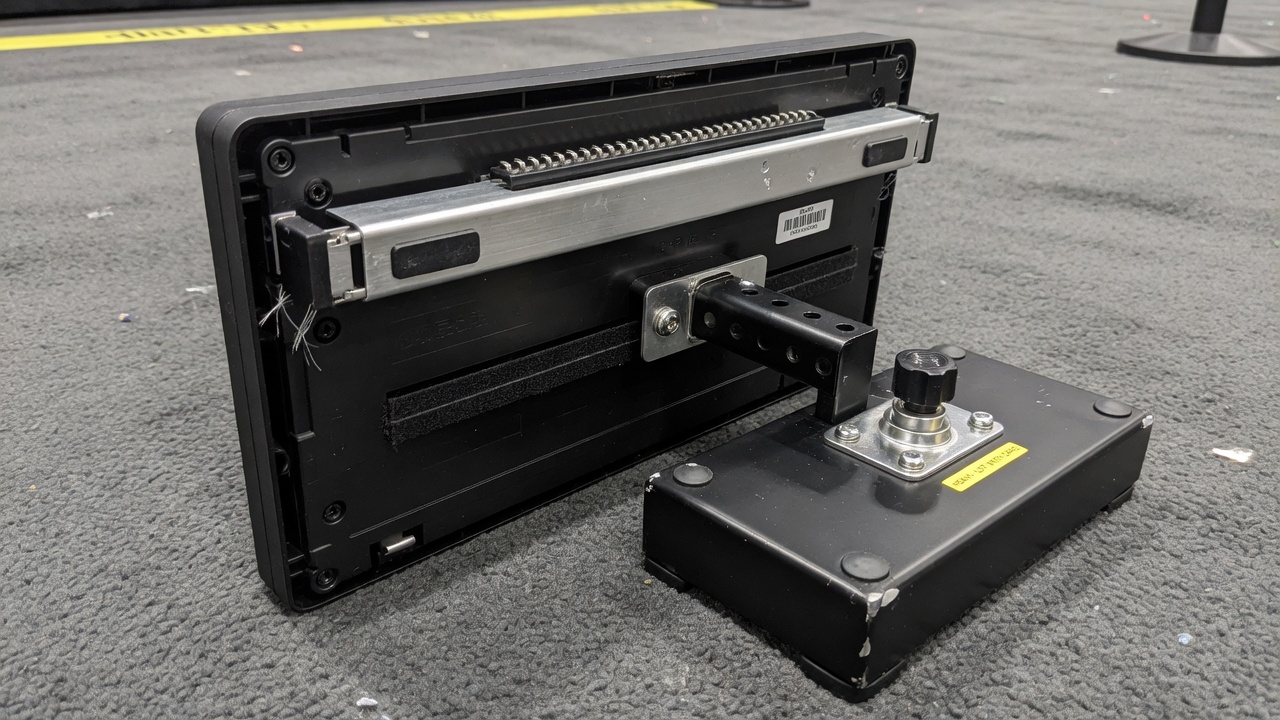
Retractable sizes in catalogs are nominal. A “33×79” from one hardware line might be a 33.5-inch-wide graphic with an 80-inch live height and a 2- to 6-inch footer that disappears into the cassette. A “24×63” from another line might be 23.5 by 61 live. Always design to the template for the stand you will actually use, not to a round number you saw in a search result. The ranges below are typical industry sizes we quote in Irvine. Your quote will lock the live area, footer, and pole pocket for that cassette.
| Format | Typical live size | Where it earns its keep in OC | Where it fails |
|---|---|---|---|
| 24×63 (compact floor) | About 24 in wide by 63 in high | UCI 3×6 envelopes, tight hotel columns, small suites | Gets lost in a tall ACC hall if it is your only graphic |
| 33×79 (standard floor) | About 33–33.5 in wide by 78–81 in high | Hotel foyers, ACC booth rear, indoor Spectrum shops | Over 6 ft tall; too high for a 6-foot campus cap |
| Tabletop retractable | Often about 11–24 in wide, shorter height | 6-foot registration tables, counters, demo islands | Invisible if you set it on the floor like a floor stand |
| Double-sided floor | Same footprint, two faces, blockout media | Hotel corridors, aisle end caps, open foyers | Wasted against pipe-and-drape; needs a heavier base |
24×63 is the compact floor stand. Width is easy to carry through a hotel service corridor. Height stays under many campus and meeting-room caps. Viewing distance is short: people are at a table or in a queue, not across a hall. Put the logo high, the offer in the upper two-thirds, and keep body copy large. This size is also the one we recommend when you are not sure which OC venue is next. It is harder to get thrown off a floor for being too big than for being slightly modest.
33×79 (and its cousins at 31.5×79, 33.5×80, 36×79) is the default “we have a booth” stand. In a hotel foyer it has presence. In an Anaheim inline booth it can carry a product hero and a headline without pretending to be a back wall. It is the wrong default for UCI’s 6-foot height rule. If you split time between ACC and campus, own two heights or use a cassette system that can run a shorter graphic. Do not trim a 79-inch panel with scissors and hope the roller still tensions.
Tabletop retractables are a different object that happens to use the same spring idea. They sit on a 6-foot table and stop at a height a seated or standing guest can read without stepping back into the aisle. UCI’s table is 6 by 3 feet; a tabletop unit belongs on that cloth, weighted, not teetering on the edge. Hotel registration tables and Spectrum demo counters are the same logic. A tabletop graphic still needs a footer for the mini-cassette and a safe zone so the clamp does not eat the logo.
Double-sided stands print two faces, usually on blockout or gray-back media so you do not read the reverse image as a ghost. Use them where people approach from two directions: a hotel hallway, a foyer island, an end-cap booth. Do not buy double-sided because it sounds premium if the back will face a drape. You will pay for a second graphic nobody sees, and you will carry a heavier cassette for no reason. Two single-sided stands, placed at right angles, are often clearer in a corner booth than one double-sided unit in the middle.
Wider retractables exist at about 39 and 47–48 inches. They look like a small wall and behave like a sail even indoors when hall doors open. They also fight doorways, freight elevators, and UCI’s 3-foot width cap. We print them when the venue and the base can take them. They are not the first recommendation for a marketer who has to park in a UCI structure and walk the case in.
Hardware: bases, cassettes, cases, and indoor lights
The printed panel is half the product. The other half is a spring, a pole, a base, and a bag. Cheap hardware fails in Orange County the same way every time: the stand walks on smooth hotel stone, the pole leans, the graphic wrinkles because the leader was taped poorly, or the case zipper dies after three Anaheim weekends. Specify hardware on the quote the same day you specify size.
Base weight and footprint
A retractable stays up because the base is heavier and wider than the panel is tall, not because the spring is optimistic. Economy plastic bases are light to ship and light to knock over. A passerby’s backpack in an ACC aisle, a rolling bag in a Marriott foyer, or a student cutting between tables at UCI is enough. Metal bases with rubber feet hold on stone and low-pile carpet. Some units add a fillable base or a second weight; those help in strong HVAC, not in wind outdoors.
Depth matters as much as pounds. UCI’s published 1-foot depth is tight. A sled that sticks a foot and a half into the walking lane will get moved, and moved stands never look as square as they did on our table. In a hotel foyer, a wide, low base is less of a trip than a tall, narrow foot that guests do not see against patterned carpet. Double-sided hardware needs more ballast because it has two panels catching air. If you already own a light stand and keep finding it on the floor, do not reprint the graphic first. Replace the base.
Feet and end caps scuff rental carpet. That is on you, not the hotel. Felt or rubber pads are cheap insurance. Do not drag the base across stone to “square it up.” Lift it. The estimator note sounds fussy until you have a property-damage email on Monday.
Replaceable cassettes versus a glued-in graphic
Some stands treat the graphic as a consumable: you tape a new panel onto a leader inside a sealed cassette and throw the old panel away. Other systems use a drop-in cassette or a removable roller so you keep the base and pole, swap the cassette, and store last quarter’s campaign in a labeled box. If you exhibit more than twice a year, replaceable cassettes are the hardware feature that actually saves money. You are not buying a new stand every time the offer changes. You are buying a new print and, if the system uses a second cassette, a second roller.
Measure the cassette you own before you send a file. “33-inch retractable” is not a standard the way a #10 envelope is a standard. Leader length, tape style, hook-and-loop, and pole diameter vary by brand. Bring the stand to 15321 Barranca Pkwy or send the make, model, and a photo of the roller with a tape measure. We can print a graphic that fits your hardware, or we can quote a matching cassette so you are not fighting a 33.5-inch panel into a 31.5-inch slot.
Label the cassette and the case with the campaign name and the live size. The leftover-old-graphic problem is almost always a labeling problem. Someone grabs “the retractable” the night before a UCI fair and deploys last fall’s internship dates. A second cassette, stored in the same padded case with a luggage tag, is dull and effective.
Travel cases and the Irvine-to-Anaheim run
Most Orange County use is a car trip, not a cargo flight. Irvine to the Anaheim Convention Center is a freeway run with the stand in a trunk or a back seat. A padded nylon bag with a shoulder strap is enough if the pole is in its sleeve and the cassette is not rattling against a jack stand. Hard cases earn their keep when you ship, check bags, or stack freight for a national show. They are extra bulk for a Spectrum in-store Tuesday.
Do not fold a retractable graphic. Do not lay the assembled pole across a back seat with the panel still up. Retract it, cap it, bag it. OC summer heat in a closed car will soften adhesives on the leader and can leave a set in thin film. If you must leave the case in a vehicle, keep it out of direct sun and do not treat the trunk like an oven timer. After a hot ride, let the cassette sit in the air-conditioned hall before you pull the panel up; a cold-to-hot pull is how you get waves at the bottom.
Poles travel in sections. Count them when you pack. A missing middle section at 7:40 a.m. in a hotel foyer is not a print defect. Put a spare bungee and the hex key (if your cassette uses one) in the same pocket as the feet. We can reprint a graphic in a hurry. We cannot invent the pole you left in the other car.
Indoor lighting, glare, and clip-on LEDs
Retractable stands are front-lit by the room. They are not lightboxes. Hotel cans, ballroom festoon, and convention-hall metal halide will either make the panel readable or wash it out. Glossy film under a spotlight is a mirror. Satin or a matte-leaning laminate is the default we recommend for foyers and halls. If your brand guidelines insist on gloss, we can print it; stand far enough to one side of the can light that you are not the content.
Clip-on LED arms exist for retractables. They help in a dim hotel niche. They need power or charged batteries, they add a glare source of their own, and they are one more thing to pack. At UCI indoor fairs, standard tables often have no electricity; a light that needs a plug is a non-starter. In Anaheim halls the ambient light is usually high enough that a well-contrasted graphic does more than a $40 lamp. Design the panel as if the light will be warm, overhead, and slightly behind the viewer. That means darker type on a lighter field, not a charcoal panel with a thin gold logo.
Window light at Spectrum shops and glass hotel facades changes through the day. A stand facing west glass in late afternoon will flare. Place it perpendicular to the glass when you can. UV through glass still fades ink over months. Indoor does not mean immortal. If the stand lives in a sunlit lobby as décor, plan on a fresher graphic on a schedule, not on “indoor so it lasts forever.”
Graphic media and how we print the panel
Retractable graphics are not the same construction as an outdoor grommeted vinyl banner. Outdoor vinyl is heavier, often scrimmed, and finished with hems and grommets so it can hitch to a frame or a fence. A pull-up panel has to roll into a tight cassette thousands of times without cracking the ink, scuffing the face, or growing a memory curl. We typically print on a smooth indoor film or a grey-back / blockout composite made for retractable hardware — not on 13-ounce scrim vinyl unless the cassette is built for that thickness.
Thickness is a hardware constraint. A film that is too thick will not retract, or it will retract and bulge the cassette. A film that is too thin will cockle, show the pole as a shadow, and wrinkle if you retract it while the hall is still humid. Grey-back and blockout hide show-through. Double-sided units need true blockout or two panels with an opaque core. Single-sided units in a dark hall can sometimes run a lighter grey-back. Tell us single- or double-sided on the quote so we do not guess.
Ink and finish are indoor-rated. That is correct for hotels, UCI ballrooms, and ACC halls. It is not an invitation to park the stand on a Spectrum patio. Indoor inks still dislike prolonged sun through lobby glass. We can add a laminate for scuff resistance when the stand will be assembled and struck every week. Laminate also changes how the panel behaves in the roller; we spec it to the cassette, not as a default “make it shinier” upgrade.
The print itself is wide-format inkjet onto the roll, then trimmed to the cassette template. Edges must be straight. A panel that is 1/8 inch wide of the cassette will telescope and jam. A panel that is narrow will wander and show white at the sides. That is why we do not treat a retractable file like a poster you can crop in the RIP. If you also need posters, table throws, or rigid signs for the same event, those are separate setups under the same PrintBig Irvine roof — send them as separate files with their own sizes.
Color is CMYK unless we have a reason to match a coated spot. Hotel lighting is warm. A logo that looks correct on a calibrated monitor in an office park will read redder under 2700K cans. If the brand red has to hit, say so and send a coated swatch or a prior printed piece we can get on press. We still cannot reprint the hotel’s lamps. For most pull-ups, contrast beats a perfect Pantone match that disappears at 12 feet.
Artwork: vector logos, 150 dpi photos, and bleed at the roller
Artwork is where otherwise careful marketers lose a day. The file is not a slide, not an Instagram export, and not a 72 dpi PNG of the homepage hero. It is a full-size panel, viewed at 3 to 12 feet, with a strip of the design sacrificed to the cassette. Build it at actual size or at a clean half-size scale, in CMYK, with fonts outlined or packaged, and with the footer included as extra art — not as a white strip you assumed we would add.
Vector logos and type
Logos, icons, rules, and headlines belong as vectors: PDF, AI, or EPS with outlines, or a high-quality PDF export from the layout file with fonts converted. A logo that looks sharp at 2 inches on a business card still looks sharp at 10 inches on a pull-up if it is vector. The same logo, saved as a 400-pixel PNG from a brand portal, will stair-step. We cannot “AI upscale” our way out of a soft wordmark that is also your legal name on the floor of the Anaheim Convention Center.
Type size is a viewing-distance problem. If guests read the panel from 10 feet, body copy under about 28–36 points starts to fail, depending on the typeface and contrast. Headlines need to work as a silhouette. Fine serifs and hairline rules disappear under hall lighting. Do not put a paragraph of boilerplate on a 24×63 and expect it to recruit anyone in a UCI ballroom. One claim, one proof, one action. The table is for the leave-behind.
Safe zones are not the same as bleed. Keep logos, URLs, and QR codes out of the side rails (about 0.75 to 1 inch) and well above the roller. QR codes need to sit in a quiet field, large enough to scan at arm’s length, not in a busy photo, not at the bottom, and not wrapped around the pole. If the only reason for the stand is a QR, you may want a tabletop unit plus a printed card. A 79-inch panel that exists to hold a 1-inch code is a waste of cassette.
Photographs at 150 dpi at size
Photos on retractable banners are judged at viewing distance, not at the 300 dpi poster standard people remember from desktop publishing. For a panel this size, 150 dpi at final size is a typical industry target that looks clean from a few feet away. 100–120 dpi can hold for a soft background. 72 dpi web images, stretched, look like mush. 300 dpi at full 33×79 size makes a file that is painful to transfer and does not print sharper in any way a guest can see.
Do the math before you buy stock. A 33-by-79-inch panel at 150 dpi is about 4,950 by 11,850 pixels. That is a large photo. Phone shots and website heroes rarely have it. If the photograph is the product, shoot it for this size or license a file that actually contains those pixels. If the photograph is atmosphere behind a vector headline, you can get away with less — but then the headline, not the photo, is doing the work. Do not hide a soft image under a dark gradient and call it designed. Hall lights will still show the noise.
Crop with the roller in mind. Faces, product hero, and screens belong in the upper two-thirds. A face that sits on the cassette line will lose its chin in the hardware. A laptop mockup that sits low will lose the keyboard. We can send a template with the live area, pole clamp, and footer marked. Use it. Designing in a 8.5×11 board and “scaling up” is how important content lands in the roller.
Bleed at the roller, the pole, and the sides
Every retractable eats graphic. The bottom leader — often about 2 to 8 inches depending on the cassette — tucks into the base and is not visible when the stand is open. Some hardware also hides a strip at the top in a pole clamp or rail. Sides may lose a fraction to the cassette walls. We call the bottom the footer or the bleed at the roller. It must be extra image or a continuation of the background, never the only place you put the URL, the phone number, or the legal line.
If you send a file that is exactly 33 by 79 with the logo sitting on the bottom edge, two things happen. We either refuse it and ask for a rebuild, or — if you insist the live area is already correct — we add a footer by cloning background, which looks cheap if the background is a photo with a horizon. Build the footer yourself. Extend the color field or the photo downward. Keep critical content in the live zone marked on the template.
The top has a similar trap. A logo crammed under the pole rail will look cropped even if the pixels are there. Leave headroom. The pole is a physical object in front of the panel on some stands and a clamp on the back of others. Tell us which hardware you have so we place the top safe zone correctly. Side bleeds are small, but a full-bleed photo still needs them so you do not flash white if the panel shifts a hair in the cassette.
File delivery: PDF/X or a flattened high-quality PDF is fine if fonts are outlined and images are embedded. Native AI or INDD with packaged links is better if you want us to move a logo out of the footer. RGB files will be converted; neon blue on screen will dull. Do not send a Google Slides export as a 33-inch document. Do not send a JPEG saved three times from a group chat. If the only art you have is a brand portal PNG, say so early so we can tell you whether it is usable or whether you need the vector from whoever drew the mark.
Quote your Orange County retractable stands
Mistakes that turn into reprints
Most reprints we see on retractable banners are not printer errors. They are hardware mismatches, roller-bleed surprises, leftover campaigns, and files that were built for a phone. This list is the short version of the conversation we would rather have before we print.
- Critical copy in the footer. The phone number, QR, or “Booth 1247” sits in the last 4 inches and vanishes into the cassette. Guests see a nice photo and no way to act. Rebuild with a real footer and a safe zone.
- Web-resolution photography. A 1200-pixel-wide image stretched to 33 inches is about 36 dpi. It will look soft at arm’s length. Replace the photo or drop it and go type-forward.
- Raster logos. The wordmark is a PNG from the website header. At pull-up size it frays. Get the vector. If the brand team cannot find it, that is a brand-team problem, not a RIP setting.
- Wrong cassette width. A 33.5-inch graphic forced into a 31.5-inch stand telescopes, wrinkles, and may not retract. Measure the roller. Do not trust the word “standard.”
- Outdoor duty. The stand goes to an Aldrich Park lawn, a Spectrum piazza, or a Katella sidewalk “just for two hours.” Wind lays it down, the panel creases, and the spring is never the same. Retractables are indoor tools.
- Leftover old graphics. Last year’s percentage off, an expired date, a former product name, or a booth number from a different hall. Label cassettes. Swap them. Do not tape a letter-size printout over the old price.
- Wrinkling from heat, haste, and the wrong film. Pulled up hot from a car, retracted damp, stored assembled, or printed on vinyl too thick for the cassette. Let the panel relax in the room. Retract slowly and square. Use retractable media.
- Gloss under a can light. The only thing guests can read is their own reflection. Spec satin for hotels and halls unless you have a reason not to.
- A 79-inch stand at a 6-foot-cap fair. UCI’s published cap is 6 feet high for standard banners. A 33×79 is a violation waiting for a tape measure. Match the venue.
- Double-sided art on single-sided film. The reverse ghosts through. Use blockout, or print one face.
Wrinkling deserves its own paragraph because it gets blamed on the printer when it is often handling. Thin indoor film will take a wave if you retract it at an angle, if the leader tape is only in the center, or if the panel sat partly extended in a humid hall overnight. Orange County indoor rooms are air-conditioned and dry relative to a coastal fog morning; bringing a cold cassette into a packed ballroom and yanking it up can still put a set in the panel. Pull straight, hook the pole, and let it hang. If a wave appears, retract and try again before you decide the print is bad. Deep creases from a fold or a fall are not recoverable. That is a reprint, and it is usually a packing problem.
Leftover graphics deserve the other paragraph. Sales teams are loyal to “the black bag in the closet.” The bag does not know which campaign it holds. We have seen stands deployed with a competitor’s co-brand from a joint booth, with a show date that ended Tuesday, and with a QR that 404s. If you recassette often, keep a printed thumbnail taped inside the case lid. If you do not recassette often, budget a new panel when the offer changes — do not send a junior employee to the show with a Sharpie. We can turn a replacement graphic quickly when the file is already built to the cassette. We cannot fix a live event that is already using last year’s art.
When a fabric backdrop is the better tool
A retractable is a column of message, not a room. If you need a photo background, a step-and-repeat, or the back wall of an 8-foot or 10-foot booth, a fabric pop-up or frame is the better tool. Mentioning that here is a boundary, not a second article. Pull-ups in a row do not become a seamless wall; you will see bases, poles, and vertical gaps. Guests will also see whatever is behind those gaps — drape, a fire extinguisher, another exhibitor’s lightbox.
Choose fabric (or another backwall system) when the job is to own the field of view at a booth, to photograph people in front of a brand, or to hide the pipe. Choose a retractable when the job is to travel light, to stand in a foyer, to mark a table without touching the building, or to swap a campaign without rebuilding a booth. Many Orange County teams own both: a backwall for the two or three ACC shows that justify freight, and a 24×63 or 33×79 in the car for everything else. We will tell you when you are about to order the wrong one. We will not upsell you a 10-foot wall because this page is about pull-ups.
If you already know you need booth hardware beyond a cassette, start on the trade show displays page and still send the exhibitor kit with the quote. Height caps, hanging-sign rules, and union labor for overhead work are show-specific. A retractable you carry in yourself is the simple case. A backwall is not.
What to send so the quote is real
A useful quote for a retractable banner stand names the live size, the hardware, the media, the finish, the quantity, and the date you need it. “Need a banner stand for Anaheim next week” is a voicemail, not a spec. Send the following to Avanti Printing and we can price without a round of twenty questions. Walk-ins at 15321 Barranca Pkwy, Irvine, CA 92618 are fine if you bring the old stand. Phone is (949) 387-0787.
- Venue and date: hotel name, ACC hall or show, UCI fair, Spectrum in-store, or office lobby, plus the first day you will set up.
- Size: 24×63, 33×79, tabletop, double-sided, or a photo of your existing cassette with a tape across the roller.
- Hardware: new stand, graphic only for a stand you already own, extra cassette, travel case, yes/no on clip-on lights.
- Quantity: how many units, and whether art is identical or versioned (English/Spanish, two product lines, two dates).
- Finish: satin vs gloss, laminate yes/no, single-face vs blockout.
- File status: vector logo, photo at 150 dpi at size, or “we have a PNG and a hope.” Layout PDF at actual size helps.
- Pickup or delivery: Irvine pickup is simplest. Delivery to a hotel or to ACC exhibitor services needs a destination and a show label.
Quotes confirm size, material, quantity, finish, and date. If any of those five is missing, the number you see is a guess. Rush work is possible on many standard retractable sizes when the file is clean and the cassette is in stock. It is not possible when the logo is a screenshot and the hardware is a brand we have to reverse-engineer from a blurry phone photo sent at 4 p.m. Send the stand or send the model.
If you need matching banner printing for an outdoor fence or a hanging vinyl in a hall the retractable cannot cover, put that on the same request as a separate line. Different media, different finishing, different file. Mixing them into one “just like the pull-up but bigger” instruction is how outdoor vinyl ends up in a cassette, or a retractable film ends up grommeted and flapping on a fence.
Send size, hardware, and files for a quote
Frequently asked questions
What size retractable banner should I use in Orange County?
Use 24×63 when the room is small, the venue publishes a 3-by-6-foot banner cap, or you need one stand that will not get you in trouble on campus. Use 33×79 when the room is a hotel foyer or an Anaheim booth rear and you have the height. Use a tabletop unit on a 6-foot registration table. Confirm the live size to the cassette, not to a round catalog number. If you split time between UCI and ACC, do not assume one height serves both.
Can I reprint only the graphic and keep the stand?
Yes, if the cassette is replaceable or if we can tape a new panel to your leader. Bring the hardware or send the make, model, and roller width. A new graphic on the wrong width is a jam, not a savings. If you change campaigns often, a second cassette is cheaper than a second stand and prevents leftover old graphics from going to the show by accident.
Are retractable banner stands OK outdoors at Spectrum or on campus lawns?
No. They are indoor displays. Wind, heat, and uneven ground damage the spring and crease the panel. Spectrum common areas and UCI outdoor expos need landlord or campus permission anyway, and they need hardware rated for those conditions. Use the pull-up inside a shop, a ballroom, a foyer, or a booth. Ask us for a different product if the event is outside.
What resolution and file type do you need?
Vector logos and type. Photographs at about 150 dpi at final size (100 dpi can hold for a soft background). CMYK PDF with fonts outlined, or packaged native files. Include the footer that goes into the roller. Do not send a 72 dpi web JPEG, a Google Slides deck, or a logo copied from a website header. If 150 dpi at size makes the photo look bad on your screen, it will look worse at 8 feet in a hall.
Do you print for hardware I already own?
Yes. A large share of Irvine jobs are replacement panels, not new stands. We still need to know the roller width, leader style, and top finish (pole pocket, rail, clamp). A photo with a tape measure in the frame is enough to start. Do not assume every “33-inch retractable” shares a template. If the stand is damaged — bent pole, dead spring, cracked base — repair or replace the hardware first. A perfect new graphic in a leaning stand still looks like a leaning stand.
Should I buy one double-sided stand or two single-sided stands?
Double-sided if people approach from two directions and both faces have a reason to exist: hotel corridor, foyer island, end-cap aisle. Two singles if you need two messages, an L-shaped corner, or a backup unit when one person goes to UCI and another goes to a hotel breakfast. Double-sided hardware is heavier and needs blockout media. It is not automatically more professional. It is two pages of a very tall book.
How long will an indoor retractable graphic last?
With indoor use, a decent cassette, and a satin scuff-resistant face, a graphic can look presentable through a season of weekends. There is no honest single number, because handling does more damage than ink fade indoors. Creases, dirty hands, hotel stone scuffs, and sun through lobby glass retire panels faster than the printer. If the stand lives assembled in a window, budget a refresh. If it lives in a case and comes out twelve times a year, inspect the leader tape and the pole feet each time you pack.
What if I need this for a show that already started setup?
Call (949) 387-0787 with the cassette size, a usable file, and the pickup or delivery address. Rush is a production question, not a slogan. Clean vector art on a stock cassette size is a different conversation from a new hardware order and a photo we cannot use. Quotes still confirm size, material, quantity, finish, and date — including a date that is tomorrow, if we can meet it. We will say no if the honest answer is no.
Set the stand up like you mean the room
A retractable banner stand is the least dramatic display we print, which is why Orange County teams actually use it. It fits a hotel foyer, an Anaheim aisle-legal booth, a UCI table rule, and an indoor Spectrum pop-up without a freight call. It fails when you pick a catalog height the venue does not allow, when the photo is a web JPEG, when the offer is in the roller, or when last year’s graphic is still in the bag.
Bring us the room, the cassette, and the file. Avanti Printing, 15321 Barranca Pkwy, Irvine, CA 92618, will spec 24×63, 33×79, tabletop, or double-sided hardware against that room, print on media that will retract, and leave the footer where it belongs — in the base, not in your headline. Call (949) 387-0787 or send the quote form with size, material, quantity, finish, and date. We will tell you if you should have ordered a fabric wall instead. Most of the time, for the jobs in this article, you should not.