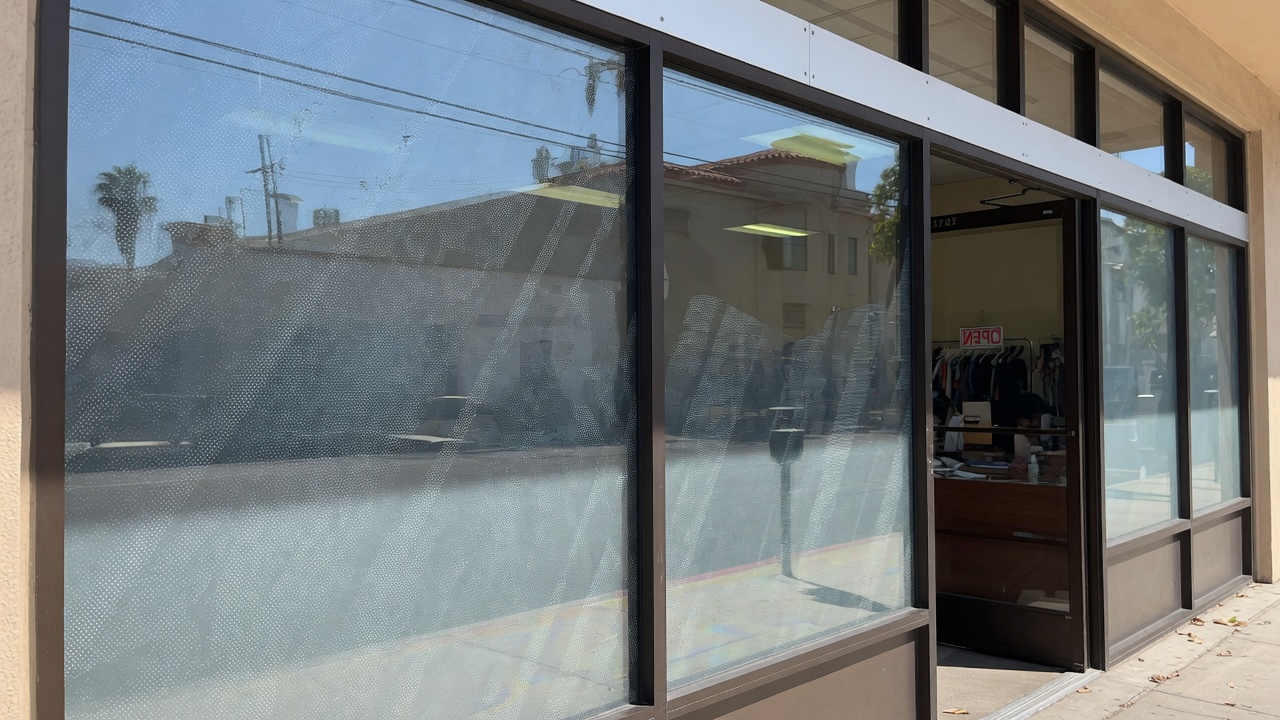
Window graphics in Irvine are printed vinyl or film on glass: perforated one-way so you see out, opaque so you do not, or interior-applied film that lives on the room side of the lite. Pick the product from the viewing job, the punch percent, whether you contour-cut, and who can actually reach the glass.
The catalog shot is always a night-empty storefront with a perfect rectangle and a smiling barista. Your glass is more likely a leased Irvine Company lite with a mullion in the wrong place, a west sun load, a HOA rule that forbids covering vision glass, and a property manager who wants after-hours install with a certificate of insurance. That is why we quote window graphics as a system: each daylight opening, film type, punch, contour, laminate, side of glass, and access. Avanti Printing at 15321 Barranca Pkwy, Irvine, CA 92618 prints and finishes the film. Call (949) 387-0787 if you already measured the lites and only need us to match a punch you used last year.
This is the estimator version of that conversation. It is written for Irvine and Orange County buyers who will actually own the glass after we leave. It is not a tour of every large-format product we print. Quotes still confirm size, material, quantity, finish, and date.
Who is ordering window graphics on Irvine glass
If you lease or own a storefront, a suite, or a clubhouse anywhere from the Spectrum to Jamboree to the Irvine Business Complex, the glass is already doing a job. It is a billboard, a daylight source, a privacy problem, a collision hazard, or all four. Window graphics in Irvine are how you change that job without replacing the storefront.
Typical buyers from Irvine, Tustin, Costa Mesa, Newport Beach, Lake Forest, Laguna Hills, and Santa Ana are not shopping “a sticker.” They are shopping a covering that has to survive Orange County sun, a landlord packet, and a cleaner with a razor on Friday. Retail managers want a full-height graphic that still lets staff see the sidewalk. Restaurant owners want hours and a logo that will not peel at the gasket. Medical and dental offices want privacy on the exam-side lites without turning the suite into a cave. Property managers want empty-suite coverage that comes off when the next tenant signs. HOA boards want frosted bands, not a photo of a happy family, on the clubhouse doors.
This is for you if you can photograph each lite with a tape in the frame and you know whether the film may sit on the exterior face, the interior face, or both. It is also for you if a previous graphic left adhesive ghosts in the silicone and you do not want a second round of that. It is the wrong product if you need a rigid panel in front of the glass, a painted wall, or a mural on drywall — those are different jobs under large format printing in Irvine and wall murals for Irvine interiors.
California buyers outside Orange County use the same films. The local twist is the glass mix: Irvine Company retail criteria, village HOAs, office-park vision-glass rules, west-facing storefronts on Barranca and Jamboree, and second-story lites you cannot reach from a parking-lot ladder. Those conditions change punch, side of glass, contour versus rectangle, and whether we even show up with a squeegee. They do not change the fact that window film is a covering bonded to glass, not a poster in a frame.
- Retail tenants at Spectrum, The District, and Jamboree-frontage shops who need the sidewalk to read a graphic without blinding the staff.
- Restaurants and cafes that want hours, logos, and a privacy band on the lower lite, not a blackout of the dining room.
- Medical, dental, and spa suites that must hide the interior and still keep a professional face on the corridor or parking lot.
- Office-park tenants whose conference rooms are fishbowls and whose landlords still want a see-through zone on the doors.
- Property managers covering empty suites, construction dust, or a lease graphic until the next occupant arrives.
- HOA and community facilities that will approve frosted or cut vinyl and will reject a full-color campaign on the clubhouse.
Pick the film from the job, not from the sample book
Three products get called “window graphics” in the same email, and they are not interchangeable. Perforated one-way is a hole pattern that prints on the outside and lets you see out when the street is brighter than the room. Opaque vinyl is a solid print with no holes; the glass becomes a wall. Interior-applied film is a location, not a chemistry: the graphic lives on the room side of the lite, reverse-printed so it reads from the sidewalk, or right-reading if it is only meant for people already inside.
Start with four questions. Do people inside need to see the sidewalk, the parking lot, or the corridor? Do people outside need to see in? Is the glass a required vision lite on a door or a sidelite? Who is allowed to put a ladder or a lift on that face of the building, and at what hour? The table below is typical shop practice for Irvine storefronts and suite glass, not a materials-science paper. Your quote will lock the actual film, punch, and side.
| Product | See out? | Privacy from the street | Typical punch | Usual side of glass | Where it earns its keep in Irvine | Where it fails |
|---|---|---|---|---|---|---|
| Perforated one-way | Yes, when the exterior is brighter | Partial; not a blackout | 50/50, 60/40, 65/35, 70/30 | Exterior face, print out, black toward the room | Retail storefronts that still need staff sightlines | Night interiors with the lights on; tiny type; HOA bans on covering glass |
| Opaque printed vinyl | No | Full, if the film is truly opaque | None (solid) | Exterior or interior (reverse) | Empty suites, changing rooms, construction cover, full campaigns | The only daylight in a deep suite; dark film on a hot IGU |
| Interior-applied film | Depends on the film | Depends on the film | Usually none; perforated is uncommon inside | Room side; often reverse-print for street read | Landlord-no-exterior, second-story access, vandalism, weather | True one-way on a sunlit street; dirty interior glass you cannot reach behind furniture |
| Frosted / etched-look | Diffused, not a view | High for silhouettes, not for color graphics | None | Interior preferred in OC sun | Office doors, restrooms, HOA clubhouse bands, medical sidelites | A photo-quality campaign; small reverse type from the parking lot |
Read the table as a filter, not as a menu. If the staff must see shoplifters, bike traffic on the sidewalk, or a host stand queue, you are in perforated territory unless the landlord already forbade covering the glass. If the job is to hide an empty suite, a demo wall, or a spa treatment room, opaque is the honest product. If the property manager will not let you touch the exterior, or the lite sits on a second story above a fire lane, interior-applied is often the only legal and practical path — even if the marketing team wanted a one-way wrap they saw on a bus.
Frosted film sits next to these three because Irvine office parks ask for it constantly. It is not a perforated product and it is not a photo. It is a translucent vinyl or polyester that scatters light. Use it when the job is privacy and collision safety, not when the job is a hero image of a salad. You can contour-cut frosted into bands, logos, and dots. You cannot make it behave like 60/40 one-way.
Punch percent: what 50/50, 60/40, and 70/30 actually mean
Punch percent is the hole pattern in perforated window vinyl. It is also the number people reverse in emails. The industry writes it as print-area / open-area in most retail conversations: 60/40 means about 60 percent vinyl and 40 percent holes. Manufacturers sometimes list only the open area. 3M Scotchcal Perforated Window Graphic Film 8170 is sold in perforation patterns around 40 percent and 50 percent open — that 40 percent-open pattern is the storefront workhorse people call 60/40. Avery Dennison’s MPI perforated window series publishes 50/50 and 65/35 hole patterns as two stock choices. Those are typical industry constructions, not a promise that every roll on our shelf is the same SKU. Say the viewing job. We will name the film on the quote.
Holes are typically about 1.5 mm in diameter on standard architectural and vehicle perf. “HD” or micro-perf uses smaller holes at a similar open percentage so type and faces look less dotted at short range. Smaller holes do not magically add opacity. They change how the pattern reads at six feet. They also change how the film squeegees and how dirt sits if you skip laminate. Do not order micro-perf because the name sounds premium if the graphic is a solid color field viewed from the parking lot. Order it if you have small type or a face that will be judged at sidewalk distance.
50/50 — more view, weaker billboard
50/50 is half vinyl, half holes. It is the transit default because a bus driver and a passenger both need to see through the glass. On an Irvine storefront it is the most honest choice when the interior is a working room: a restaurant floor, a gym, a showroom where daylight and sidewalk awareness matter more than ink density. From the street the graphic is there, but it is airier. Fine type and thin logos fall apart because half of every letter is missing. If your mark is a hairline script, 50/50 will make it look like a crossword.
Use 50/50 on first-floor retail that must keep a visual connection to the sidewalk, on vehicle-adjacent glass if you ever put the same art on a van window (different product, same punch conversation), and on any lite where the landlord’s packet still wants a high see-through. Do not use it as a privacy film. You will see silhouettes, screens, and the mess on the back counter. Privacy is opaque or frosted, not a 50 percent hole pattern.
60/40 and 65/35 — the Irvine storefront default
Most retail window graphics we quote in Irvine land on a 60/40 or 65/35 pattern: more print than open area, still a usable view out in daylight. The extra vinyl densifies the photo and the logo. The remaining holes still carry daylight and a sidewalk sightline if the room is not blazing with cans. This is the pattern to start from when a Spectrum or Jamboree tenant says “I want the graphic, but the staff has to see out.”
65/35 (Avery’s published second pattern) is a step denser than 60/40. At parking-lot distance the difference is a fuller color, not a different product category. At arm’s length you see fewer holes. Inside, the room is a little dimmer and the night-time see-through is a little worse. If you are covering a full storefront and the suite is already deep, talk about leaving upper lites or a door lite clear instead of jumping to 70/30 and then buying more light bulbs.
Type still needs mass. As a shop rule of thumb — not a type-code — keep letterforms on perforated film in the neighborhood of a half-inch stroke or larger at final size, and do not park a phone number in a hole field and expect it to survive at 20 feet. Vector logos with open counters (A, B, 8, 0) need to be large enough that a 1.5 mm hole cannot eat a counter. If the logo is legally required at a small size, put it on an opaque contour-cut panel, not on the perf.
70/30 — graphic first, view second
70/30 (about 70 percent print, 30 percent open) is the densest common architectural punch. It is what people reach for when they wanted opaque and someone talked them into “but you can still see out.” You can, in daylight, sort of. The graphic is stronger. The room is darker. Night performance as a one-way is worse because there is less hole to look through when the interior lights overpower the street. Upper-floor decorative wraps and long viewing-distance facades are the usual argument for 70/30. A first-floor cafe that lives on sidewalk connection is not.
There is no honest single “best punch for Irvine.” West glass on a July afternoon is a different optical problem than a north-facing suite in an office park. The punch you used on a van is not automatically the punch for a 10-foot storefront lite. Tell us whether the priority is the photo, the view, or the daylight, and we will pick among the patterns we actually stock rather than inventing a custom drill pattern. Perforated film is manufactured with a punch. We do not CNC a new hole percentage for one door.
Punch is a viewing-distance and lighting decision. 50/50 favors the person inside. 70/30 favors the person in the parking lot. 60/40 and 65/35 are the compromise most Irvine storefronts actually want — if one-way is even the right product.
How one-way vision works, and when Irvine lighting kills it
One-way vision is not a magic coating. It is a printed face, a hole pattern, and a dark backing, plus a lighting imbalance. In daylight the street is brighter than the shop. Your eye hits the printed vinyl from outside and reads a graphic. From inside, your eye looks through the holes toward the bright exterior and reads the sidewalk. The black backing (the dark layer facing the room) keeps you from reading the reverse of the print as a muddy stain.
At night the imbalance flips. Interior cans, pendants, kitchen lights, and open coolers are brighter than the sidewalk. People outside look through the same holes and see the room. The graphic thins out or ghosts. This is physics, not a defective roll. If your brand moment is 7 p.m. on a winter storefront, perforated is a weaker billboard than opaque, and it will not give you privacy while the lights are on. Restaurants that wanted “one-way so diners are not in a fishbowl” learn this the first Friday night. If night privacy is the job, use opaque or frosted on those lites and keep perforated for the display window you still want to see through during the day.
Interior lighting also changes the daytime view. A white, over-lit showroom behind 50/50 will show more of the interior than a dimly merchandised shop. Dark walls help the one-way. A window wall of glass with no solid wall behind the viewer does not. You cannot laminate your way out of a brightly lit white room. You can dim the front zone, leave a lite uncovered, or switch those lites to opaque.
Do not put perforated film on both sides of the same lite. Do not mix an interior blackout shade with exterior perf and then wonder why the view died. Shades, security films, and existing tint are part of the spec. If the glass already has a solar-control film, say so. Printed graphics and solar-control films are different products; stacking them without a plan is how you get bubbling, warranty arguments, and a view that matches neither brochure.
Opaque vinyl: when the glass should stop being a window
Opaque window graphics are solid printed vinyl. No holes. The lite becomes a printed wall. Color is denser. Type can be smaller than on perf (still not business-card small). Privacy is real. Daylight through that lite is gone. That last sentence is the one empty-suite landlords forget when they cover every pane in a deep floor plate and then complain the space photographs like a basement.
Use opaque when the job is a campaign that must look like a poster, when you are hiding construction or an empty suite, when a spa, clinic, or changing room cannot show silhouettes, or when the landlord already said you may cover a percentage of the glass and you are spending that percentage on a real image. Do not use opaque on the only daylight in a kitchen, a dental operatory that needs north light, or a stair that was using that sidelite as a lamp. Walk the room at 2 p.m. before you black out a west wall because the rendering looked dramatic.
Exterior-applied opaque
Exterior application puts the print on the weather side. The adhesive hits the glass. The face takes UV, irrigation overspray, and the cleaner’s squeegee. In Orange County that is a laminate conversation, not an optional upgrade. A UV overlaminate is the usual finish for a campaign that has to last more than a promotion weekend. Gloss laminate pops color and shows every wipe mark. Satin or luster hides some of the sidewalk glare on west glass. Spec the finish on the quote. “Whatever looks good” is how you get a mirror at 4 p.m. on Jamboree.
Exterior opaque is the right call when you need maximum color from the parking lot, when the interior is too cluttered to reverse-print cleanly, or when the room-side of the glass is blocked by slatwall, a cooler, or a display you will not move. It is the wrong call when the landlord forbids exterior film, when the lite is on a floor you cannot access without a lift you have not budgeted, or when the glass is a low-E IGU that the glazing contractor already warned you not to heat-load with a dark film. Dark, full-coverage films on insulating glass can contribute to thermal stress. That is a typical industry caution, not a lab report from our floor. If the elevation faces south or west and the film is a dark flood, say so. We would rather split the graphic, use a lighter field, or move the job interior than pretend vinyl is harmless on every IGU.
Interior-applied opaque, reverse-printed
Interior opaque is often reverse-printed: you look through the glass from the street, through the sheet, at the ink. The vinyl sits in the air-conditioned room. Rain never touches it. The exterior stays a clean lite, which some Irvine Company and mall criteria prefer because the building face stays “glass” from the common area. The print is also harder to vandalize and harder for a well-meaning porter to peel from the sidewalk side.
The costs are optical and practical. You are looking through glass plus whatever dirt, mineral film, and existing tint are on the lite, so color is a bit less punchy than an exterior face. You need access to the room. Furniture, blinds, and alarm contacts have to move. Operable windows and sliding doors can trap the film in a track if you run it to the edge like a wallcovering. Reverse type must be mirrored at output. If you pre-flip the file “to help” and do not mark it, we may flip it again and your hours will read backward from the street. That reprint is not a printer gift.
Blockout constructions exist when you do not want the interior to see the reverse of the street graphic as a ghost on the room side. A standard white-opaque vinyl is already much denser than perf. If the room-side look matters — a clean white back, a second graphic facing the shoppers inside — say that. Two-sided window graphics are two prints or a printed blockout construction, not a checkbox on a 4-mil economy calendered film.
Interior-applied film for HOA glass, suites, and second stories
Interior-applied is the product you order when the face of the building is not yours to touch. Village HOAs, office parks, and a lot of second-story glass in Irvine fall in that bucket. The film can be opaque, frosted, clear-polyester printed, or (rarely) a perforated sheet forced onto the room side. Standard one-way perforated is manufactured and warranted as an exterior-mount graphic. The black backing and hole pattern are built for the street to be on the printed side. Interior-mounting perf is how you get a weaker one-way, a dirtier hole pattern, and a film that does not match the bulletin. If you cannot reach the exterior, do not pretend interior perf is the same product. Use interior opaque, frosted, or a reverse-printed solid, and keep a clear vision band where you still need to see out.
HOA clubhouse doors in Woodbridge, Turtle Rock, Northwood, and similar villages are a recurring interior job: a frosted band at handle height so members do not walk into the glass, maybe a contour-cut logo, no campaign photography. The architectural committee is not grading your brand colors. They are grading coverage, color of the film, and whether you turned a vision door into a billboard. Send the CC&Rs or the approval letter with the quote. We can cut to a sketch. We cannot argue with a committee.
Office-park conference rooms are the other interior volume job. The fishbowl on the corridor gets a frosted film with a clear head-height band, or a printed pattern that still leaves a see-through zone so people do not collide with the glass. Full-opaque on a corridor sidelite that used to leak borrowed light into a workstation is how you get a facilities ticket the week after install. Interior film is also how medical suites handle HIPAA-adjacent sightlines without claiming the product is a security film. It is a visual block, not a ballistic product and not a legal opinion.
Second-story lites change the labor more than the film. If we cannot stand on the sidewalk with a ladder that is legal for the height and the wind, we need a lift, roof access, or an interior install. Irvine office parks and retail centers often restrict when a lift may sit in a drive aisle. That is installer access, and it belongs on the quote next to the square footage. A cheap film with a $900 access problem is not a cheap job.
Contour cut versus a rectangle on the lite
Contour cut means the vinyl is cut to a shape: a logo, hours, a frosted stripe, a set of circles, a bottom-band that stops at a measured height. A rectangle means we print a panel and square-cut it to the daylight opening, usually with a small gap at the gasket. Both are window graphics. They are not the same finishing path and they are not the same file.
Contour-cut opaque or frosted is the right tool for suite numbers, hours of operation, door logos, “pull” indicators, and privacy bands. We plot a vector path, weed the waste, and transfer the vinyl to the glass. Small type is possible if the stroke survives weeding — typically a problem in script fonts and in anything under about a quarter-inch. Interior glass is more forgiving of tiny cut vinyl than exterior, because you are not asking a 3-mil letter to hold through a year of irrigation and west sun. Still send vectors. A PNG of a wordmark is not a cut path.
Do not contour-cut perforated film and expect a clean edge. The hole pattern at a curved logo edge looks chewed. Holes that fall on a 2-point stroke disappear. If you want a shaped graphic on perf, print a rectangle (or a panel that follows the lite) and put the shape in the artwork, with the background continuing to a square edge. The holes stay in a mechanical grid. The logo stays a picture of a logo. That is the professional version of “die-cut window wrap,” and it is the one that still looks like a product after a month.
Kiss-cut sheets for DIY install are a different conversation from shop install. We can supply numbered panels with application tape for a facilities team that has installed vinyl before. We should not supply a garbage bag of weedy letters and a YouTube link for a 40-foot storefront. If your “installer” is the opener on a Sunday, order fewer, larger, rectangular panels, not a hundred contour-cut pieces.
Bands and vision zones are contour’s most useful Irvine job. Many office parks and glass-door programs want a see-through zone at approach height so people do not walk into a newly frosted lite. We can leave a clear horizontal band, cut a pattern that thins at eye level, or stop an opaque campaign a measured distance from the strike side of a door. Measure the hardware. A beautiful frosted logo that covers the lock, the closer arm, or the required exit view is a removal, not a design win.
Materials, print, laminate, and the file we actually need
Window film is wide-format inkjet onto a pressure-sensitive vinyl or polyester, then cut, then applied. Perforated architectural films are typically a calendered or cast vinyl with a black backing and a removable or long-term adhesive depending on the SKU. Opaque window vinyl ranges from economy calendered films for short promotions to cast films when the lite is curved, the duration is long, or the removal has to be clean. Frosted films are usually a translucent calendered vinyl or a decorative polyester. The quote should name the class of film, not just “window vinyl.”
Print is CMYK unless we have a reason to pull a spot. White is the face stock on most opaque vinyl, so “white in the file” is unprinted vinyl, not white ink. On clear or frosted film, white in a PDF is a hole. If you need a white logo on clear, that is a different construction (printed white ink on clear, or a cut white vinyl). Say which. Do not send a social-media export with a transparent background and assume the RIP will invent a white plate.
Laminate on exterior perforated is the usual way we keep dirt and irrigation out of the hole pattern and add UV. The overlaminate is optically clear; you still see through the holes because the extra film is clear, not because we drilled it again. Skipping laminate on a west-facing Spectrum lite is how the holes scum up and the black backing weathers. Laminate on interior film is optional and often skipped on frosted, because the room side is not in the weather and a gloss laminate on frosted fights the etched look. Satin laminate on interior printed opaque can help with cleaner abrasion. Spec it. Do not add it after we have already trimmed 14 lites.
Seams belong on mullions when the art and the glass allow it. A 54- or 60-inch print width does not magically become a 72-inch lite without a seam or a tiled panel. Horizontal seams on storefronts read as a line at 20 feet; vertical seams can hide in a mullion. Tell us whether the graphic may break on the aluminum. Wrapping film over the mullion looks “seamless” in a rendering and looks like a wrinkled bumper in real life, and it makes removal ugly. Panel per lite is the cleaner Irvine default.
Artwork rules are boring and they prevent reprints:
- Build at actual size or a clean even scale (50 percent, 25 percent). Mark the scale.
- Vectors for logos, type, and every contour-cut path. Outlined fonts or packaged fonts.
- Photographs at about 150 dpi at final size for sidewalk viewing. 100 dpi can hold a soft background. 72 dpi web heroes will look like 72 dpi web heroes on a 8-foot lite.
- CMYK. RGB neons will dull. If a brand red is contractual, send the coated number and approve on the actual film, not only on a monitor.
- Bleed past the cut on rectangles — typically 0.25 to 0.5 inch of extra image so we do not flash white if the panel shifts a hair on the lite.
- Safe type well inside gaskets, handles, and any vision band. The last inch against a rubber gasket is not where the phone number lives.
- Seam plan and a lite-by-lite diagram. Number the openings the way the elevation is numbered.
- For reverse interior print, send right-reading art and we will mirror. If you already mirrored, write that on the ticket in language a stranger can see.
Measure the daylight opening — the glass you can touch — not the aluminum frame, not the brick opening, not a laser-from-the-sidewalk guess. Width and height of each lite, in inches, and a photo with a tape. Note transoms, mail slots, alarm contacts, and whether the door is a slider. A 0.25-inch error on a gasket-to-gasket panel is a wrinkle or a gap. We would rather you be 0.125 inch shy of the gasket than buried in the silicone.
Leave a small gap at the gasket. Typical shop practice is on the order of 1/8 inch in from the rubber so water can drain on exterior jobs and so the adhesive is not bonded to silicone that will fail later. Do not wrap film onto the frame unless the sign program and the glazing details allow it. Do not wrap into the track of an operable window. Those are removal charges waiting for a humid Tuesday.
Quote perforated or opaque window graphics
Installer access is part of the product
The best film in the building still has to go on the glass. Installer access is why two identical 40-square-foot jobs are not the same quote. Ground-floor, empty suite, parking at the curb, weekday morning: that is the easy version. Occupied restaurant during lunch, second-story glass over a fire lane, HOA that only allows Saturday 8 to 10 a.m., office park that wants a lift permit and a COI naming extra insureds: that is the other version.
Tell us the face of the building, the floor, and whether we can work from inside, outside, or both. If the lite is above a safe ladder height, we need a lift, a roof tie-off plan, or an interior-only install. Irvine wind in the afternoon on an open parking structure is a real limit on a lift. So is a property manager who will not let a boom sit in a Spectrum drive aisle on a Saturday. We will not guess that from a cell-phone photo of the glass.
Occupied interiors need a furniture plan. Conference-room chairs, reception desks, and window-adjacent merchandising have to move. Blinds come down. Alarm contacts on the glass are easy to knock off with a squeegee if nobody flags them. Newly sealed storefronts off-gas; film applied over fresh silicone or on construction dust will tunnel. If the glazing is new, give it the cure time the glazier specified. If the glass is dirty with irrigation scale, we clean what film-prep will take. Mineral crust that needs a razor and a chemical is a prep line, not “included because we brought a squeegee.”
Surface temperature matters. Pressure-sensitive vinyl wants a working range that is typically in the neighborhood of 50–90°F at the glass, depending on the adhesive. That is a typical industry range, not a lab curve from our parking lot. West glass on a July afternoon in Irvine can be far hotter than the air. North glass at 7 a.m. in January can be too cold for the adhesive to wet out. We schedule the face of the building, not only the calendar date. If your open-house is Saturday at 10, say so; we may need a Friday interior install instead of a Saturday exterior bake.
After-hours and weekend work is normal for restaurants and medical offices. It is also a labor multiplier. Put the access window on the quote with the square footage. If the only time you can give us is “after close, but the alarm is set at 10,” we need a person on site with the code. We cannot film a suite we cannot enter, and we cannot hold a lift overnight in a lot that tows at midnight.
Certificate of insurance, additional insureds, and vendor approval are routine on Irvine Company properties and on many HOA and campus jobs. Ask the property manager for the current requirements before you schedule us. We can provide insurance documents. We cannot invent a vendor number you were supposed to apply for last month. UCI and other campus facilities have their own vendor and brand rules if the glass is on university property; bring that packet.
Do not block ADA paths, fire-department connections, or required egress while we work, and do not ask us to film over hardware that has to stay usable. Door handles, closers, crash bars, and lock cylinders stay clear. If the graphic is a full-door wrap in a rendering, the rendering is lying about the hardware. We cut around it, or we film the lite beside the door.
HOA, office-park, and City of Irvine rules
Irvine treats glass as part of the architecture. A perfect print can still be the wrong covering. Check the landlord or HOA first, then the City if the graphic is a sign visible from the public way, then us. That order saves reprints that are really removals.
The City of Irvine identifies many sign types that may need a permit and some that are prohibited. Start at the City’s sign permit rules for Irvine and the companion sign-permit instructions. Window graphics that function as advertising can fall under those rules depending on type, illumination, and how the building is entered. We can print to a permitted drawing. We cannot issue the permit, and we will not tell you a full-coverage campaign is “probably fine” because the photo is attractive. If your architect or sign vendor already has an elevation with allowed window coverage, send it. We would rather build to their numbers than invent a percentage.
Do not treat a blog as a substitute for the zoning ordinance. Cities sometimes cap how much of a storefront window may be covered; Irvine’s rules are in the sign program and the zoning text, not in a printer’s memory. Landlord criteria can be stricter than the City. When they conflict, the stricter one that applies to your lease is the one that keeps the film on the glass.
Irvine Company retail and office properties — Spectrum, the Irvine Business Complex, University Research Park, and the Jamboree office market — usually have a written sign program. It may control window coverage, whether film may sit on the exterior, type sizes, illumination, and whether a campaign is temporary. A tenant who copies a neighboring shop’s full-wrap is copying someone else’s approval, not a right. Ask for the PDF. If they have a binder, the binder wins.
Village HOAs (Woodbridge, Turtle Rock, Northwood, University Park, and the rest of the village map) are not looking for a retail wrap on a garage or a clubhouse. Home-based businesses run into this constantly. If the CC&Rs forbid commercial signage, a beautiful 60/40 one-way on the dining-room window will not charm the architectural committee. We will still print it if you insist and if it is not an illegal install we have to stand behind. We will also still say you should read the document.
Empty-suite and leasing graphics have their own etiquette. Property managers often want a leasing board or a simple frost, not a leftover tenant’s menu. If you are covering glass during construction, confirm whether the film is a temporary paint-protection or a printed opaque, and confirm who removes it. Construction films left in west sun for six months can cook onto the lite. That is a glass problem, not a printing special.
Orange County sun, west glass, and what actually ages the film
Orange County sun is the other landlord. South- and west-facing storefronts on Barranca, Jamboree, and the parking-lot side of Spectrum will bake whatever you mount in the open. Two different things fail, and buyers mash them together.
The ink and the laminate: UV fades a printed face. Exterior films with a UV overlaminate last longer than bare prints. Interior reverse-print puts the glass between the sun and the ink, which is a real advantage on a west lite. There is no honest single lifespan number, because a north door and a west storefront are different climates, and because a cleaner with the wrong blade will retire a graphic faster than the sun. If the campaign is seasonal, economy film on a dated offer is rational. If the graphic is the brand on the building for years, spend the laminate and pick a film rated for that duration. Ask us to name the film. Do not ask for “the outdoor one” as if there is a single SKU.
The adhesive and the edges: heat cycles lift edges that were buried in a gasket, or that were stretched around a mullion. Irrigation overspray leaves mineral dots on exterior film. Kitchen exhaust and coastal air (closer to Newport and Costa Mesa than to inland Irvine) change how dirt sits. None of that is a reason to avoid window graphics. It is a reason to leave the gasket gap, to laminate exterior jobs, and to stop the film short of a sprinkler’s favorite pane if you can choose the lites.
Heat load is the quiet one. Dark opaque on an insulating glass unit, afternoon west sun, no exterior shading — that is the thermal-stress conversation. Perforated film passes more solar energy through the holes, which is one reason retailers like it on sun-loaded glass they still want to see through. It is not a substitute for a solar-control window film designed for energy. If your goal is load reduction, say that; we may be the wrong vendor, or we may be quoting a different film family. Printed graphics and energy films can coexist when they are specified together. They should not be stacked as an afterthought.
Indoor does not mean immortal. Interior film on a sun-facing lite still sees UV through the glass. It usually outlasts the same print on the exterior, which is why we like interior reverse for long campaigns on brutal elevations — if the landlord and the access allow it. Direct the cleaner not to use ammonia-heavy glass cleaner on printed faces, and not to dry-blade a new install. Plastic-safe cleaner and a soft cloth on the film; regular glass technique on the unfilmed glass. Write that on the packet you leave at the suite.
Mistakes that turn into reprints or removals
Most window-graphic failures we see are not RIP errors. They are punch mismatches, night-lighting surprises, bad measurements, and films applied to glass that was never allowed to receive them. This is the short list we would rather walk through before we print.
- Fine type on perforated film. A 2-inch script logo on 50/50 is a dotted suggestion of a logo. Put small legal lines, phone numbers, and delicate marks on opaque contour-cut vinyl, or scale them up until the stroke survives the holes.
- Expecting night-time one-way. Interior lights on, street dark: people outside see in. If Friday night privacy is the job, opaque or frosted those lites.
- Contour-cutting perforated film. The edge looks moth-eaten. Print a rectangle and put the shape in the art.
- Measuring the frame, not the glass. Panels come in fat and fight the gasket, or come in short and flash a ring of uncovered lite. Daylight opening, tape in the photo, each lite numbered.
- No gasket gap. Film buried in rubber holds water, lifts, and bonds to silicone. Leave a small, even reveal.
- Wrong side of the glass. Exterior film on a lite the landlord reserved as clear. Interior film on a window the staff cannot access behind a built-in. Operable sliders with film in the track. Name the side on the quote.
- Pre-mirrored reverse files with no note. Hours read backward from the sidewalk. Send right-reading unless we ask otherwise, and label any exception.
- Web-resolution photography on an 8-foot lite. A 1200-pixel hero stretched across a storefront is about 12 dpi. It will look soft from the parking stall. Replace the photo or go type-forward.
- Opaque on the only daylight. The suite becomes a cave. Walk the room at midday before you cover every pane.
- Dark full-flood on a sun-loaded IGU. Thermal-stress risk. Lighten the field, perforate, split lites, or move interior after a glazing conversation.
- HOA or sign-program surprise. The film is perfect. The committee hates the coverage. Now it is a removal. Get the letter first.
- Install over construction dirt or fresh silicone. Tunnels, fish-eyes, and a bond to a sealant that will fail. Prep and cure time are part of the date.
- Skipping laminate on exterior perf. Holes scum. The black backing weathers. The graphic looks tired while the ink is still technically there.
- Covering required vision or hardware. Door lites, exit views, locksets, closers. Cut around them. Leave a vision band where people approach glass.
- No access plan. The film is ready. The lift is not allowed in the aisle until Monday, and the campaign launched Friday. Access is a spec, not a hope.
Adhesive ghosts from a previous graphic deserve their own paragraph. Cheap film, long dwell in west sun, and a dry peel will leave adhesive on the lite and sometimes stain the gasket. Removal is a labor line. If you want a short-term promotion, say the end date so we spec a removable adhesive instead of a permanent cast that was meant to live for years. If someone already destroyed the last graphic with a razor, tell us before we price a “simple overlay.” We may be quoting glass cleanup, not only a new print.
Seam surprises deserve the other paragraph. A rendering with a single uninterrupted photo across three lites and two mullions is a design, not a glazing plan. We can align a face or a logo across mullions if you accept that the aluminum is still there. We cannot make the mullion disappear. If the photo cannot break, pick a lite that fits the hero and let the side lites carry color or type. That is how storefronts actually look good, as opposed to how they look in a wide-angle mockup.
What to send so the quote is real
A useful quote for printed window graphics for Irvine storefronts names the lites, the film, the punch or lack of it, the side of glass, the contour versus rectangle, the quantity, the finish, the access, and the date. “Need window wraps for the Irvine store” is a voicemail, not a spec. Send the following to Avanti Printing and we can price without twenty questions. Walk-ins at 15321 Barranca Pkwy, Irvine, CA 92618 are fine if you bring photos with a tape. Phone is (949) 387-0787.
- Address and elevation: which building face, which floor, Spectrum / office park / HOA village / street-front retail.
- Lite schedule: width × height of each daylight opening in inches, numbered, with photos and a tape in the frame. Note doors, transoms, sliders, and hardware.
- Product: perforated one-way, opaque, interior-applied reverse, frosted, or a mix by lite.
- Punch percent if perforated: 50/50, 60/40, 65/35, 70/30, or “recommend from the viewing job.”
- Side of glass: exterior, interior, or both. Whether windows operate.
- Finish: contour cut versus rectangle, laminate yes/no, gloss versus satin, vision bands.
- Quantity: how many lites, and whether art is identical or versioned (hours that change, tenant names, English/Spanish).
- Access: hours we can work, lift or ladder, interior furniture, COI and vendor requirements, parking.
- Permissions: landlord letter, HOA approval, City permit status if it is a regulated sign.
- File status: vector logo, photo at 150 dpi at size, reverse-print yes/no, or “we have a PNG and a hope.”
- Date: the day it must be on the glass, not “ASAP.”
Quotes confirm size, material, quantity, finish, and date. If any of those five is missing, the number you see is a guess. Access and permissions are how window jobs miss the five even when the square footage is clear. Rush exists when the film is in house, the file is clean, and the glass is reachable. It does not exist when the logo is a screenshot and the second-story lites require a lift that the center will not allow until next week.
If the same suite also needs a printed wall behind the reception desk, put that on the request as a separate line for wall murals. Different substrate, different file, different install. Mixing them into one “just make the space look branded” instruction is how window vinyl ends up specified like a wall covering, or a mural gets quoted as if it were a 4-mil film.
Pickup versus install: film can leave the shop on a roll with a panel map if your facilities team is doing the glass. Most Irvine storefronts should be shop-installed or installed by a crew that has squeegeed perforated film before. A first-time wet-apply on 60/40 in a windy parking-lot breeze is a wrinkle factory. Tell us who is on the glass.
Send measurements and punch percent for a quote
Frequently asked questions
Can I still see out through perforated window graphics?
Yes, in daylight, if the exterior is brighter than the room and you picked a punch with enough open area. 50/50 sees out most easily. 60/40 and 65/35 are the usual storefront compromise. 70/30 is a graphic that you can sort of see through. At night with the interior lights on, people outside will see in through the same holes. One-way is a lighting imbalance, not a privacy film. If you need real privacy, use opaque or frosted on those lites.
What punch percent should I use on an Irvine storefront?
Start at 60/40 or 65/35 if you want a dense graphic and a usable daytime view. Use 50/50 when sidewalk awareness and daylight matter more than ink. Use 70/30 when the photo is the point and the room can lose some view. Confirm against the actual film we will print — 3M and Avery publish specific open-area patterns, and we will name the SKU on the quote. Do not copy a van’s 50/50 onto a restaurant if night privacy was the real request.
Should the film go on the inside or the outside of the glass?
Exterior is the native home of perforated one-way and of the punchiest street-facing color. Interior reverse-print is the right call when the landlord forbids exterior film, when you cannot reach the outside, when vandalism or weather is the enemy, or when a long campaign on west glass should put the sheet between the sun and the ink. Frosted privacy is usually interior in this climate. Name the side. Do not make us discover at install that the blinds are glued to the interior face.
Can you contour-cut perforated vinyl into a logo?
You can. You should not, except as a last resort. Holes on a cut edge look damaged, and small strokes vanish. Print perforated as a panel and put the logo in the artwork, or contour-cut opaque or frosted vinyl for hours and marks. Mix the two on the same storefront if you want: a rectangular perf image on the display lites, cut hours on the door.
Do I need a City of Irvine permit or landlord approval?
Often you need the landlord or HOA even when you do not need the City, and sometimes you need both. Window graphics that act as signs can fall under Irvine’s sign rules; start with the City’s published sign pages and with your lease packet. Office parks and Spectrum-area retail almost always have a criteria book. We print to approved drawings. We do not issue permits. Put the approval status on the quote so the date you want on the glass is a date we can actually install.
How do I measure the glass for a quote?
Measure each daylight opening, gasket to gasket, width then height, in inches. Photograph every lite with a tape in the frame. Note mullions, transoms, door hardware, sliders, and alarm contacts. We will usually size panels a hair under the glass so we are not buried in the rubber. Do not measure the brick opening. Do not send a single overall storefront width and expect us to invent the lite schedule. If you cannot get on a ladder for the transom, say so; that is an access problem, not a measuring app problem.
How long will window graphics last in Orange County sun?
There is no honest single number. Exterior laminated film on a north lite lasts longer than the same print, unlaminated, on west glass at the Spectrum parking lot. Interior reverse-print usually outlasts exterior on brutal elevations because the glass is a UV filter. Handling, cleaners, irrigation, and whether the adhesive was specified as removable or long-term do as much as the sun. Give us a duration (a 6-week promotion versus a 3-year brand face) and we will spec film and laminate to that, not to a brochure “up to” line.
Can you match window graphics to a wall mural in the same suite?
We can print both under the same roof at PrintBig Irvine, and we should treat them as two specs: window film for glass, mural media for the wall. Color will be close, not a spectro match across vinyl and wall covering under two different lights. Send both files with sizes. Do not assume the window RIP will use the mural file cropped. If the mural is the hero and the window is a color field plus a logo, that is often the better pairing than forcing the same photograph onto two substrates.
Put the right film on the lite you actually have
Window graphics in Irvine fail when you buy a hole pattern for a privacy problem, an opaque flood for a room that needed daylight, or an exterior wrap for a building you are not allowed to touch. They work when you decide, lite by lite, whether the job is to see out, to hide the room, or to live on the interior because that is the only glass you can reach.
Bring us the openings, the punch, the side, the contour, and the access. Avanti Printing, 15321 Barranca Pkwy, Irvine, CA 92618, will spec perforated one-way, opaque, or interior-applied film against that glass, leave the gasket gap, and keep small type off the holes. Call (949) 387-0787 or send the quote form with size, material, quantity, finish, and date. We will tell you if you should have ordered frost instead of a photo. On a lot of HOA doors, you should have.