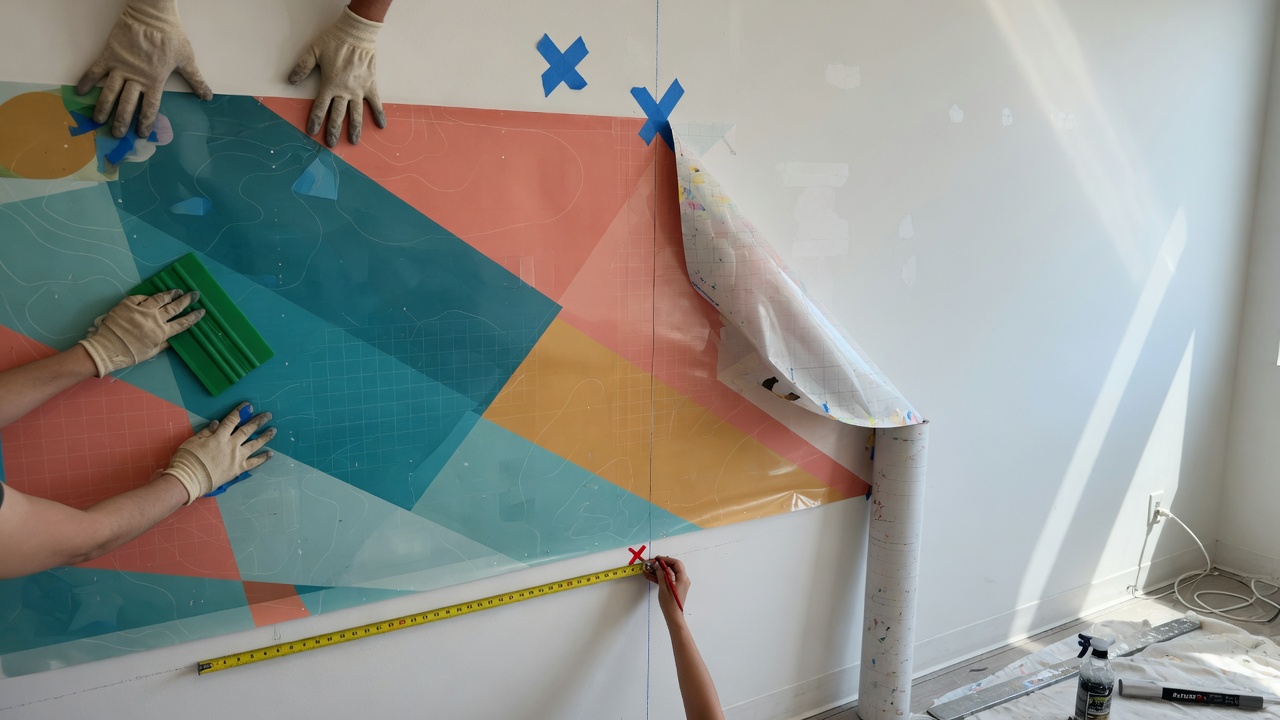
Printed wall murals, commercial wallpaper, and removable vinyl are three wall coverings for Irvine offices and retail. A mural is printed graphic film applied dry. Wallpaper is paste-up wallcovering, often Type II vinyl. Removable vinyl is a short-term graphic meant to come off at lease end. Pick from texture, seams, and landlord restoration rules.
The catalog shot is always a seamless photo wall in a white loft. Your wall is more likely orange-peel drywall in an Irvine Company suite, a knockdown feature in a Spectrum shop, or a painted corridor the landlord wants back to builder beige. That is why we quote wall coverings as a system: the wall you actually have, the product family, the panel and seam plan, the adhesive, the finish, and who restores the drywall when you leave. Avanti Printing at 15321 Barranca Pkwy, Irvine, CA 92618 prints the graphic and can finish mural film, commercial wallcovering, or removable vinyl. Call (949) 387-0787 if you already measured the wall and only need us to match a film you used in another suite.
This is the estimator version of that conversation. It is written for Irvine and Orange County tenants who will still own the walls after we leave. It is not a paint tutorial and not a tour of every large-format product we print. Quotes still confirm size, material, quantity, finish, and date.
Who is covering walls in Irvine offices and retail
If you lease or own a suite, a shop, or a clinic anywhere from the Irvine Business Complex to University Research Park to the Spectrum office market, the drywall is already doing a job. It is a brand surface, a corridor, a photo backdrop, a landlord asset, or all four. Printed wall murals for Irvine interiors are how you change that job without rebuilding the room. Commercial wallpaper and removable vinyl are the other two answers people put in the same email. They are not the same product.
Typical buyers from Irvine, Tustin, Costa Mesa, Newport Beach, Lake Forest, Laguna Hills, and Santa Ana are not shopping “a poster for the wall.” They are shopping a covering that has to survive orange-peel texture, a cleaner with a rag, Orange County sun through west glass, and a lease clause about restoring the paint. Marketing managers want a reception hero that still looks like the brand in month eighteen. Retail operators want a feature wall they can change when the campaign changes. Medical and dental offices want a calm field that will scrub, not a fashion vinyl that peels at the chair rail. Property managers want empty-suite color that comes off when the next tenant signs. Restaurant owners want a dining-room wall that can take a shoulder and a mop splash.
This is for you if you can photograph the wall with a tape in the frame, you know whether the surface is paint, existing wallpaper, brick, or glass, and you can say how long the covering has to live. It is also for you if a previous graphic left adhesive ghosts and torn paper faces, and you do not want a second round of skim-coat surprises. It is the wrong product family if the job is actually glass — that is window graphics for Irvine storefronts and suite glass — or a rigid panel that stands off the wall under large format printing in Irvine.
California buyers outside Orange County use the same three product families. The local twist is the wall mix: Irvine Company office and retail criteria, village HOA clubhouses, orange-peel drywall as the office-park default, west-facing glass that cooks the wall behind the reception desk, and restoration language in leases that treats paste-up wallpaper as a construction change. Those conditions change film, paste, seam plan, and whether we even recommend you cover the wall. They do not change the fact that a mural is a printed sheet bonded to a wall, wallpaper is a hung covering, and removable vinyl is a bet on the adhesive and the paint.
- Office tenants in the Irvine Business Complex, Jamboree corridor, and University Research Park who need a reception or conference feature without a tenant-improvement rebuild.
- Retail shops at Spectrum, The District, and street-front Irvine locations that want a campaign wall they can change without steaming the drywall.
- Medical, dental, spa, and wellness suites that need scrubbable walls and a professional field, not a fashion poster.
- Restaurants and cafes that will put chairs, bags, and mop water against the covering.
- Property teams covering an empty suite or a leasing office until the next occupant arrives.
- Agencies and in-house marketers who already have the photo and need an honest panel plan, not a rendering with no seams.
Three products, one wall: pick from the job
Three products get called “a mural” in the same request, and they are not interchangeable. A printed wall mural is wide-format inkjet on pressure-sensitive film, applied dry with a squeegee, usually in numbered vertical panels. Commercial wallpaper is a hung wallcovering — often a Type II vinyl goods with a fabric or nonwoven back — that goes up with paste and is trimmed at the ceiling, base, and openings. Removable vinyl is still a printed film; the difference is the adhesive and the intended dwell. It is meant to peel. It is not a magic coating that forgives orange peel, west sun, and a three-year leave-behind.
Start with four questions. What is the wall, really — paint sheen and texture, not “drywall”? How long must the covering look intentional? What does the lease say you must leave behind? Who will be leaning on it, mopping it, and photographing it? The table below is typical shop practice for Irvine interiors, not a mill-sheet reprint. Your quote will lock the actual film or goods, adhesive, panel width, and finish.
| Product | How it goes on | Typical dwell in an Irvine suite | Seams | Texture it will forgive | Landlord restoration | Where it earns its keep | Where it fails |
|---|---|---|---|---|---|---|---|
| Printed wall mural (PSA film) | Dry apply, squeegee, numbered panels | A campaign to several years, depending on film and sun | Vertical overlaps or matched butts; you will see a line if you hunt | Smooth to light orange peel; specialty films for heavier texture | Peel; residue and paint lift are possible | Reception heroes, photo walls, brand graphics inside the suite | Heavy knockdown; a face parked on a seam; calling it paint |
| Commercial wallpaper (often Type II) | Paste, hang, double-cut or butt, trim | Years in commercial traffic if specified and hung correctly | Hung seams; pattern match on repeating goods | Paste can hide mild texture; heavy texture still telegraphs | Strip, steam, skim, repaint — not a Friday peel | Corridors, exam rooms, restaurants, long-term brand walls | A two-year lease; DIY paste; a photo treated like a 27-inch repeat |
| Removable vinyl graphic | Dry apply, removable adhesive | Weeks to about one or two years of intended dwell (typical industry range) | Same panel language as a mural; edges lift first | Wants smoother walls; texture shows and fights a clean peel | Designed to peel; still test a patch; still may take paint | Seasonal retail, pop-ups, lease-end branding, empty-suite color | Years on a west wall; cheap film left too long; knockdown |
Read the table as a filter, not as a menu. If the wall is a five-year brand statement in a clinic corridor that will be washed, you are in commercial wallcovering territory unless the landlord already forbade paste-up. If the wall is a reception photograph that must look like a single image, you are in printed mural territory, and you still need a seam plan. If the wall has to revert to builder paint when you leave in fourteen months, start at removable vinyl and be honest about texture. Do not order Type II because it sounds more “office” if you cannot restore it. Do not order removable because it sounds cheap if the wall is knockdown and the graphic is a face.
The wall is the spec. Smooth painted drywall can take a mural, Type II wallpaper, or removable vinyl. Heavy orange peel and knockdown will telegraph a thin film and fight a clean peel. Ask what “restore the walls” means in the lease before you pick a paste-up.
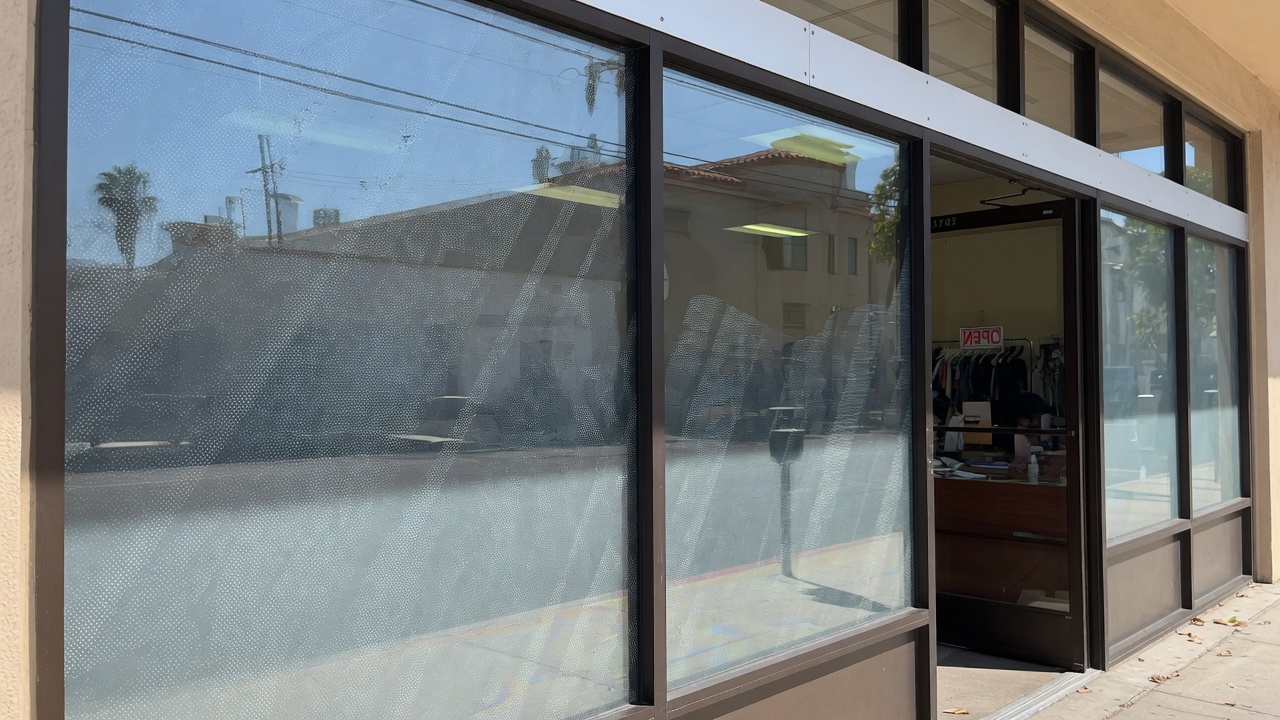
Wall texture is the spec, not a footnote
Most reprint and restoration arguments we see on Irvine walls start with texture, not with ink. The film is innocent. The wall was never a magazine page. Walk the room in raking light — morning sun from the glass, or a flashlight held flat — before you pick a product. What you feel with a palm at noon is not what a squeegee and a camera will see.
Smooth and light orange peel
Smooth painted drywall, or a very light orange peel, is the easy Irvine case. A lot of newer suites and TI punch-list walls live here. Printed mural film, removable vinyl, and commercial wallpaper can all work. You still need cured paint, a clean surface, and a primer story for wallpaper. You still need a panel plan. You do not need a textured-wall specialty film for a light peel if the installer can work the air out. Light orange peel will still show a little through thin gloss film. Satin or matte laminate hides more of that telegraph than a high-gloss face. Spec the finish because you care about the wall, not because gloss “pops.”
Builder-beige eggshell is the office-park default. Eggshell and satin hold vinyl better than dead-flat paint, which can powder and release. High-gloss enamel can be too slick for some remoistenable pastes and some removable adhesives. If the wall was just painted, say so. Many pressure-sensitive wall films want the paint fully cured; a typical industry caution is on the order of weeks, not overnight. Fresh paint under vinyl is how you get tunnels, ghosting, and a peel that takes the new latex with it. That is a paint schedule problem, not a printer who “used the wrong sticker.”
Heavy orange peel, knockdown, and skip trowel
Heavy orange peel, knockdown, and skip-trowel plaster are common on older Irvine interiors, on feature walls someone paid a decorative painter for, and on retail that was trying to look hand-finished. Standard calendered mural film will bridge some of that texture and fail at the rest. You will see hills in raking light. Air will trap. Edges will not bite in the valleys. Removal will take the high spots of the paint. This is the wall that needs either a conformable / air-egress wall-graphic film made for texture, a true commercial wallcovering whose paste can fill some of the roughness, or a decision to skim and sand before anyone prints.
Skim-coating is a construction line. It is often the right line. A bargain print on an honest knockdown wall looks like a bargain print on an honest knockdown wall. A skim, a primer, and a mural look like a mural. If the landlord will not let you skim, do not order a fashion removable and hope. Order a film the mill rates for texture, or hang Type II if paste-up is allowed, or put the budget into a rigid panel that stands off the wall. We will say that out loud. Texture does not become smooth because the rendering was smooth.
Skip trowel and heavy knockdown are also where “seamless” dies. Every valley is a place a seam can catch. Overlaps show more. Double-cuts on wallpaper are harder because the knife wants to follow the bump. If you insist on a photographic face on skip trowel, we will still talk about a sample patch in the worst light before we print a 12-foot run.
Brick, block, tile, wood, and glass
Painted brick and CMU in older industrial-adjacent Orange County interiors, and the occasional retail feature, are not drywall. Mortar joints are depth. Specialty conformable films exist for that job; they are not the same SKU as a 4-mil office mural. Commercial wallpaper is a poor brick covering unless you plaster first. Removable vinyl on raw brick is a dare. Tell us it is brick. A phone photo from across the room is not a texture survey.
Ceramic tile, glass, and glossy millwork are closer to a window-film conversation than a wallcovering conversation. If the “wall” is a storefront lite or a conference-room vision panel, stop. That is glass. Use window graphics. If the wall is wood paneling with a factory finish, adhesion and removal are both risks; test a patch. Do not assume a wall film that loves latex paint loves a sealed oak door, a plastic laminate wainscot, or a metal elevator lobby.
Existing wallpaper under a new mural is a trap. Vinyl on vinyl can hold. Vinyl on old paper-faced residential goods can take the paper off the drywall when you peel, or bubble when the paste in the old layer reactivates. If you can see a seam from a previous hang, we need to know whether we are covering it, stripping it, or walking away until the wall is a wall again.
Printed wall murals: a graphic film, not paint
A printed wall mural in this shop is wide-format inkjet on a pressure-sensitive vinyl or similar film, trimmed into panels, applied dry. It is a graphic. It is not plaster, not a hand-painted mural, and not a substitute for a building sign on the exterior. Interior is the usual home for the films we quote on Barranca. Exterior building wraps are a different product family with different UV, adhesive, and access problems. If your “mural” is on the outside of the suite, say so; do not send an interior wall film to a west stucco elevation and expect it to behave.
Panel width follows the roll, not the rendering. Typical mural media we print lives in the neighborhood of 54-inch or 60-inch goods. After you leave a little overlap or a trim edge, you are looking at a visible seam every four to five feet on a long wall. A 16-foot reception wall is three or four panels, not one magic sheet. Horizontal seams are possible and usually uglier at standing height. We plan vertical seams and we put them where the art can take a break — in a sky, a dark field, a texture — not through a pair of eyes or a wordmark.
Overlaps are the common mural language: each panel covers a fraction of an inch of the previous panel so you never flash a hairline of wall. You will see a ridge if you stand with your cheek to the wall. From a reception chair, a good overlap in a busy photo disappears more often than a bad butt gap. Some films and some very smooth walls can be matched and butted; that is a material and installer decision, not a checkbox you add in a mockup. Do not write “no seams” on the ticket. Write “hide seams in the art, overlap as needed, keep type off the joints.”
Adhesive is the other half of the film. Permanent or high-tack wall adhesives are for long dwell and heavier texture. Removable and low-tack adhesives are for painted drywall you hope to get back. Air-egress patterns — the channels that let you squeegee trapped air — are what make large panels possible on real walls. A film without a way for air to leave is a bubble factory on orange peel. 3M and other mill lines publish interior wall-graphic films for smooth and textured surfaces; see 3M building and wall graphic films for the manufacturer’s application map. We will name the class of film on the quote. “The sticky mural roll” is not a spec.
Laminate is a scuff and cleanability choice indoors, and a UV choice if the wall sees sun through glass. Matte or satin is the usual Irvine office finish because west glass and downlights will turn gloss into a mirror. A dry-erase laminate exists when the wall is a working surface; it is a different face and a different cleaning packet. Do not assume a standard mural laminate is a whiteboard. Do not skip laminate in a corridor that gets mail carts and backpacks and then blame the ink for the scuff.
Cutouts are part of the mural, not a surprise at install. Outlets, switches, thermostats, card readers, fire-extinguisher cabinets, sprinkler escutcheons, and access panels stay usable. We cut the film to the device, or we stop the mural at a planned reveal. A rendering that floods over a thermostat is a drawing, not a plan. Measure the devices. Photograph them. If the wall has a chair rail, decide whether the mural lives above it, wraps it (usually no), or replaces the paint in that band only.
Commercial wallpaper: Type II, paste, and why offices still specify it
Commercial wallpaper is a hung wallcovering. In Irvine offices, clinics, and hospitality-adjacent interiors, that usually means a Type II vinyl wallcovering: a heavier commercial goods, often discussed in the industry around 20 ounces per linear yard on 54-inch goods. That ounce number is a typical range, not a promise that every roll we can print or supply is the same mill tag. Type I is a lighter commercial or residential-leaning goods. Type III is the heavy-duty cousin for abuse. ASTM F793/F793M is the classification standard people mean when they say Type II as if it were a brand. It is a use-characteristics classification — washability, scrubbability, staining, and related tests — not a print-shop nickname. If your facilities packet or your healthcare spec says Type II, we need that language on the quote so we are not substituting a decorative mural film and calling it done.
Paste-up is the process. The wall is primed with a wallcovering primer or sizer so the paste grabs a known surface instead of a mystery latex. The goods are pasted (or the wall is pasted, depending on the product), booked if the mill wants a book time, hung to a plumb line, and trimmed. Seams are butted or double-cut. Double-cut means both sheets overlap, a straight knife cut goes through both, and the waste strips pull away so the edges meet. That is how you get a tight commercial seam. It is also how an amateur cuts into the drywall paper. This is not a weekend rental-squeegee job on a 40-foot corridor.
Why offices still specify it: traffic, cleaning, and fire paperwork. A Type II vinyl wallcovering is built to be washed and, in the right grade, scrubbed. Printed mural film can be laminated for cleanability, but it is still a graphic film. In exam rooms, restaurant wait stations, and school-adjacent corridors, the wallcovering mill sheets and the ASTM classification are what a facilities manager recognizes. Many commercial goods also publish ASTM E84 flame-spread data aimed at Class A interiors. Printed PSA murals may have their own mill fire sheets; they are not automatically the same document. If the City, the campus, or the landlord will ask, say so before we print. We can share a mill sheet for the goods on the job. We cannot invent a Class A wallcovering rating for a film that does not have one.
Printed commercial wallcovering is a hybrid you will hear about. Some Type II and digital-wallcovering substrates are made to take inkjet, so you get a custom mural image on a hung commercial goods. That is a real product. It is not “wallpaper” in the residential peel-and-stick sense, and it is not a 4-mil removable. It is the right conversation when you want a photographic wall and a Type II traffic rating in the same specification. It still hangs with paste. It still restores like wallpaper. Do not order it for a 12-month pop-up because the name includes “mural.”
Pattern repeats belong to catalog wallpaper. A 27-inch floral or a 52-inch texture has a match. A custom photo mural printed on wallcovering does not have a mill repeat; it has a panel plan, like a vinyl mural. Send the image and the wall. Do not send a 4-by-6-inch swatch of a catalog paper and a 20-foot photograph and expect one process. They are both “wallpaper” only in the sense that they both go on a wall.
Residential peel-and-stick from a lifestyle brand is not Type II. It is a consumer film. It can look fine in a home office. On an Irvine commercial corridor it scuffs, lifts at the corners, and leaves a restoration problem that still is not a mill-rated wallcovering. If that is what you hung last year, send a photo of the corner. We may be quoting strip and skim, not a new print.
Removable vinyl: the lease-friendly option and its limits
Removable vinyl is the product tenants ask for when the lease says the walls go back to the original paint. The adhesive is formulated to release. On a well-cured, sound, reasonably smooth painted wall, a quality removable wall film can peel in large sheets and leave the latex behind. That sentence has conditions. The wall has to be sound. The paint has to be bonded. The dwell has to be in the window the mill had in mind. The texture cannot be a knockdown that only contacted the film on the high spots.
Typical industry intent for removable wall graphics is short to medium dwell — think seasonal campaigns, a year, maybe two — not a five-year brand installation you forgot was “removable.” Heat through west glass, time, and cheap adhesive all work against a clean peel. A film that was easy to lift at month four can cook onto eggshell by month thirty. “Removable” is not a warranty that the landlord will smile. It is a material class. We will still tell you to test a patch in an inconspicuous corner, and we will still tell you that orange peel increases the odds of paint lift.
Where removable earns its keep in Irvine: a Spectrum in-store campaign, an empty-suite leasing wall, a conference-room graphic for a product launch, a pop-up in a short-term space, a recruiting wall that will change with the class year. Where it fails: a textured restaurant feature you wanted to look like plaster; a west-facing reception that also has to last the whole lease; a landlord who already forbade any adhesive on the paint and wants you to use a rigid, freestanding panel instead.
Edge lift is the usual first failure. Removable adhesives hold less aggressively at the cut. High-traffic corners, baseboard kicks, and HVAC that blows along the wall will start a flag. Laminate helps the face; it does not glue the edge down. We can spec a slightly more aggressive removable, a permanent film you accept as a restoration risk, or a wallcovering. We cannot spec a film that is both a ghost when you peel it and a vice-grip on knockdown.
Do not confuse removable wall vinyl with a cling or a hanging fabric. Cling wants glass. A fabric panel wants a track. Removable vinyl wants a painted wall that is cleaner and smoother than you think. If the real constraint is “we cannot touch the paint at all,” the honest product may be a rigid graphic or a freestanding panel — different quotes, different files, not a sticker with optimism.
Seams: panel width, overlap, and where the eye lands
Seams are not a defect. They are how a 54-inch roll covers a 16-foot wall. The defect is putting a nose, a logo, or a 6-point legal line on the joint, or promising a client there will be no joint. Design the art for panels the way you would design a storefront for mullions.
Measure the wall in inches, width by height, in sections if the plane breaks at a corner, a column, or a soffit. Note outlets, returns, and devices. We build a panel map: panel 1 left, overlapping or matching onto panel 2, and so on, with extra image at the ceiling, base, and inside corners so we can trim. Inside corners should get a cut, not a stretched wrap. Outside corners on vinyl can wrap a little; wrapping a thick Type II around an outside corner is a different hang. Do not ask a mural film to behave like upholstery on a bullnose.
Where to hide a seam in a photograph: sky, water, a dark gradient, a texture, a blur. Where not to hide a seam: a face, a product bottle, a wordmark, a QR code, a map of Irvine with a thin street on the joint. If the hero cannot break, size the hero to a single panel and let the side panels carry color or type. That is how walls actually look good, as opposed to how they look in a wide-angle mockup shot from the doorway with the seams in vanishing-point denial.
Wallpaper pattern matches are a different seam language. A straight match lines up across at the same height. A drop match offsets. Custom mural prints on wallcovering use the mural panel language, not a mill match. If you mix a catalog Type II on the corridor with a printed mural in reception, those two walls will not share a seam logic or a sheen. That can be fine. Pretending they are the same material is how the corridor looks “off” next to the photo wall under the same cans.
Horizontal seams belong above doors or in a planned wainscot break, not at eye height in the middle of a portrait. Ceiling-to-base panels are the default for murals. If the wall is taller than the roll is wide and you rotate the film, you have just chosen horizontal seams on purpose. Say that. A 12-foot ceiling with 54-inch goods laid on their side is a row of sidewalks around the room. Sometimes a soffit or a paint break saves you. Sometimes you buy a different goods width. Sometimes you accept a reveal and paint the top band.
Overlap direction should follow the light and the traffic when we can. You do not want a thumb to catch an uphill edge in a corridor. You do not want raking west sun to backlight an overlap like a step. These are installer notes, and they belong on the panel map, not in a hope that “it will look seamless.”
Landlord rules, restoration, and Irvine office-park packets
Irvine treats interiors as part of someone else’s building. A perfect print can still be the wrong covering. Check the lease and the property manager before we print a paste-up you cannot legally leave, or a permanent film on a wall they consider a painted finish. That order saves restorations that are really arguments.
Inside the suite, many office leases allow reasonable décor and still require you to return walls to the original paint at vacancy. Removable vinyl is the usual tenant answer. Printed murals with a more aggressive adhesive, and especially commercial wallpaper, can be treated as an alteration. Alterations can need written consent, a vendor COI, and a restoration standard that includes skim and two coats of the building standard paint. If your property manager already has a binder, the binder wins. We print to what you are allowed to install. We do not negotiate your TI exhibit.
Common-area walls — elevator lobbies, shared corridors, restroom vestibules, parking-structure faces — are not your mood board. Irvine Company office and retail properties (Spectrum, the Irvine Business Complex, University Research Park, the Jamboree office market) typically run written criteria. A reception mural inside your suite is one conversation. A graphic on the corridor side of your demising wall is another. A window graphic that reads as a sign from the parking lot can also pull in City of Irvine sign rules; interior drywall usually does not. When in doubt, ask the manager, then us. Do not copy the neighbor’s full-height photo wall as if it were a right.
Retail interiors at Spectrum and similar centers still live under a lease and a sign program. Feature walls inside the lease line are often straightforward. Walls that face the common mall or the piazza may be treated as storefront. If the graphic is on glass, it is not this article. If the graphic is on the drywall behind the cashwrap, it is. Send the criteria PDF if you have it. We would rather build to their coverage and material notes than invent a look they will make you strip.
HOA clubhouses in Woodbridge, Turtle Rock, Northwood, and the rest of the village map are a paste-up minefield. Architectural committees are not grading your brand colors. They are grading whether you changed the building. A removable, a painted accent, or a hung textile they can take down may pass where Type II fails. Send the CC&Rs or the approval letter. We can print to a sketch. We cannot argue with a committee.
UCI-adjacent offices and campus-related spaces can add vendor and brand rules if the wall is on university property. Bring that packet. Certificate of insurance, additional insureds, and after-hours work are routine on Irvine Company sites and on medical buildings. Ask for the current COI language before you schedule us. We can provide insurance documents. We cannot invent a vendor number you were supposed to apply for last month.
Restoration is a scope, not a vibe. “Removable” means we spec a removable adhesive and we still warn you about paint lift. “Wallpaper” means someone will strip, and someone may skim, and someone will paint, and that someone is rarely the printer unless you hired that work. “Mural film” means a peel that can be clean, messy, or paint-taking depending on the wall you hid from us. Photograph the wall before install. Keep a can of the building standard paint. If the lease requires a walk-through, budget time to restore before the walk-through, not after the keys are due at noon.
Do not cover life-safety and building systems. Extinguisher cabinets, strobes, exit signs, fire-alarm devices, sprinkler heads, access panels, and required signage stay visible and usable. ADA protruding-object rules are rarely the problem with thin film; they become a problem if you build a thick panel off the wall in a circulation path. Film is thin. A 3/4-inch rigid stack in a corridor is not film.
Quote wall murals or wallpaper for an Irvine suite
Sun through glass, HVAC, and what actually ages an interior wall graphic
Interior is not immortal. West- and south-facing glass in Irvine offices will put UV and heat on the wall opposite the windows. Reception walls that photograph beautifully at 10 a.m. can be a fade and adhesive test by August. Printed films with a UV laminate last longer than bare prints. Wallpaper pigments have their own lightfastness, and they still sit in that sun. There is no honest single lifespan number, because a north conference room and a west glass box on Jamboree are different climates, and because a cleaner with the wrong chemical will retire a graphic faster than the sun.
Heat softens adhesives and can tunnel a film that was installed on a cool morning. HVAC that blows along a wall will lift a weak removable edge. Kitchen and coffee-bar humidity is a restaurant problem more than an office-park problem, but a suite break room with no exhaust will still teach a cheap film a lesson. None of that is a reason to avoid wall graphics. It is a reason to name the elevation, spec laminate on sun-loaded walls, and stop the mural short of the espresso machine’s splash zone if you can choose the walls.
Cleaning is the other aging clock. Plastic-safe cleaner and a soft cloth on laminated film. The mill’s washability notes on Type II. No acetone, no Magic Eraser as a personality, no drywall-dusting that sands the ink. Write a care line on the packet you leave with facilities. If the wall is a children’s clinic or a restaurant pass, say that on the quote so we do not spec a fashion matte that cannot take a wash.
Files, print, and the measurements we actually need
Artwork for a wall is not a slide, not an Instagram export, and not a 72 dpi homepage hero. It is a full-size surface, viewed at 3 to 15 feet, built in panels. Build at actual size or at a clean even scale (50 percent, 25 percent) and mark the scale. Photographs at about 150 dpi at final size are a typical industry target for wall viewing. 100 dpi can hold a soft background. 72 dpi web images, stretched across 12 feet, look like 72 dpi web images across 12 feet. 300 dpi at full wall size makes a painful file and does not print sharper in any way a guest can see from the sofa.
Do the math before you buy stock. A 12-by-8-foot wall at 150 dpi is about 21,600 by 14,400 pixels. That is a large photo. Phone shots rarely have it. If the photograph is the wall, shoot it for this size or license a file that contains those pixels. If the photograph is atmosphere behind a vector headline, you can get away with less — but then the headline is doing the work. Vector logos and type. Outlined fonts or packaged fonts. CMYK. RGB neons will dull. If a brand red is contractual, send the coated number and approve on the actual film or goods, not only on a monitor under office LEDs.
Bleed past every trim: ceiling, base, inside corners, and overlaps. Typical shop practice is on the order of 1 to 3 inches of extra image at the edges we will cut, plus the overlap strip between panels. Safe type well inside those trims. The last inch at the baseboard is not where the URL lives. Keep QR codes large, in a quiet field, off the seam, and off the kick zone.
White in the file on white mural film is unprinted film, not white ink. On a colored wall, unprinted film is still the film’s white, which may not match the paint. If you want the wall color to show, that is a contour-cut graphic or a clear film, and those are different constructions. Do not send a transparent PNG and assume we will print nothing in the transparent pixels unless you say “contour cut to this path.” A PNG is not a cut path. Send vectors for every cut.
Measure the wall, not the room. Width and height of each plane, in inches, with a tape in the photo. Note baseboard height, crown, chair rail, outlets, and whether the ceiling is a soffit. A 1/4-inch error on a floor-to-ceiling panel is a gap or a wrinkle. We would rather trim extra image than come up short at the inside corner. If you cannot get a ladder to the ceiling, say so; that is an access problem, not a measuring-app problem.
Install access is part of the product. Occupied medical offices, after-hours restaurants, and furniture-heavy conference rooms are not the same quote as an empty suite with parking at the door. Tell us whether we can move the credenza, whether the alarm is set at 7 p.m., and whether the property wants a COI. Surface temperature at the wall matters for pressure-sensitive film; a typical industry working range sits somewhere around 50–90°F at the surface depending on the adhesive. West glass can make the wall hotter than the thermostat. We schedule the wall, not only the calendar date.
Mistakes that turn into reprints or drywall patches
Most wall-graphic failures we see are not RIP errors. They are texture denials, seam surprises, lease surprises, and files built for a phone. This is the short list we would rather walk through before we print.
- Ordering wallpaper for a wall that must peel. Type II is a hang. Restoration is strip and often skim. If the lease wants paint back, start at removable film or a freestanding panel.
- Ordering removable film for knockdown. The adhesive hits the peaks. The valleys show. The peel takes paint. Skim first, or change products.
- A face or a logo on the seam. You will see the joint. Move the hero to a single panel.
- Web-resolution photography on a 12-foot wall. A 1600-pixel hero stretched across 12 feet is about 11 dpi. Replace the photo or go type-forward.
- Measuring the room, not the plane. Columns, soffits, and returns eat image. Each plane gets a width and height.
- Installing on uncured paint. Tunnels, stain, and a peel that takes the new latex. Respect the paint schedule.
- Covering existing wallpaper without a plan. You may be bonding to a layer that will fail. Strip or test.
- Gloss laminate opposite west glass. The wall becomes a window. Spec satin or matte for Irvine offices.
- No device plan. Thermostats, outlets, and cabinets cut as afterthoughts. Photograph every obstruction.
- Calling a consumer peel-and-stick “Type II.” It is not. Traffic and fire paperwork will tell on you.
- Skipping laminate in a scuff zone. Mail carts, backpacks, chair backs. The ink is still there; the face is not.
- Horizontal seams at eye height. Plan ceiling-to-base panels or a wainscot break.
- Landlord surprise. The print is perfect. The manager hates paste-up on a painted finish. Now it is a strip. Get the letter first.
- No overlap, no bleed. A hairline of beige at the joint or the ceiling. Extra image is cheaper than a reprint.
- Treating glass as a wall. Window film is a different spec. Do not squeegee mural stock onto a lite and call it a mural.
Adhesive ghosts and torn drywall paper deserve their own paragraph. Cheap film, long dwell, and a dry peel on weak paint will take the face of the drywall with the graphic. That is a patch, texture match, and paint — not a reprint coupon. If someone already destroyed the last covering with a razor, tell us before we price a “simple overlay.” We may be quoting wall repair, not only a new print. If you want a short-term promotion, say the end date so we spec a removable adhesive instead of a permanent wall film that was meant to live for years.
Color surprises deserve the other paragraph. A mural, a Type II goods, and a window graphic in the same suite will not be a spectro match. Different substrates, different illuminants, different laminates. Close is the honest word. If the reception mural has to live next to a storefront film, send both files and both sizes, and consider letting one wall carry the photo while the other carries a color field and a mark. Forcing the same photograph onto drywall film and glass is how both look slightly wrong.
What to send so the quote is real
A useful quote for wall murals vs wallpaper in Irvine names the wall, the product family, the size of each plane, the quantity of walls, the finish, and the date. “Need a mural for the Irvine office” is a voicemail, not a spec. Send the following to Avanti Printing and we can price without twenty questions. Walk-ins at 15321 Barranca Pkwy, Irvine, CA 92618 are fine if you bring photos with a tape. Phone is (949) 387-0787.
- Address and room: which suite, which wall, office park / Spectrum retail / HOA / medical. Facing if there is glass.
- Wall schedule: width × height of each plane in inches, numbered, photos with a tape. Note base, crown, chair rail, outlets, thermostats, cabinets.
- Texture and current finish: smooth, light orange peel, heavy peel, knockdown, skip trowel, brick, existing wallpaper, fresh paint date.
- Product: printed mural film, commercial Type II or printed wallcovering, removable vinyl, or “recommend from the wall and the lease.”
- Dwell: six weeks, a year, the rest of the lease, “until we rebrand.”
- Finish: matte / satin / gloss laminate, dry-erase yes/no, contour cut versus full-wall.
- Quantity: how many walls, and whether art is identical or versioned.
- Access: hours we can work, furniture, COI and vendor requirements, parking, occupied or empty.
- Permissions: landlord letter, HOA approval, whether paste-up is treated as an alteration, restoration standard.
- File status: vector logo, photo at 150 dpi at size, or “we have a PNG and a hope.”
- Date: the day it must be on the wall, not “ASAP.”
Quotes confirm size, material, quantity, finish, and date. If any of those five is missing, the number you see is a guess. Texture, access, and permissions are how wall jobs miss the five even when the square footage is clear. Rush exists when the film or goods are in house, the file is clean, and the wall is reachable and legal. It does not exist when the photo is a screenshot and the knockdown still needs a skim the center will not allow until next month.
If the same suite also needs glass covered, put that on the request as a separate line for window graphics. Different substrate, different file, different install. Mixing them into one “just make the space look branded” instruction is how wall vinyl ends up specified like a window film, or a mural gets quoted as if it were 4-mil on glass. Pickup versus install: panels can leave the shop numbered with a map if your facilities team has hung vinyl. Most Irvine feature walls should be installed by a crew that has squeegeed wall film or hung commercial goods. A first-time dry-apply on 10-foot panels in a furnished reception is a wrinkle factory. Tell us who is on the wall.
Start the mural conversation on the Irvine wall mural service page if you already know you want a printed graphic, and keep the other products on their own specs under the same PrintBig Irvine roof.
Send wall photos and measurements for a quote
Frequently asked questions
What is the difference between a wall mural and wallpaper in an Irvine office?
A printed wall mural is a pressure-sensitive graphic film applied dry in panels. Wallpaper is a hung wallcovering, usually pasted, often a Type II commercial vinyl if the spec is serious. Murals are the right language for a custom photograph and a tenant who may need to peel. Wallpaper is the right language for traffic, washability, and a long-term commercial finish. Removable vinyl sits with the murals, not with the paste-up. The wall texture and the lease decide among them more than the rendering does.
Will you see seams on a printed mural?
You will have seams. You may not notice them from the seating if we hide them in the art and overlap cleanly. You will notice them if we run a face or a logo through a joint, or if we butt cheap film on orange peel and the gap flashes. Ask for a panel map. Do not ask for a 16-foot photograph with no joints. That is not how 54-inch rolls work.
Can removable vinyl come off without damaging Irvine office paint?
Sometimes, on sound, cured, reasonably smooth paint, within the dwell the adhesive was built for. Texture, weak paint, heat, and time all raise the odds of residue or paint lift. Test a patch. Photograph the wall before install. “Removable” is a material class, not a restoration contract. If the landlord’s standard is untouched builder paint, get their written OK and still budget touch-up.
Is Type II wallpaper better than a mural?
It is better at being commercial wallcovering: scrub ratings, a facilities language, a hang that can last years. It is worse at being a tenant-friendly peel, and it is the wrong tool if you only wanted a photograph for a year. Printed Type II-style digital wallcovering exists when you need both a custom image and a wallcovering spec. Say which job you are buying. Do not use Type II as a prestige synonym for “the expensive one.”
What wall texture works for vinyl murals?
Smooth and light orange peel are the home turf for standard mural films. Heavy orange peel, knockdown, and skip trowel need a textured-wall film, a skim, or a switch to hung wallcovering. Brick and block need specialty conformable films or plaster. Glass is window graphics. Existing wallpaper is a strip-or-test problem. Send raking-light photos. We will tell you if the wall is the wrong wall.
Do I need landlord approval for an interior mural in Irvine?
Often yes if the covering is paste-up, permanent, on a common-area wall, or in a center with written criteria. Inside your suite, many leases still want consent for alterations and still want paint restored at vacancy. HOA clubhouses and campus spaces have their own packets. We print to approved conditions. We do not issue property-manager letters. Put the approval status on the quote so the date you want on the wall is a date we can actually install.
What file do you need for a wall mural?
Vector logos and type. Photographs at about 150 dpi at final size. CMYK PDF or packaged native files at actual size or a marked even scale. Bleed at ceiling, base, corners, and overlaps. A device and seam plan. Do not send a 72 dpi JPEG, a Google Slides board, or a logo copied from a website header. If 150 dpi at size makes the photo look bad on your screen, it will look worse at 8 feet in reception.
Can you match a wall mural to window graphics in the same suite?
We can print both under the same roof at PrintBig Irvine, and we should treat them as two specs: mural media for the wall, window film for the glass. Color will be close, not a spectro match. Send both files with sizes. Do not assume the window RIP will use the mural file cropped. If the mural is the hero and the window is a color field plus a logo, that pairing usually looks more deliberate than forcing the same photograph onto two substrates.
Pick the covering the wall and the lease can survive
Wall murals vs wallpaper in Irvine fails when you buy a paste-up for a peel-off lease, a removable film for knockdown, or a seamless rendering for a 54-inch roll. It works when you decide, wall by wall, whether the job is a custom graphic, a commercial hung finish, or a short-term vinyl, and you let texture and restoration veto the pretty option.
Bring us the planes, the texture, the dwell, and the landlord language. Avanti Printing, 15321 Barranca Pkwy, Irvine, CA 92618, will spec printed mural film, commercial wallpaper, or removable vinyl against that wall, put the seams where the art can take them, and keep small type off the joints. Call (949) 387-0787 or send the quote form with size, material, quantity, finish, and date. We will tell you if you should have skimmed the knockdown first. On a lot of Irvine feature walls, you should have.